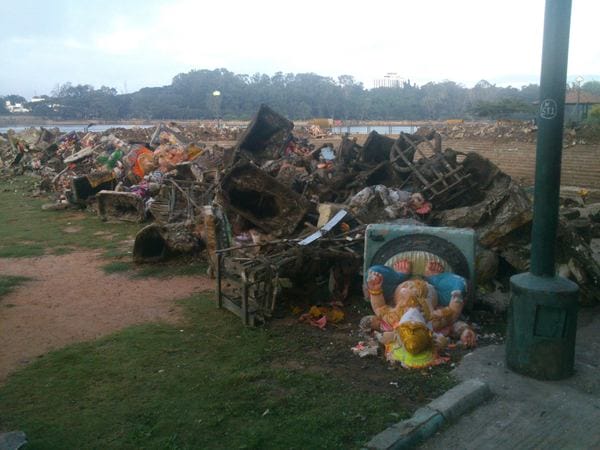
Mutilated Ganeshas at Sankey Tank. Pic: Vani Murthy
Lord Ganesha is my favourite childhood friend, my saviour at all times – when I met with a road accident on a highway, during my illness, when I am in despair. He is the one who comes to my rescue.
I do know many others too love him, respect him, look up at him as their friend in need, but for me he is something special. As I grew up I realised what makes him so special to all.
Everything he did evoked fun in the mind of young ones. His every act was a lesson in removing obstacles from the path to achieve success. This is why he is a favourite. Both children and grown-ups cherish the very thought of him, at the time of starting something new or when faced with an unexpected problem.
Ganesh Chaturthi, Ganesha’s birthday is celebrated in many households as though it is the birthday of a family member. It should have remained that way, but things have changed.
Celebration that changed with time
What Lokmanya Tilak started as community celebration of Ganesha’s birthday with his favourite goodies, has reached new heights now.
- It has become a money making project to get Him installed on every road.
- There is rivalry among two groups to show their strength during immersion.
- Many water bodies are getting polluted.
- There is a lot of noise pollution.
Above all, the mutilated parts of the idols evoke so much anger in my mind.
He is a light hearted, fun-loving God, no doubt. But, do you think that Ganesha would really want all of this to happen? When the temples are so many and each one is celebrating Ganesha ‘s birthday, where is the need to install one on every street corner?
When he is already sitting at river banks and under the trees, is it necessary to install yet another for community prayer purpose? Not at all. Instead why don’t we worship the Ganesha statues that are already there? The pomp and show with which a statue is installed, vanishes in no time.
The tradition of immersing clay idols practised during my childhood has almost disappeared now. Lord Ganesha is made of different materials these days – small and big Ganeshas, made of insoluble Plaster of Paris with dangerous chemical colors added. Bigger Ganeshas are put up on a big wooden pedestal with dry grass stuffed inside. Just imagine the number of idols that are being immersed and the pollution that it is creating. It is mind-boggling!
Is this the right way to show devotion?
Water pollution unlimited
Polluted water bodies spoil the groundwater resources that are close by, thereby spreading skin diseases. The idols that have dry grass stuffed clog the drainage. In their anxiety to immerse their own Ganesha, the public does not mind stamping the other idols. Mutilated idols make it look like a war field.
This is the scene almost in every town, city and village where the festival is celebrated. Are we not hurting the feelings of the people whose idols we are stepping on? How would you feel if it happened to the idol that you have immersed?
Is this the respect we show to our favourite god, friend and guide? Is this our love and devotion towards him? Festivals are a time for celebration — agreed. But are we not sensible enough to think of environment and the future?
I request everyone who comes across this, to say no to non eco-friendly idols. If you have to buy one at all, keep it with you, why immerse it in water?
I personally have collected more than 200 idols. In almost every nook and corner of my flat, there is a statue of Ganesha. If you buy a clay idol, then only immerse it. Even better, worship the statues that you already have for your daily puja, offer him all his favourite goodies and then let the family members eat and enjoy.
This will save our water bodies, save our mother earth and will also save us from noise pollution. Let others also enjoy the festival as much as you want to. Share this with as many people as possible and persuade them to follow the same. Let us enjoy the festival peacefully!
Related Articles
An eco-friendly Ganesh Chaturthi could win you a prize!
‘Cannot ban Plaster of Paris Ganeshas because it is a sentimental issue’
Eco-Ganesha : Where to find him, and why?