In 2019, 23-year-old R Subhasri lost her life in Pallikaranai when an unauthorised cutout collapsed, knocking her off her scooter. That same year, K Ragupathi, a software engineer visiting from the US, died in Coimbatore after reportedly colliding with an illegal wooden arch erected across a main road. These tragedies lay bare the daily hazards that pedestrians and road users face because of illegal, unchecked hoardings.
Flashy advertisements lining roads, signals, and flyovers have become an integral part of the everyday commute. But the threat they pose has only grown over time. Across Chennai, illegal banners continue to multiply with the Greater Chennai Corporation (GCC) identifying at least 390 unauthorised hoardings across 15 zones. In June, civic authorities removed 31 illegal hoardings in Alandur, and fined a private advertising firm ₹35.73 lakh.
Commuters and local representatives routinely flag hazardous installations that have been ignored by authorities. Along the Koyambedu bridge near VR mall alone, residents point to at least 16 shaky, unstable hoardings. “We are unsure how many have licences and have been tested for stability and weight,” says ward councillor TV Shemmozhi. He adds that, while hoardings can contribute to GCC funds, the licensing process must be streamlined.
Enforcement delays endanger public safety. In Kodungaiyur, ward councillor B Vimala points to a large flex banner standing at a busy junction. “I flagged the illegal structure, which is mounted on a building and is structurally weak, during the ward committee meeting three months ago. But it remains there,” she adds.
Meanwhile, the northeastern monsoon brings strong winds and heavy downpour, increasing the risk from falling banners. Local representatives, activists and residents urge the government to crack down on illegal hoardings and consider a total ban on them.
History of banning and reversals
Over the past decade, the Madras High Court has heard several petitions calling for a ban on hoardings. But these have led to a series of bans and reversals.
In 2017, the Madras High Court (HC) ordered a blanket ban on the use of photos of living persons on cut-outs, hoardings, flex boards and banners across Tamil Nadu. They then reversed it the same year.
Again, the court banned the installation of hoardings on roadsides in 2019, and the DMK and AIADMK gave an undertaking to the court that they would restrain cadres from erecting cutouts, flex boards or banners that could cause public hindrance. In October that year, the court permitted the state government to erect banners, welcoming Prime Minister Narendra Modi and Chinese President Xi Jinping in Mamallapuram.
In May this year, residents flagged cutouts and flexes of Tamilaga Vettri Kazhagam chief C Joseph Vijay and several MLAs across the city, including Velachery, Anna Nagar and the East Coast Road.
“What we should understand is that we have lost Subhasri in Chennai, we have lost Ragu in Coimbatore, and many other lives to these hoardings. They are life-threatening, and it is important that the government takes serious action against these illegal structures,” says Jayaram Venkatesan, Convenor of NGO Arappor Iyakkam.
Read more: Hoarding menace returns: A step backwards for Singara Chennai 2.0
Previously, hoardings were permitted on both private and public land. Later, a 2018 amendment to the Chennai City Municipal Corporation Act entailed that they were allowed only on Corporation-owned land. In 2020, the Madras HC held hoardings could be put up on private properties as well.
What do the rules say?
The Tamil Nadu Urban Local Bodies Rules, 2023 outlined by the Municipal Administration and Water Supply Department detail guidelines for hoardings. These include:
Maximum dimensions for hoardings:
- Roads over 30 metres wide: 12 metres × 6 metres
- Roads 15 to 30 metres wide: 10 metres x 4.5 metres
- Roads 9 to 15 metres wide: 8 metres x 4 metres
Maximum height: Hoardings cannot exceed 10 metres from the ground level (or up to the second floor of a building).
Material used: Printed on flex, paper or other materials.
Placement and orientation: Must be set parallel to the road or footpath (never across them).
Spacing: Must leave at least a five feet gap between adjacent hoardings.
Uniformity: Hoardings and spacing along the same road should maintain uniform dimensions as much as possible.
Areas where they are not permitted
- In road corners, traffic islands and junctions.
- National parks, district forests and waterbodies.
- Historical monuments, cremation grounds, graveyards and ruins;
- World Heritage sites.
- Areas classified as remnant or endangered regional ecosystems.
- Places of worship like temples, mosques, churches, gurudwaras, etc.
Guidelines related to digital hoardings
- Scrolling of printed displays with a dwell time of 10 seconds and transition time of one second.
- Animations or full motion video only at locations for viewing by non-vehicular traffic or at parking lots.
Officials must ensure that independent hoardings, including the foundations, are designed and checked for extreme wind conditions, earthquakes, soil bearing capacity, etc. Agencies must comply with the relevant Indian structural design standards, codes of practice, and policy guidelines. However, experts say that these are often not followed.
Law and fines
In Chennai, a single window committee, of officers from the municipality, a traffic police officer not below the rank of Inspector of police of the area, and the GCC commissioner, must approve applications for hoardings.
Licenses must be approved annually, and unauthorised hoardings will attract ₹25,000 fines.
The District Collector or any authorised officer must periodically inspect the hoardings, say experts. According to an order of Madurai Bench of the Madras High Court, the Revenue Department, and local bodies would be held guilty of dereliction of duty and negligence, if they failed to remove illegal hoardings.
Hoardings must withstand storm, be regularly inspected
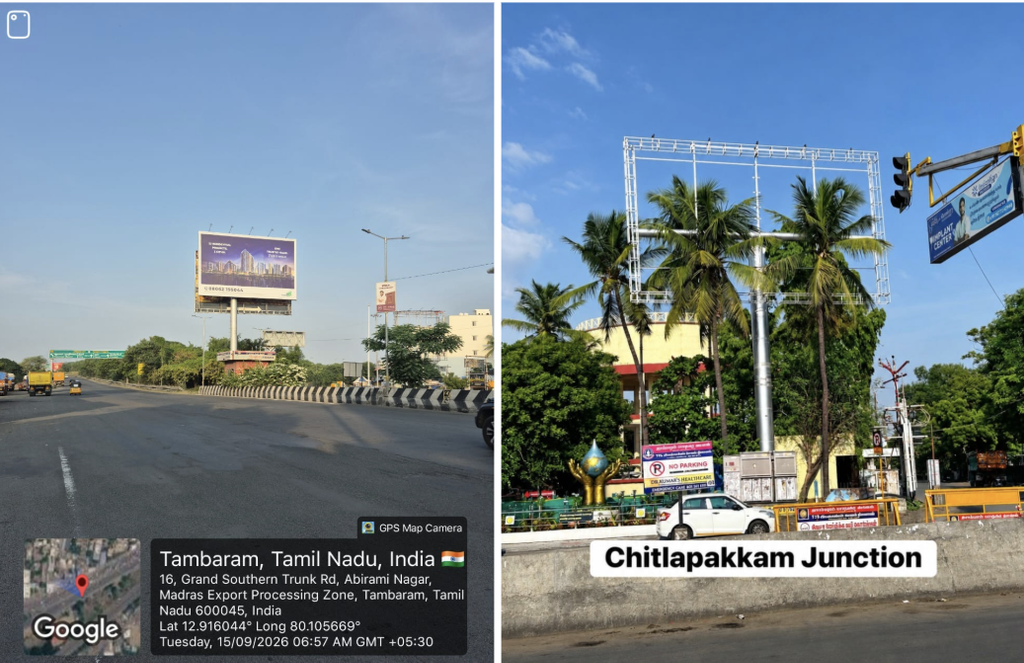
In Sholinganallur, Pallavaram and Tambaram, activist David Manohar flags innumerable unipole hoardings protruding onto roads. With no checks and balances in place, hailstorms and dust storms could throw around flexes. He also emphasises the need for supervision, and that officials must ensure stability of hoardings to withstand storms.
Chennai-based lawyer R Shiva notes that while the single-window committee should be an effective mechanism, its fails because of a lack of enforcement. He also questions the absence of regular inspections. “Why aren’t the rules evident and transparent, rather than buried in a 50-page document we have to dig through, making them inaccessible?”
Taking the example of digital hoardings, he points out a provision that mandates no obstruction of traffic visibility, and should not cover traffic signs. “But who is going to mark them? The authorities have to identify and mark them.”
Read more: Illegal hoardings in Chennai remain unchecked, raise accident risk
“Authorities should maintain a dashboard with the number of hoardings and inspections done as per the GCC rules,” says Shivaa. He adds that overlapping jurisdictions cause further confusion. For instance, for hoardings on state or national highways and bridges, it is unclear which government agency is responsible.
“All hoardings involve a three-way contract: between the GCC, the agencies renting or leasing the land, and the advertising companies. Usually, the fine is slapped on the middleman, but never reaches the real beneficiaries,” says Shivaa. He stresses that GCC must send notices to violating firms and ensure strict enforcement.
What can citizens do?
Citizens can utilise a number of methods to report fallen hoardings, illegal banners, unstable cutouts and more:
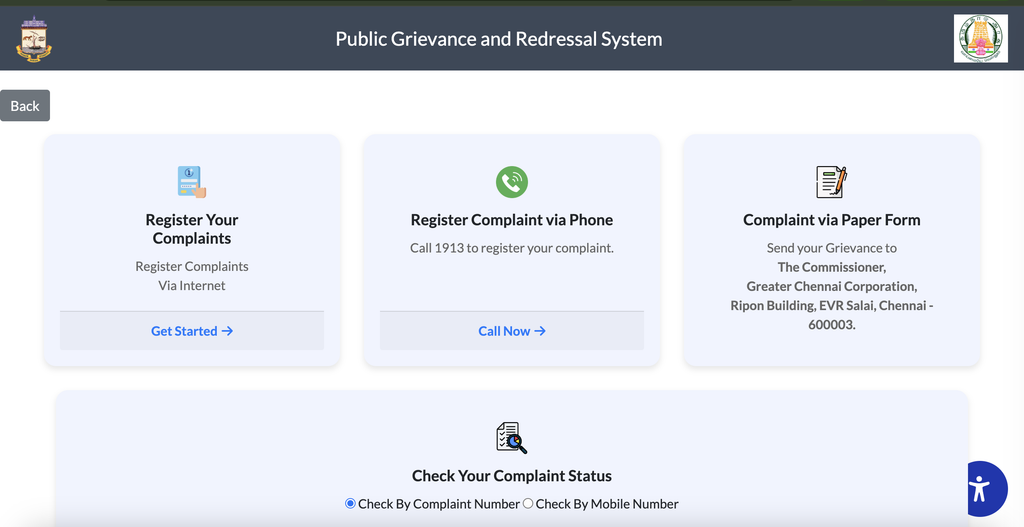
- Call the GCC helpline 1913 and provide any information on unauthorised hoarding or flex banners.
- On the GCC website, residents can access the GCC Public Grievance and Redressal System and fill out a petition.
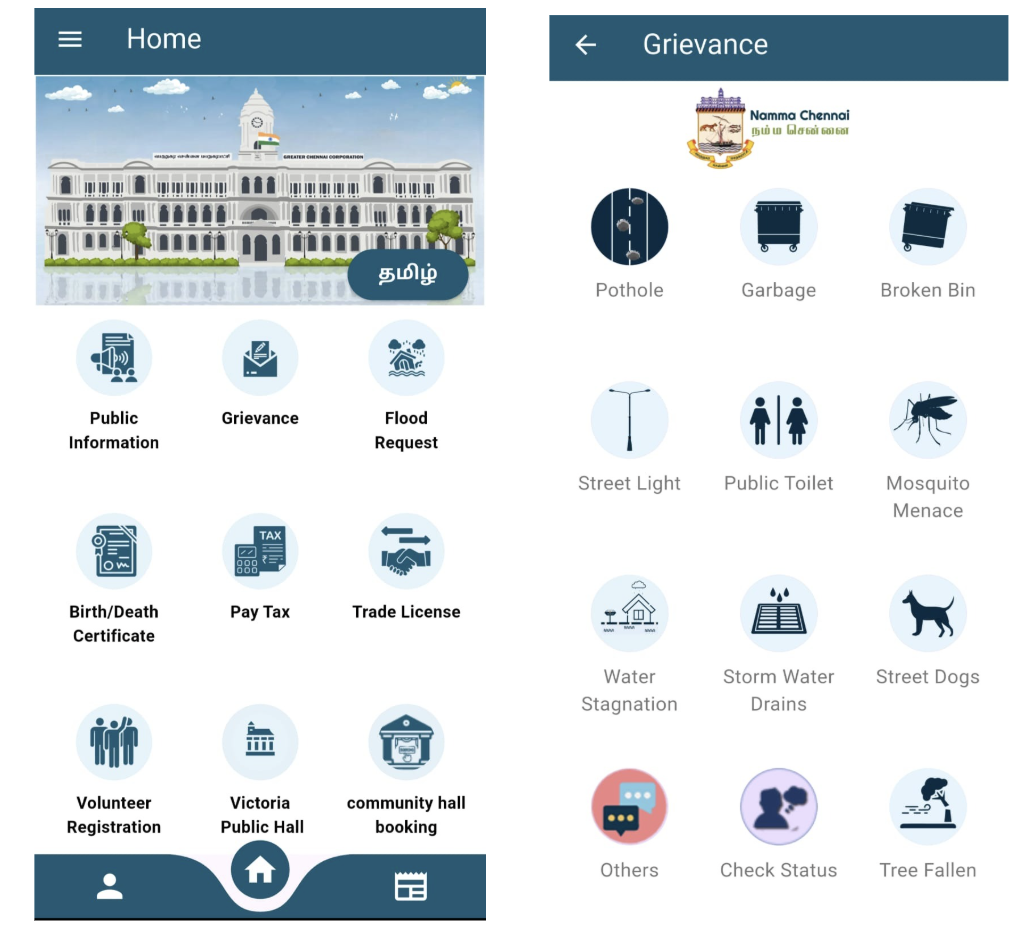
- Report illegal hoardings on the Namma Chennai app. First, residents must register on the app with an email ID and phone number.
- Post a photo or video of the hoarding on X (formerly Twitter) with a geotag, the street name or location. Tag the GCC on @chennaicorp and GCC Commissioner GS Sameeran on @sameerangs
However, whenever a citizen complains, Jayaram says, the government closes the case saying it has been removed but on ground, nothing changes. To counter this, Shivaa suggests the GCC release a map of the hoardings, flex banners, etc along with details, so data can be used to hold companies accountable.
Citizen Matters reached out to GCC officials but did not get a response. We will update the story when we receive a response.
Experts also suggest:
- Increase the fine amount from ₹25,000 to ₹1 lakh to keep violators in check.
- Form a team to crack down on illegal and unauthorised hoardings.
- Ensure that each hoarding has a QR code with licence details.
- Ensure regular inspection of hoardings so agencies comply with the law.
- Put up tender and licensing approvals transparently online for citizens to check
- Create a map of hoardings in Chennai that is available to citizens.