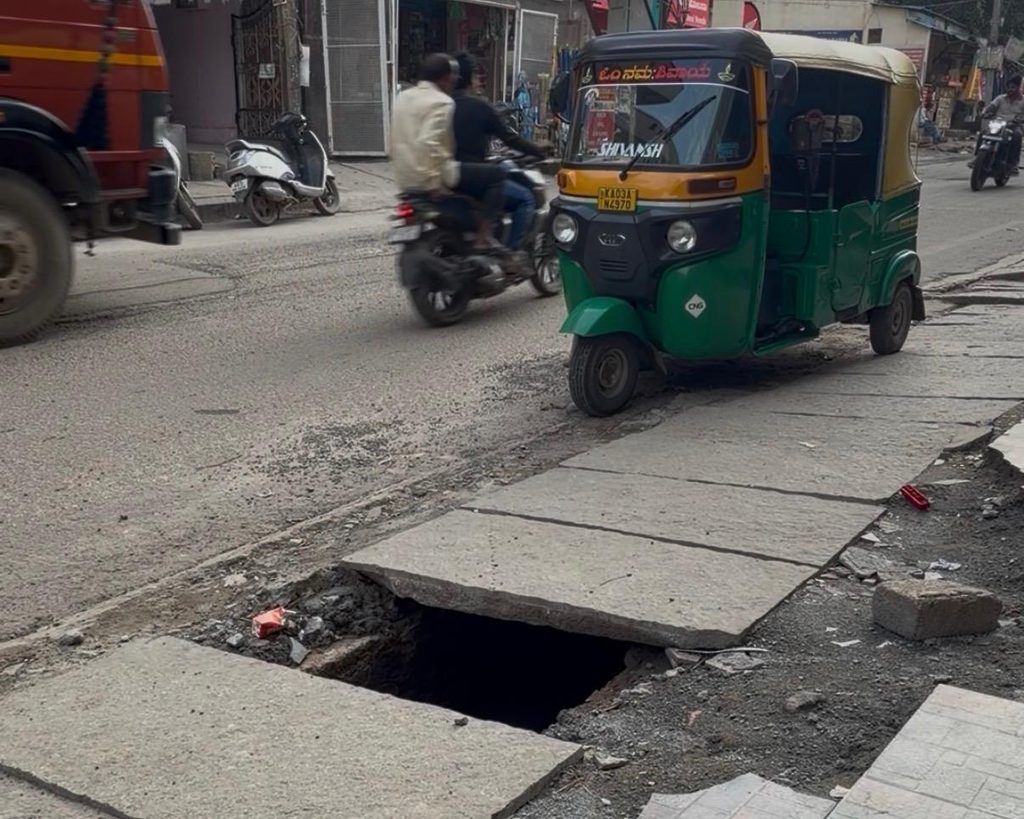
Walk down almost any street in Bengaluru, and you will spot them: missing slabs, wide gaps, and wooden planks covering openings. Uncovered stormwater drains have become a safety hazard across the city, creating serious obstacles and putting residents at risk of injury or death. Experts flag bad engineering design, poor monitoring, inadequate funding, and lax enforcement of liability rules as the major reasons for this public safety crisis.
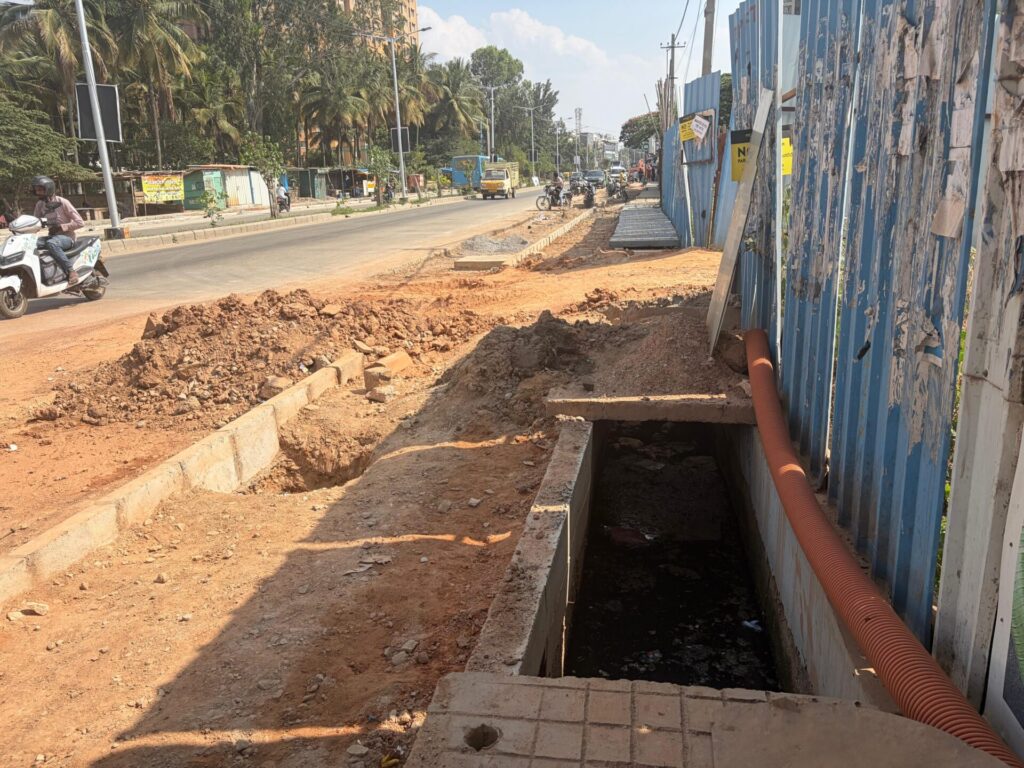
In Sanchar Nagar, Thanisandra, contractors dug up a stretch of at least 150 metres for stormwater drain works. A few weeks ago, a resident slipped and fell into the trench, getting badly injured. Janakiram V, a resident of the area, says that it has been more than a month and a half since the stretch was excavated. “An ex-Army person living next door wanted to move his two-wheeler; he slipped and an iron rod pierced his leg. That was exactly what we were afraid would happen,” says Janakiram.
The drains are left recklessly open with exposed metal rods, with only makeshift wooden planks placed at house entrances. Even after multiple follow-ups, Janakiram says contractors have failed to finish the work, leaving the trench exposed. Raising complaints with the North City Commissioner’s office yielded no results, with an official advising him to “be patient”.
Poor drainage and sewage systems
Vivek, Bellandur resident and member of Adarsh Palm Retreat Residents Association, faces a similar issue. Just a few metres away from the entrance of the gated community, a large open drain has been covered using makeshift arrangements: a few planks with stones on top, left in this state for over a year.
Vivek explains that when the area was developed, it lacked a proper drainage system, and raw sewage mixing with stormwater remains a major problem. Moreover, whenever there is a downpour, the drain fills up and sewage-contaminated rainwater overflows onto the roads and into the gated community. “They have changed the shapes and tried different ways of covering it, but it has never actually been repaired,” says Vivek.
The open drain is on Gear School Road in Mahadevapura, a busy thoroughfare connecting Sarjapur Road with the Inner Ring Road, posing a threat for pedestrians using the crowded footpath.
These are not isolated incidents. Open drains translate to broken footpaths, putting pedestrians’ lives and limbs in danger. But why do these open drains exist in the first place?
Read more: Broken roads, zero accountability: Bengaluru’s MCECHS Layout faces year-long civic chaos
Built cheap, Built wrong
Stormwater drains in Bengaluru follow a design called box drain — a square or rectangle shaped conduit covered on top with removable slabs. Ankit Bhargava, an urban planner and co-founder of Sensing Local, an urban living lab in Bengaluru, explains that the corporation uses this design because it is cheap to construct, ignoring its high long-term maintenance costs.
Another problem with the design is that it brings silt in. “Desilting is constantly required because there is no silt trap,” Ankit says. Silt traps are not engineered into the box drains and the water flow is not managed properly. “Bare road dust, leaves and waste all flow inside.” He adds that a wide and more accessible silt trap needs to be engineered within the drain.
Desilting drains before the monsoon is an annual flood prevention practice. A Deccan Herald report noted that the North City Commissioner instructed engineers in May to finish desilting before the rains arrived. However, as Janakiram says, in the same North City Corporation, the work began only in August. He adds that the existing stormwater drains were functioning well earlier and there was no need of desilting.
Ankit adds that desilting is done as a reactive mechanism, just before or during the monsoon, and the open drain “lies open for half a month, one month, adding to the stress for pedestrians.” No safety barriers are provided.
A Senior Engineer from the Greater Bengaluru Authority said that drains opened for desilting are usually closed once the work is done but admitted that sometimes there’s a delay.
“Right now we don’t have any technology to see which drain is open and still not closed,” says the official. “We don’t have any application for monitoring. However, people can always raise the complaint in the Sahaaya app.”
Poor grievance redressal mechanism
However, when Janakiram raised concerns about the delay, the contractors cited shortages of labour and materials. When he reached out to the MLA Krishna Byra Gowda’s office the responses were rather dismissive. An official allegedly told him, “I am also a citizen. You should have patience. We will get this done. We are putting our best efforts.” The very next day Janakiraman’s neighbour was injured because of the exposed drain.
Citizen Matters tried reaching out to the North City Corporation Commissioner but did not get any response.
On the other hand, Vivek registered a complaint about the open drain through the Sahaaya app in March 2025, but it hasn’t been fixed yet. “I have given up on these apps, because they just don’t work. I am realising it’s a waste of time,” he says. The association is also trying to raise complaints with the corporation directly, to no avail.
Disproportionate budget allocation
While roadworks are allocated thousands of crores, Ankit highlights the stark contrast in the minimal funds earmarked for pedestrian infrastructure. In March this year, the Bengaluru North City Corporation allocated ₹50 crores for footpaths, skywalks and junction improvements.
The West Corporation has also allocated ₹50 crores and has proposed upgrading 500 km of footpaths along with constructing 100 skywalks. The Central City Corporation has allocated only ₹50 crores, while the South City Corporation budget does not have a separate allocation for footpaths.
Annual maintenance mechanism
All corporations set aside specific budgets for maintaining footpaths and desilting drains under Annual Maintenance Contracts (AMC):
| Corporation | Budget earmarked for annual maintenance |
| Central City | ₹ 50 Lakhs per ward (63 wards) |
| South City | ₹ 84 crores in total (Annual Maintenance of Roads, Footpath and Drains, Potholes in Ward jurisdiction) |
| East City | ₹ 44 crores in total (annual maintenance in 50 wards – Footpath, Desilting and maintenance, and pothole filling). |
| West City | ₹ 30 lakhs per ward for desilting and ₹ 25 lakhs per ward for footpath maintenance |
| North City | ₹ 20 lakhs per ward for drain desilting and ₹ 25 lakhs per ward for footpath maintenance |
Source: Opencity
Despite these allocated funds, execution on the ground remains poor. Sensing Local’s footpath audits across 19 wards in different parts of Bengaluru, found 10,072 instances of broken footpaths. Moreover, reports show that desilting is not carried out as frequently as required.
The annual maintenance record is not available publicly but the GBA engineer said that it may be made public in a month. The official added that a Road Information and Management portal maintains details of roadworks, budgets and contractor details, while engineers carry out quality control checks to monitor delays.
Read more: Draft GBA Parking Rules: Fixing the problem or making it worse?
The defect liability period
Ankit stresses that accountability rests not only with municipal corporations but also with contractors.
The Defect Liability Period (DLP) is a limited time period after construction, when the contractor should take care of necessary repair works. For drain covers and footpaths, the DLP is three years. But this is rarely enforced in Bengaluru, says Ankit.
“Contractors fail to carry out repairs, and nobody tracks who completed the work. That lack of transparency creates a maintenance problem,” Ankit explains. “If a defect occurs within the DLP, it should not be a financial burden on the municipality; it is the contractor’s responsibility.” Yet, contractors are seldom held accountable.
Who gets the contract and how?
- GBA is the formal custodian of stormwater drains, while regular maintenance works are contracted and carried out by the five city corporations.
- The tendering process is carried out under The Karnataka Transparency in Public Procurement Act, 1999.
- The work is identified by the corporation, MLAs or local authorities and the engineers prepare a detailed plan and budget and tenders are floated on the Karnataka e-Procurement portal.
- Registered contractors can bid; technically qualified bidders are evaluated and the contract is awarded to the lowest eligible bidder.
Why civic bodies must be held accountable
Every road is supposed to have a road history data, which records the history of roadworks carried out over the years including drain construction and repair works. This data was publicly available till 2017 and was also hosted on Opencity. It was then made inaccessible and the then BBMP portal shut down.
According to the National Crime Records Bureau (NCRB) report 2024, civic negligence in Bengaluru caused 17 deaths, highest in the country. So, what could have been a major public accountability system has failed implementation.
“This is not a planned city,” the GBA engineer admitted, noting that carriageways and footpaths were historically built without proper integration with other utilities, though recent road projects are being executed more carefully.
Never meant to carry cars
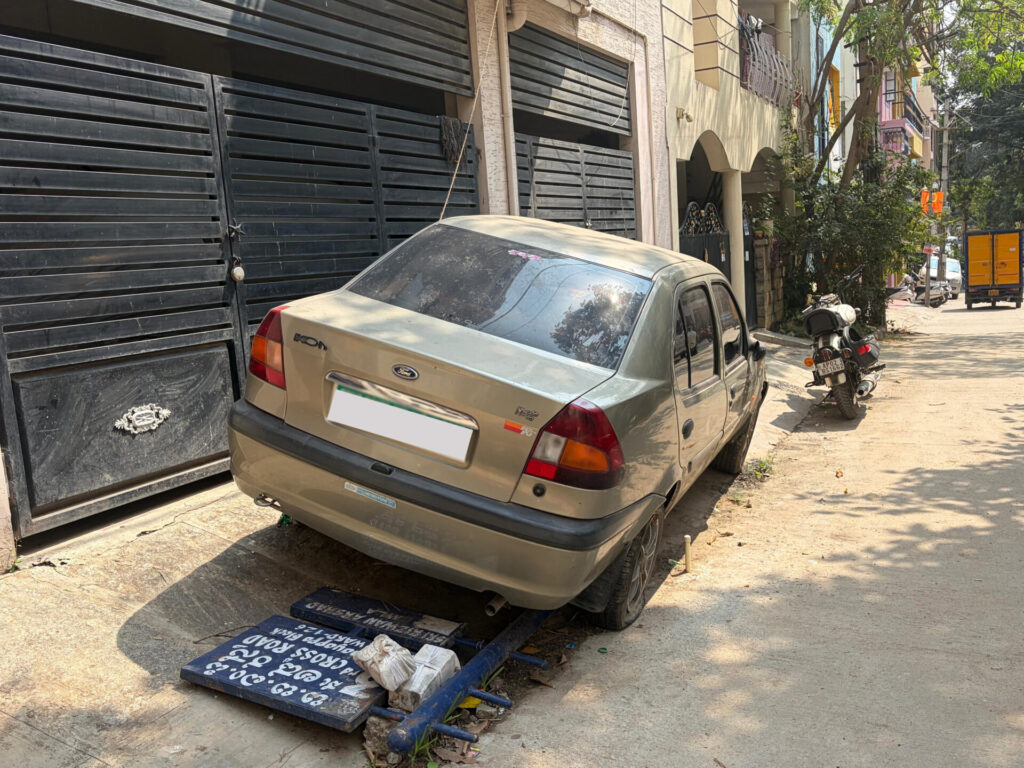
Another major planning problem is the lack of parking space. The narrow streets of Bengaluru do not leave any space for car parking, neither do most builders of individual houses include car parking in their building plan. And the cars end up on the footpaths and drain covers. “People tend to park their five-tonne vehicles on the drain. That stone is not made for a heavy vehicle to be sitting on it. So it’ll break. When that breaks, somebody is going to fall in it,” Ankit says.
Maheswar Rao, GBA chief commissioner announced that the cars parked on footpaths will be towed after a 7-day notice and citizens have to pay a fine to retrieve their vehicles. But Ankit says that citizens can’t be blamed all the time without being cognizant of the (parking) situation. The planning itself is poor. While the number of cars registered in the city has grown significantly over the decade, the city planning did not anticipate the future requirements.
Earlier this year GBA launched a safe footpath campaign and removed vendors off the footpaths without planning any rehabilitation. However, the footpaths still aren’t safe. While encroachments are a major problem, it is deeper than that: cheap and unsafe designs, frequent repair works, poor monitoring and repair enforcement, and minimal budgets need to be fixed for a safer pedestrian infrstructure.
Way forward
- Roadworks data must be maintained enabling better accountability and strictly implementing the Defect Liability Period.
- Drains and footpath design must be well planned to tackle stormwater and silt without having to constantly repair them.
- Enough budget should be allocated prioritising safe footpath access.
- Tendering process should also look into the quality of works done by the bidders.
- Grievance redressal mechanism should be strengthened to identify and fix issues with open drains.
Does your neighbourhood have half dug-up trenches and drains left open that are posing a safety hazard? Have you approached authorities about it? Tell us about it in the comments.