Recently, on my way home from my office in Bengaluru, I noticed that the street vendor who usually sat across from my office building had disappeared. It wasn’t until I began following news reports that I realised her absence was part of something much larger.
Following the Supreme Court’s judgement on walkability in June 2026, city governments launched eviction drives against the most vulnerable users of streets and footpaths in India. Within weeks, street vendors across Mysore, Bengaluru, and Kolkata were evicted from footpaths without notice. News reports described altercations between evicted street vendors and civic officials as the eviction drive gathered pace. On 8 July, street vendors across Bengaluru observed a citywide bandh and staged mass protests against the evictions. Overnight, vendors who had long earned their livelihoods on the city’s streets were recast as encroachers, many of them forcibly removed.
Cities’ use of force to evict street vendors from footpaths and public spaces is a reactionary short-term fix for long-term governance failures. Treating vendors and their livelihoods as a clearance drive rather than a governance challenge addresses only the symptoms while leaving the systems that produce them unaddressed.
Footpaths as shared spaces
In a country where nearly half of urban workers still walk or cycle to work, footpaths are among the most widely used public spaces. Yet, they have never served just one purpose. Footpaths are shared spaces where people walk, earn a living, shop, and interact, all within a few metres. Treating them merely as corridors for movement overlooks the multiple functions they perform.
Governments often frame this as a conflict between vendors and pedestrians rather than confronting their own failures to implement the law. A solution cannot be achieved by choosing between pedestrians and vendors but by planning public spaces where both can coexist.
The Street Vendors (Protection of Livelihood and Regulation of Street Vending) Act, 2014, framed under the directions of the Supreme Court, was introduced to avoid this very conflict. The Act provides a way for vendors and pedestrians to co-exist in the same space, and vendors cannot be relocated without due process. It recognised street vendors as everyday users of public space and required municipal corporations to designate spaces for vending, conduct periodic surveys, issue vending certificates, and constitute Town Vending Committees (TVCs).
Even though it’s been more than a decade since the Act came into force, these four core provisions remain unimplemented on the ground. This is not merely a lack of state capacity but a breakdown of accountability. The law already provides a framework for coexistence; what is missing is its implementation.
No recognition by the government
A closer look at Bengaluru’s markets reveals these failures. The number of street vendors in the city remains contested. Although BBMP’s latest survey conducted in 2024 shows that only around 27,500 vendors hold valid certificates of vending, more than 1.4 lakh have accessed the PM SVANidhi Scheme, a collateral-free loan to help street vendors set up or expand businesses.
In effect, the government has recognised thousands of vendors as borrowers without recognising them as legitimate businesses. Without legal recognition, many continue to work under the constant threat of eviction, despite being part of a government scheme designed to support them.
Read more: Bengaluru’s street vendors struggle with extreme heat, heavy rain, and limited options
Women vendors bear the cost of a broken system
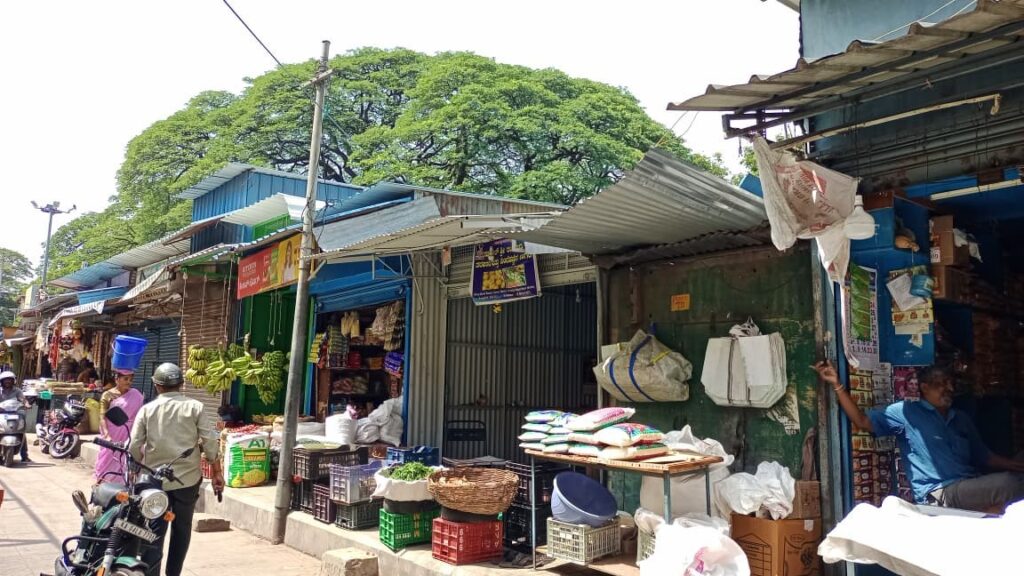
For our study on women street vendor’s access to the city, we visited six markets across Bengaluru and interviewed more than thirty-five street vendors, including vendor association representatives. There, we met women who had taken up vending as a means of survival, often to support their families as single mothers, widows, or after facing severe economic hardship.
They bear the cost of a broken system, working in markets with limited access to public infrastructure, including public toilets, drinking water, and crèches. In four of the six markets, only two functional toilets served thousands of vendors. These toilets were often located next to dumping sites, raising serious questions about the health and working conditions faced by women vendors.
The situation was much worse for women vendors in Yeshwantpur, some of whom took multiple auto trips home each day, often spending Rs.50 per trip to use a washroom. Others simply stopped drinking water at work, so they wouldn’t have to use the public toilets in the market.
Recognising street vending as part of the city’s economy would mean planning for it accordingly with basic infrastructure, particularly for women who spend more than half their days in the market.
Including vendors’ experiences in city planning
These everyday realities remain absent from city planning because vendors themselves have little say in the decisions that shape their livelihoods. Vendor organisations note that Bengaluru still lacks a functioning Town Vending Committee (TVC), the statutory body meant to represent vendors in city planning. Even where TVCs are constituted, ensuring proportional representation for women vendors is essential, both to bring their experiences into planning and to give them an active stake in decisions that shape their livelihoods. Before resorting to further evictions, the Greater Bangalore Authority (GBA) should first implement the core provisions of the Street Vendors Act.
This means:
- Conducting regular surveys and issuing vending licenses to vendors within 90 days of completing the survey.
- Constituting a Town Vending Committee with 40% representation from street vendors and proportional representation for women vendors.
- Preparing a street vending plan that demarcates vending zones across the city.
- Ensuring that any relocation follows due process by providing prior notice, fair compensation, and a choice of three nearby alternative spaces for vending.
Reimagining street vendors as small business owners and footpaths as a vibrant place for everyone would require us to change how we think about public spaces. When I walk back home from work, I like being able to pick up some vegetables from a street vendor on the way. It should not require choosing between footpaths and someone else’s livelihood. Ultimately, the right to the city belongs to everyone who lives, works, and walks through it.
With additional inputs from Vaishnavi C, Senior Manager, Urban Policy, Janaagraha.
[We express gratitude to Shreya Mokhashi for her support. Views drawn from Janaagraha’s Cities for Women, Women for Cities workstream.]