In Chengalpattu district, the main water channels of the Kovalam-Nemmeli coastal wetland, which drains a catchment of more than 270 square kilometres, have currently been blocked. Barriers that obstruct water flow have been built across Chennai’s Buckingham Canal at three places: Thiruvidanthai-Vadanemmeli, near the Nemmeli-Thiruporur bridge, and Saluvankuppam.
Earlier, we explored how the Mamallan Reservoir causes serious damage to the wetland’s ecology and how fishing livelihoods are affected. Field investigations by the Wetland Conservation Network have recorded the blockages preventing tidal exchange in the Buckingham Canal.
According to officials, these barriers were put up to enable construction of the Mamallan Reservoir in the Kovalam-Nemmeli Coastal Wetland Complex, and they do so by shutting out the natural inflow of seawater. According to local fishing communities, seawater has stopped flowing in at high tide for about six months, because of the blockage.
What this also means is that floodwater drainage may get affected, spelling disaster for South Chennai residents.
Why connectivity is the life of a coastal wetland
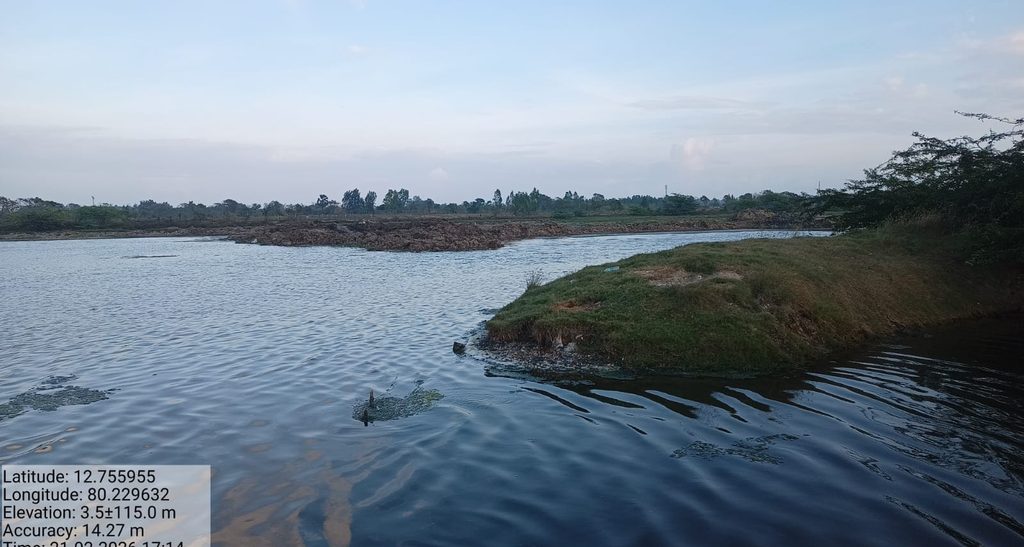
A coastal wetland like Kovalam-Nemmeli survives on water moving in both directions. Freshwater from the catchment drains out to the sea, and tidal water flows back in through channels such as the Buckingham Canal running through the wetland. This exchange sets the wetland’s salinity, carries nutrients and sediment, and drives the food web that supports its microbiome, prawns, crabs, fish, birds and plants. The complex stretches for about 26 km from Muttukadu to Kokilamedu, connected to the Bay of Bengal, and field documentation there has recorded 237 bird species, 233 plant species and the Muttukadu estuary’s role as a nursery for more than 12 finfish and shellfish species.
When the channels that carry this exchange are cut, the wetland is hydrologically disconnected from the sea. Tidal inflow stops, salinity patterns shift, and the breeding and nursery grounds that depend on them lose their function. Because the wetland is one connected system, the damage does not stay near the barriers. It spreads to all the species that depend on the whole.
Livelihoods that depend on a living wetland
That dependence includes people. Sixteen fishing villages rely on this wetland, and their catch rises and falls with the health of its breeding and nursery grounds. With tidal water held back, fishing families report a sharp fall in their catch over the past six months, and fishers estimate that each family is losing between Rs 15,000 and Rs 20,000 a month. They say they were not consulted before the work began. For these communities, the blocked channels mean the loss of both a breeding ground and an income.
A natural shield with its drainage routes obstructed
The same channels that sustain the wetland also help protect the communities around it. With a strong El Niño under way, the approaching northeast monsoon calls for extra caution: no single climate pattern fixes how much rain Chennai will receive, but the devastating floods of December 2015 came in a similar year, and a drainage system should never be blocked ahead of such a season.
During intense northeast monsoon rainfall, water from the catchment needs unobstructed routes to the sea. If the Buckingham Canal blockages restrict this outflow, floodwater could accumulate in low-lying areas and raise flood risk around OMR.
Cyclone-driven storm surges pose an additional threat. When high waves and heavy rainfall coincide, a connected coastal wetland helps absorb wave energy and excess water. If its channels are obstructed, drainage may be impaired and coastal flooding could worsen. The coastal wetland thus serves both as a drain for floods and a buffer against the sea, and blocking its channels weakens both at once.
Read more: From Kovalam to Kokilamedu, livelihoods of hundreds threatened by proposed Mamallan reservoir
Open the channels now, as the northeast monsoon is already here
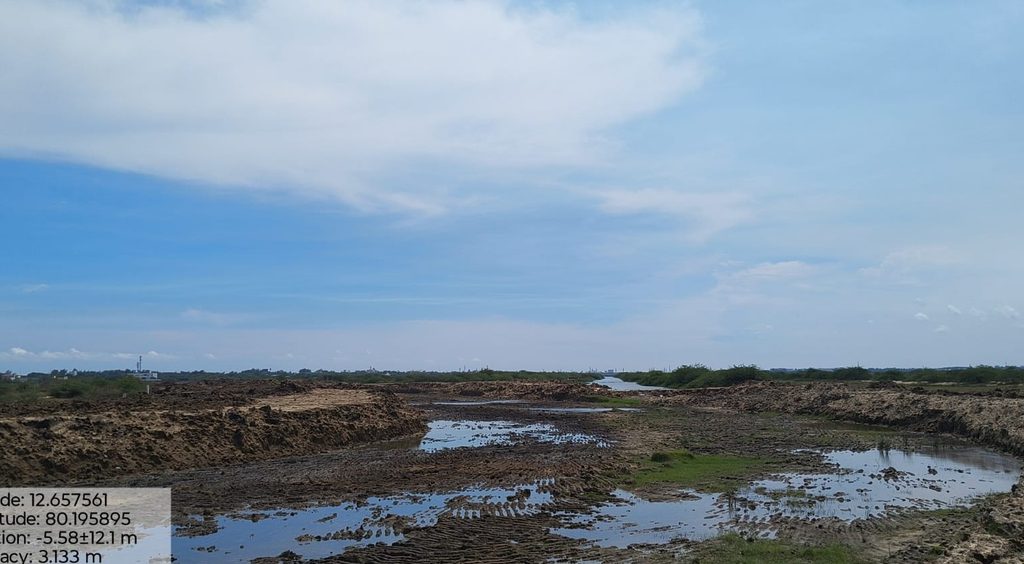
As the monsoon sets in, conservationists and local communities are demanding the removal of barriers across the Buckingham Canal on a war footing. Restoring the natural flow of water is critical to ensure that the wetland’s ecological functions are protected. Every week of delay brings the coast closer to a flood and surge season with its drains shut.
They have also urged the Tamil Nadu government to identify coastal wetlands similar to Kovalam-Nemmeli across the state and to give them legal protection as wetlands in advance. This will safeguard such ecosystems before proposing destructive projects, and not only after protests begin.
A proposed alternative to the Mamallan Reservoir
The Tamil Nadu PWD Senior Engineers Association (TANSEA), a group of retired senior Public Works Department engineers, has proposed an alternative water-storage plan based on desilting existing infrastructure. Here is what they advise:
- Desilting 99 Water Resources Department tanks across Chengalpattu, Tambaram, and the Kovalam sub-basin could add approximately 1.92 TMC of storage.
- Desilting and deepening the Poondi, Puzhal, and Chembarambakkam reservoirs could add an additional 6.75 TMC of storage.
- The project works could be funded through the sale of excavated earth.
- While these estimates require independent technical and economic assessments, the proposal deserves serious consideration as it stores water in existing tanks without disrupting the coastal wetland’s tidal connectivity.
Nemmeli is not an empty tank to be filled but a living coastal shield, and protecting it means protecting the interconnected well-being of Chennai: its people, its fisheries, its climate security and its biodiversity.