Imagine the entire population of a small country getting packed beyond capacity in trains so that they can reach their workplace. This is what happens on Mumbai’s suburban railway trains daily. Every day 62 lakh people travel by the Central Railway in Mumbai—that’s almost the entire population of Singapore. Not to be sidetracked, the Western Railway (WR) ferries 31 lakh commuters daily—that’s the number of people who live in the whole of Mongolia.
It is no surprise that Mumbai’s suburban railway network draws unimaginable crowds. After all, it is one of the most affordable, fastest and well-connected means of transport available to Mumbaikars. On the Western Railway (WR) suburban line, 1,414 trains operate daily, spanning 37 stations over a distance of 123 kilometres from Churchgate to Virar and extending to Dahanu.
In fact the term ‘super dense crush load’ was coined to describe the massive mass of people that squeeze into tiny spaces in trains during peak hours. This means that during rush hour 14 to 16 people are crammed into an area of one square metre, the space of a yoga mat, with not an inch to stretch on any side. Add to this the frequent delays. Despite claimed punctuality rates of 95% on WR and 92% on Central Railway (CR) for 2025–26, even short disruptions add to the overcrowding. By the time hapless commuters reach their destination, they are physically and emotionally drained. Unfortunately, the trials and tribulations of using Mumbai’s suburban railways have been so normalised that travellers have resigned themselves to these conditions.
To tackle all these issues, the railways have launched major upgrades under the Mumbai Urban Transport Project (MUTP) Phase III, IIIA, and IIIB. The Ministry of Railways has sanctioned ₹10,947 crore for MUTP III and ₹33,690 crore for MUTP-IIIA. Executed by the Mumbai Railway Vikas Corporation (MRVC), these multi-crore infrastructural interventions are meant to decongest Mumbai’s suburban rail and improve safety for travellers. But what do experts and regular users think of this overhaul? Let’s find out.
So, what are the upgrades?
Trespass control measures
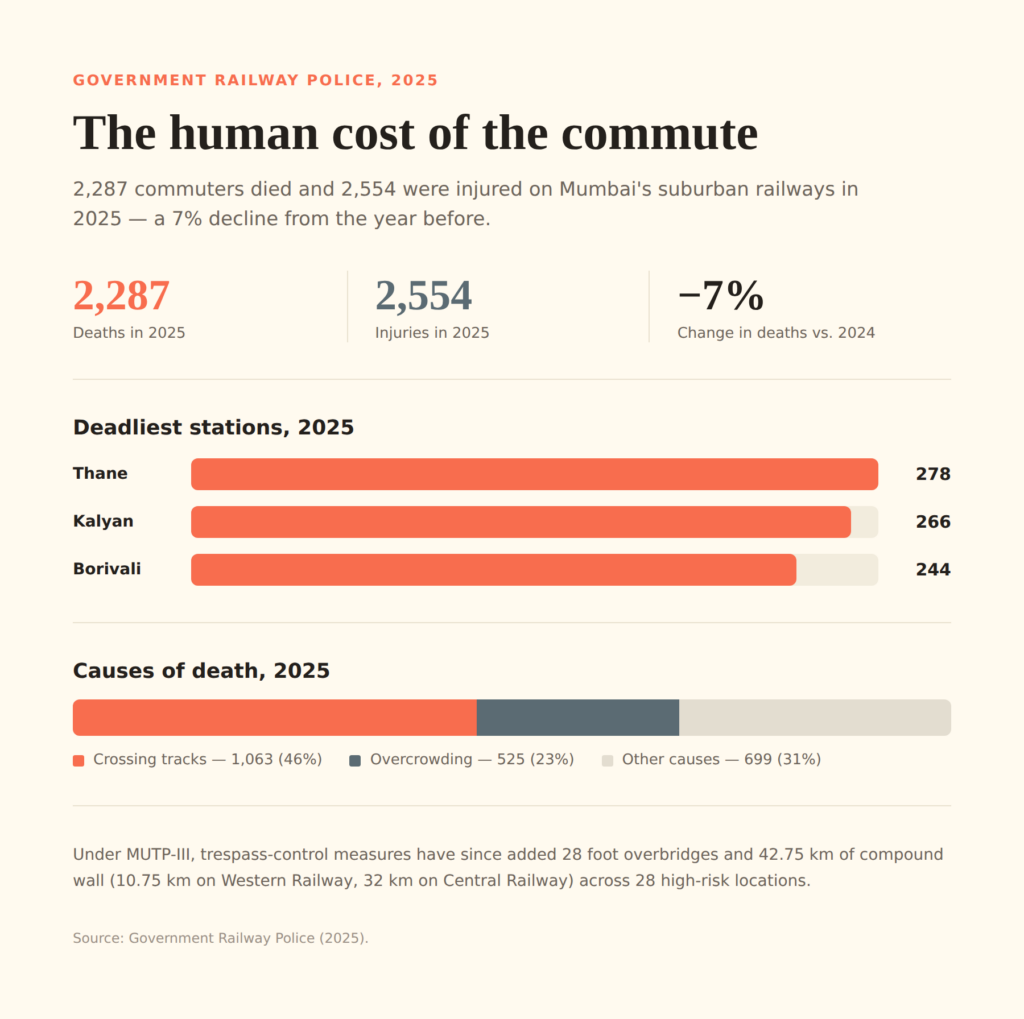
One of the main initiative under MUTP-III focusses on reducing deaths on the track. According to the Government Railway Police, on an average six people lost their lives due to various reasons while travelling on the suburban rail network in 2025, though the numbers have dropped by 7% compared to 2024.
While Thane had the highest number of fatalities with 278, Kalyan saw 266 deaths followed by Borivali at 244. Almost half the deaths were due to crossing of tracks, at 1063. Accidents due to overcrowding stand at 525 deaths.
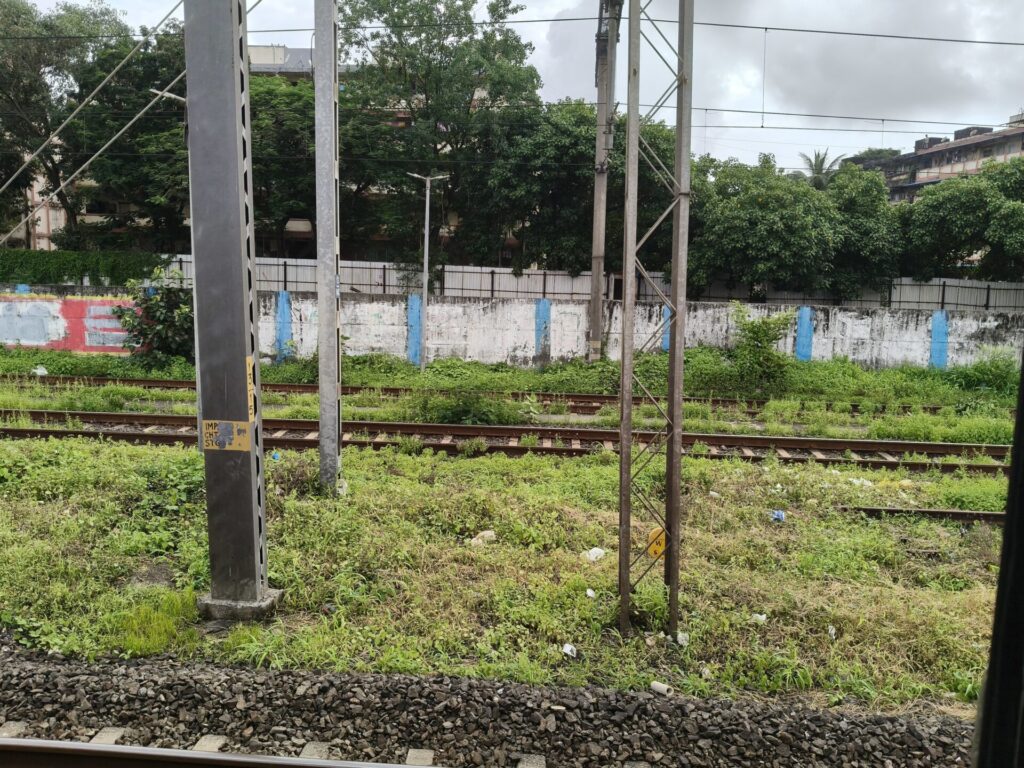
To counter this, trespass control measures are being built under MUTP-III. An official from the MRVC shared that 28 such locations were selected for the implementation of these measures. 28 foot over bridges have been constructed including both Central and Western railway and two foot over bridges have been extended. The measures also include two linkways and a home platform. To discourage crossing of tracks, compound walls stretching 10.75 km on WR and 32 km on CR were constructed.
Rishi Agarwal, founder of The Walking Project, believes that such measures are effective in ensuring safety of people. He gives the example of the foot overbridge at Amboli, built between Jogeshwari and Andheri to replace a level crossing. He believes that such measures are essential in high speed corridors such as train tracks and have a positive impact on train speeds.
Read more: Mumbai’s transport overhaul: Real solutions or a hidden agenda?
Quadrupling of the Virar-Dahanu line
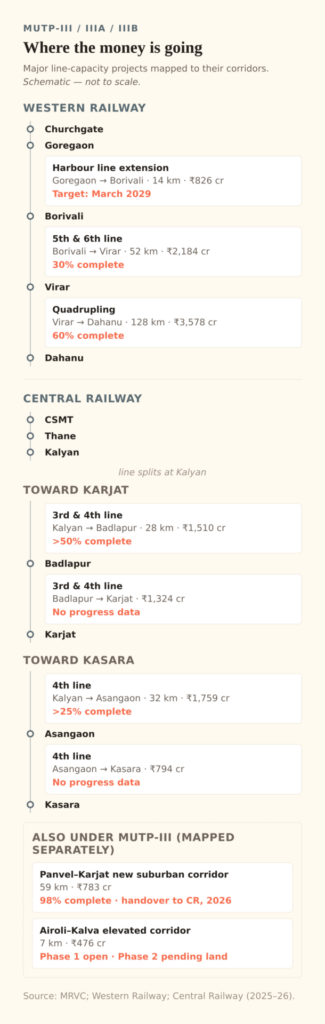
Another project under MUTP-III is the quadrupling of lines between Virar and Dahanu. Vineet Abhishek, CPRO, Western Railway, says that currently there are two tracks of 60 kilometres between the two stations. Twenty-one pairs of trains ply on them, going back and forth. He further explains that after Vasai Road, all the trains including mail/express trains, passenger trains, goods trains and local trains all run on the same two tracks.This affects the capacity to run local trains. “The addition of the two lines will allow WR to run three to four times the number of trains currently plying. It will also help segregate the local trains and out-bound trains,” he adds.
Rishi believes that the two additional lines will reduce the burden on the WR trains. “The quadrupling will largely cater to the induced demand after the Vadhavan port starts coming up. The whole Boisar, Palghar area will become a major hub after the Vadhavan port comes up,” he adds.
He also points out that traditional work patterns are changing: about twenty to thirty years ago, people who lived in suburbs like Borivali and Kandivali were working in Churchgate. Whereas now, commercial hubs are becoming polycentric. For instance, Borivali residents may now be working in Bhoisar and Palghar.
Fifth and sixth line between Borivali and Virar
Under MUTP-IIIA, the fifth and sixth line between Borivali and Virar is being constructed. The project cost is 2184 crores and 52 kilometres of track is going to be laid.
Virar trains are infamous for their crushing crowds. Amit Gholam travels during the week from Virar to Andheri and back. He does not get a place to sit, but he says he manages to get in as he is used to it. He points out that new travellers really struggle to even board the train.
He adds, “Once the sixth line is built double fast trains can run. Now, the train is fast till Borivali, and after that it stops at every station. A double fast train will stop at selected stations from Borivali to Virar, reducing the crowd.”
Anil Gadvi, who works at a pharmacy, travels daily from Virar to Vile Parle. During morning peak hours, he doesn’t get a seat, and there is barely any room to stand. Although Virar is the starting point, he still finds it difficult to get into the train because commuters travel back from Nalasopara. He too believes that increasing the number of trains will make a difference, although marginally. He says, “There are so many people that those trains will also fill up.”
Read more: Accessibility: Mumbai’s lifeline can make lives of people with disabilities easier, but how?
AC rakes on WR and CR
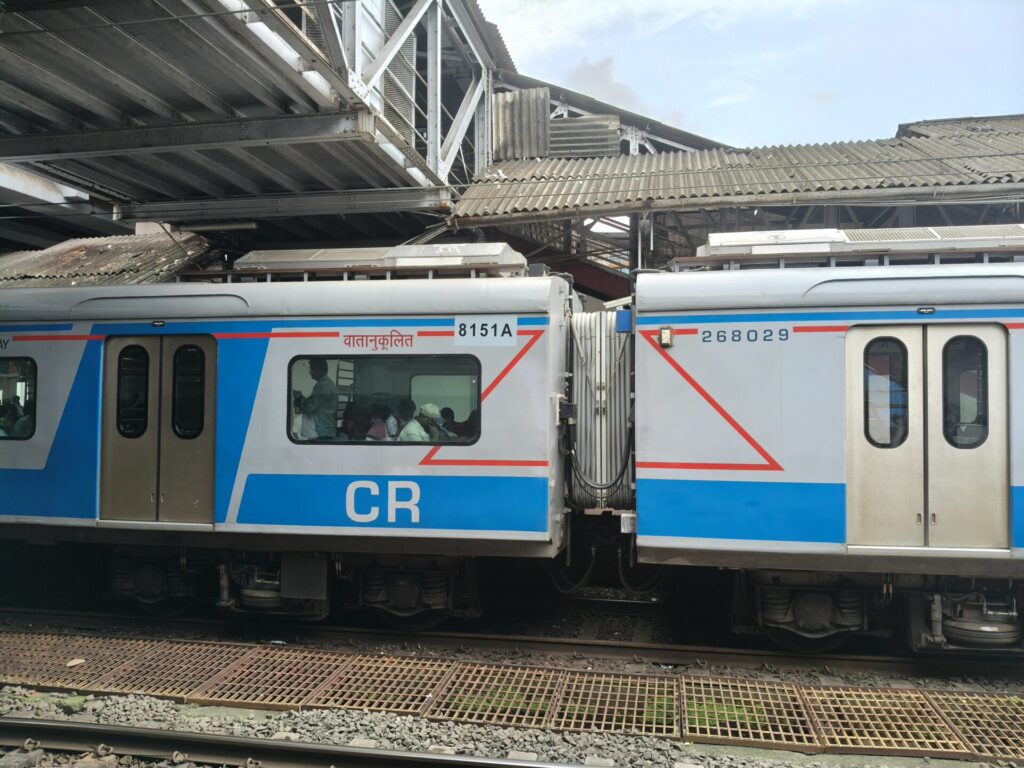
The Western railway currently runs 145 AC trains on weekdays and 118 on the weekends. On the other hand, the Central Railway operates 120 AC locals, 92 on the Main line and 28 on the Harbour line. According to an official from the MRVC, there is a plan to further add 238 AC rakes with 2856 coaches on both Western and Central Railways. The tender for this project is going to open in August 2026.
Urbanist Vedant Mhatre, who travels regularly by train, believes that AC locals have been a long time coming to a hot and humid city like Mumbai. He cites instances when he has fainted in the train due to the overcrowding and heat. “I feel AC locals should have come a long time ago. Thankfully, they are coming now. The point of contention always has been the price of the tickets.” He reiterates that the pass for the AC local is seven times the price of the non-AC train.
Anil adds that not everyone can afford to travel by an AC train. He further says that the non-AC train which comes immediately after an AC train, is overcrowded.
Experts have expressed doubts over the introduction of AC locals. On the one hand, they offer a convenient means of transport to people who can afford them, but the fact remains that AC train tickets are not within everyone’s budget. On the western line, a ticket can cost anywhere between Rs.60 to Rs. 220. Moreover, the AC locals will replace non-AC trains. As Rishi points out, this means overcrowding in the non-AC train which comes after the AC train. In the past protests have also broken out, especially at stations located on the central line after the introduction of AC locals. Moreover, when AC trains get overcrowded the doors do not close, leading to further delays.
Apart from these upgrades, MRVC is also implementing other projects such as the third and fourth line between Kalyan and Badlapur, fifth and sixth line between Borivali and Virar, third and fourth line between Badlapur and Karjat, fourth line between Asangaon and Kasara, new Panvel-Karjat suburban corridor, and the Airoli-Kalva elevated corridor. Besides this, there have been station improvements in the form of escalators and decks at five stations — Khar, Kandivali, Mira Road, Neral and Kasara.
Although crores of rupees from public funds are being used for these projects, there is no way for people to track how their money is being used. Ideally there should have been a dashboard with regular updates. How can people hold the government accountable?
“This is an across-the-board generic problem. The only way to check on the progress is to file an RTI.” says Rishi. But then, residents shouldn’t have to do that.
Giving the example of Transport for London, Rishi says, “The amount of information just readily available in the public domain is shocking to an Indian. You go looking for one piece of information, and you end up with ten other pieces of information and it is absolutely joyful if you are a transport geek.” He adds that this is the least one can expect from the government: the granular budget and a dashboard which shows progress. He further says that this is easily possible considering that public authorities maintain meticulous internal records and spreadsheets. It is only a matter of making the information public.
Also read:
- Deaths on Mumbai’s suburban rail call for action by Railways, commuters and planners
- Chennai’s ₹697 crore electric buses: Do they serve people who need it most?
- Reshaping driving lessons: Road safety should be the ultimate priority