Mahesh* owns a small paan and beedi shop near 90 Feet Road. His family has lived in Mumbai’s Dharavi for 50 years. Over the years, they added additional storeys above their home, a common practice in Mumbai’s slums. The rent from these upper floors helps Mahesh care for his ageing parents. Redevelopment would cost him both his shop premises and this vital supplementary income.
The Maharashtra Coastal Zone Management Authority (MCZMA) has given the go-ahead for the bioremediation of solid waste at the Deonar dumping yard to free the plot for housing “ineligible” residents (those lacking documentation) of the Dharavi Redevelopment Project.
Mumbai faces a critical decision about the landfill’s future. Many residents, like Mahesh, risk losing their homes and being relocated near the polluted dumping ground. With regeneration plans on the horizon, the city must choose: should this mountain of waste become high-rise affordable rental housing for Dharavi residents alongside three waste management plants, or a public green space to help a suffocating city breathe?
The current plan and its limitations
Nearly 42 per cent of Mumbai’s population lives in slums squeezed into just 6–8 per cent of the city’s land (Census 2011). The government’s plan to convert the Deonar dump into a housing scheme reveals less concern for improving lives than a desperate need to meet the housing shortfall. In effect, slum dwellers are being shifted from the heart of Mumbai to its margins—quite literally onto a dump yard.
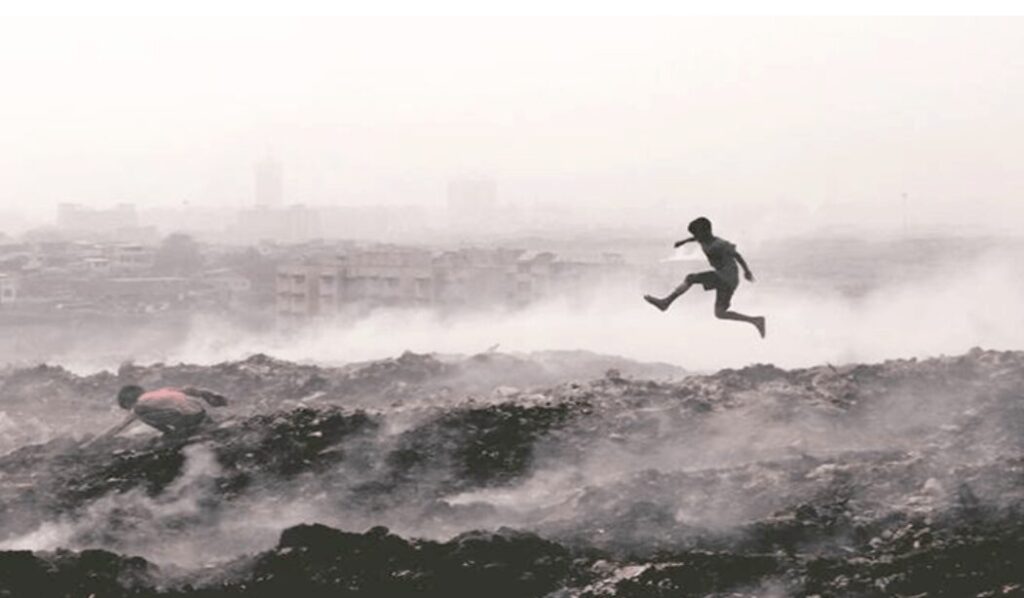
The Deonar landfill has accumulated over 1.85 crore tonnes of waste, rising more than 30 metres high. Fires and methane gas leaks plague the surrounding areas of Deonar and Govandi. The dump itself spans 132 hectares, of which 110 hectares are slated for regeneration.
The proposed land use plan is two-fold: building three waste management plants on the larger portion, and incorporating rental housing for relocated Dharavi residents. Dharavi—one of Asia’s largest mixed-use slums—is home to nearly a million people living in densely packed housing with limited access to basic amenities. The Dharavi Redevelopment Project aims to relocate residents onto approximately 50 hectares of the Deonar landfill, land that was earmarked before any remediation efforts began.
Inspired transformation
But can the remediation help build a safe residential community? This project echoes the Kilnwood Vale development near Gatwick Airport in the UK, which successfully transformed a landfill into housing.
That project, covering around 205 hectares (including a 60-hectare landfill), recycled landfill soil and managed gas and leachate to create a vibrant upmarket neighbourhood with villa-style garden housing. From the earliest technical preparations in 2003 to its completion in 2024, the transformation spanned approximately 21 years, with the key on-site remediation phase lasting about 10 years.
It converted a landfill containing 1.2 million cubic metres of waste into a new residential community. However, Kilnwood involved remediating mainly inert construction rubble across just 60 hectares, whereas Deonar consists of decades of mixed waste, making the scale and complexity of regeneration far greater.
Read more: Dharavi redevelopment: Locals oppose, planners worry, government looks on
Concerns over livelihood loss
The proposed relocation has triggered anxiety among Dharavi’s residents, who raise various concerns. Bhavesh,* who works as a carpenter in Goregaon West, says relocation to Deonar would add over an hour to his daily commute, which would affect his work prospects.
Avinash*, who recently moved to Dharavi, does not trust that the government will fulfil its promises. He fears the relocation process will be delayed or mismanaged, leaving his family on partially remediated land with poor infrastructure. His mistrust reflects the scepticism many residents feel towards the SRA process.
Many of the homes promised to some residents are larger than their current dwellings. But concerns about livelihood loss, health risks, uncertain timelines, and the absence of firm long-term guarantees explain why most Dharavi residents are not keen to relocate.
Environmental and health concerns
Asha*, a resident of Dharavi, highlights a health concern that planners seem to have overlooked. Since only 110 hectares of the landfill are supposed to be treated, most relocated residents may face potential health hazards as they will live adjacent to a highly active waste site.
The Central Pollution Control Board (CPCB) guidelines prohibit building on or near closed landfills, yet Deonar is not only an active landfill but a methane-emission hotspot. Nearly 5,500 metric tonnes of waste continue to be dumped here daily, contributing to Mumbai’s declining air quality index. Relocating residents here could expose them to serious health hazards from methane and leachate contaminating the surrounding water and air.
The dangers compound when one considers the track record of past SRA housing. Developments like the Lallubhai and Natwar Parekh compounds have been marked by poor design—little sunlight, inadequate ventilation, and overcrowding—leading to high rates of infectious diseases such as tuberculosis. The proposed rental housing at Deonar would follow the same SRA rules, offering few amenities and limited commercial space. This shortage of social facilities is likely to worsen as more people move in. Relocating Dharavi residents here would double the danger: not only landfill emissions, but also the public health risks arising out of cramped housing.
Beyond the long and uncertain wait to make the landfill safe for construction, the proposed housing plan offers residents little reason for confidence.
A green possibility
Drive around Mumbai, and you will barely encounter open spaces. The city offers just 1.28 square metres of open space per person, compared to the minimum 9 square metres recommended by the WHO. Meanwhile, Mumbai has experienced increased heatwaves and prolonged monsoons, bringing more flooding and acid rain.
Exploring the possibility of creating a green buffer zone—rather than rental housing—could reduce surrounding temperatures, reverse the Urban Heat Island effect, and absorb greenhouse gases. Such a model would support UN Sustainable Development Goal 3 (Good Health and Well-Being) by improving air quality and creating access to public recreational spaces for marginalised communities, as well as SDG 11 (Sustainable Cities and Communities) and SDG 13 (Climate Action).
Inspiration can be drawn from projects like Freshkills Park in New York, where an 890-hectare landfill was transformed into a public park generating revenue through tourism and public events while boosting surrounding property values. The Eden Project in Cornwall offers another model: a former clay pit converted into a massive greenhouse and education hub, now one of the UK’s leading examples of ecotourism and regeneration.
Economic, environmental, and social opportunities
From an economic and social perspective, a green park would create substantial employment. Security, facility management, and large-scale maintenance, including landscaping, waste management, and general upkeep, would require full-time teams and a sizeable workforce. Renewable energy plants integrated into the site would need operators for their machinery, creating additional jobs. Compared to housing, biomass plants would integrate well with green space, combining renewable energy with walking trails and recreation areas.
Ecotourism and educational programmes, such as guided tours, could boost economic growth and transform Deonar into a genuine attraction. The employment opportunities would also help reduce resistance from communities living adjacent to the site.
Perhaps most importantly, the creation of a green space and the removal of a toxic burden would encourage citizens’ faith in the government, demonstrating that positive urban change can be enacted for the greater good of the city.
What needs to be done
Urban regeneration is a response to changes in how spaces and functions serve society. With the city planning to regenerate part of the Deonar landfill, Mumbai faces a crucial choice: build more dense housing blocks for resettlement, or create a climate-resilient green public park to serve as a much-needed buffer.
One thing is certain: this is a once-in-a-lifetime opportunity to turn a dump into a dreamscape.
Based on resident concerns and expert examples, the Deonar landfill can be transformed into a sustainable, socially inclusive, and climate-resilient space through the following measures:
- Create a large public green park with walking trails, recreational areas, and playgrounds to increase open space and improve quality of life.
- Integrate renewable energy infrastructure—solar panels and the three proposed biomass plants—generating jobs and clean energy.
- Encourage ecotourism and educational programmes, such as guided tours, boosting economic growth and establishing the site as a visitor attraction.
- Implement rigorous monitoring to ensure safety, reduce methane emissions, and restore the land before any construction.
- Engage local communities and stakeholders to build trust and ensure the park meets local social needs.
*Names have been changed to protect identity
Interesting article Ayaan! M Bev sends his regards.