Nearly a decade ago, while I was working on the Revised Master Plan for Bengaluru (RMP 2031), a senior planner remarked: “Only the Bengaluru Development Authority (BDA) has the legal right to plan for Bengaluru.” Today, that assertion is unravelling in a tussle between the newly formed Greater Bengaluru Authority (GBA) and the BDA over who should plan for the city’s future.
What is more troubling is that Bengaluru’s current master plan, the RMP 2015, is based on surveys from 2003, nearly two decades out of date. The Karnataka Town and Country Planning Act (KTCPA) of 1961 requires revision every ten years, yet the city has failed to comply.
The KTCPA defines development broadly—covering building, engineering, mining, and land-use changes—but offers little clarity on outcomes cities should achieve. This normative language has left Bengaluru’s planning process fragmented, outdated, and vulnerable to political interference.
What is a Master Plan and who creates it?
A Master Plan (or Development Plan in certain contexts) is the statutory (legally binding) spatial blueprint that determines the growth and functions of cities in India. The key components of a master plan are:
- The land use plan, which spatially proposes various land uses (residential, commercial, industrial, roads) at the plot level
- The development control regulations (or zonal regulations) provide plot-level regulations like building heights, setbacks, etc. City Master Plans are prepared based on the direction provided by the Town and Country Planning Acts at the state level.
In India, city Master Plans have historically been prepared by Development Authorities, which are parastatal bodies, to ensure planned and sustainable urban growth. Master Plans must be updated every 15-20 years.
Read more: What happens to public objections on Bengaluru master plan?
What RMP 2031 got right
The RMP 2031 was built on robust datasets:
- An existing land use map at 1:5000 scale (2018)
- A socio-economic survey of 60,000 households
- A four-stage land use and transport model
- Hydrological analysis with 0.5m contour data and mapping of 800+ lakes
- Heritage mapping of 500+ assets
It employed advanced spatial technologies, including photogrammetric imagery, to generate a 3D building model of the city. Importantly, the draft incorporated several progressive planning ideas, such as aligning planning district boundaries with city ward boundaries for the first time to encourage ward-level public participation in master planning. Over 5,000 citizens, NGOs, and civil society actors were consulted — a process detailed further in this author’s published paper.
The draft also introduced significant firsts, including the integration of public transport networks directly into the proposed land-use plan, along with policies on transit-oriented development (TOD). It also established the city’s drainage network into primary, secondary, and tertiary systems with specific buffers for lakes and drains. A game changer was setting a base Floor Area Ratio (FAR) while introducing premium FARs, an idea now being adopted by the Urban Development Department of Karnataka. This was meant to put a check on rampant development occurring in the city, along with generating income for the city through premium FAR.
What RMP 2031 got wrong
Published in 2018, the draft plan received 13,000 objections and suggestions. While many saw this as the plan’s failure, in my mind it was a victory, given the unprecedented public participation. Yet conflicts quickly emerged:
- Authority to plan: A PIL by Namma Bengaluru Foundation and Citizens’ Action Forum questioned BDA’s authority to plan for Bengaluru. The Karnataka High Court, in turn, directed the State government not to approve the RMP 2031 without seeking its permission. The central conflict driving this bureaucratic paralysis is a constitutional paradox. In 2018, citizen activists fiercely rallied to demand that the Metropolitan Planning Committee (MPC) seize control of Bengaluru’s destiny. However, the law dictates a far more toothless reality: under Article 243ZE of the Constitution, the MPC’s mandate is restricted to preparing a draft Development Plan for the wider metropolitan area, rather than dictating the final, enforceable master plan. Moreover, this supposedly critical steering committee, chaired by the Chief Minister, had not convened a single meeting.
- Population projections: Projections prepared using multiple methodologies suggested Bengaluru could reach 20 million residents. Many activists were not happy with these figures. While the new census will give a clearer idea, the long-term solution lies in developing growth centres across Karnataka, as proposed by the Nanjundappa Committee in 2002, to reduce Bengaluru’s primacy.
- Political interference: Prepared under the Congress government at a cost of ₹15 crore, the master plan met a swift demise in 2020 when the BJP came to power. The official justification for shelving the plan — a lack of strong policies regarding TOD — was, frankly, a camouflage. TOD had been central to the plan, developed through a transport working group with DULT, BMTC, and BMRCL. The abrupt rejection begs the question: was it truly about optimising TOD? Or was the political motive tied to land ownership?
The state of planning in Bengaluru
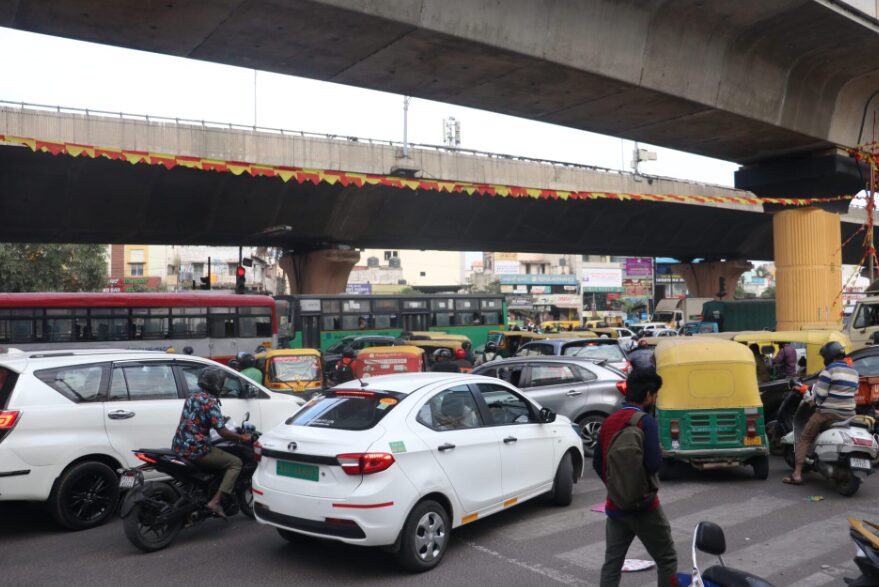
The KTCPA 1961 has primarily focused on master planning through zoning regulations, but many of its provisions have been misused. Section 14A, which permits changes in land use outside the notified master plan, is logically flawed and reduces the plan’s effectiveness. Enforcement is equally weak: although Section 76FFF prescribes penalties for jurisdictional officers who fail to prevent unauthorised constructions, these officers are rarely held accountable.
The baseline study for RMP 2031 revealed stark deviations: the authorities had implemented only 18% of proposed road networks from RMP 2015. Roads often existed only in front of approved developments, with no hierarchy on the ground. In terms of land use, the RMP 2015 did not show the proposed lake buffer zones in the proposed land use maps and only mentioned it as 30 metres in the zonal regulations. This created a lot of ambiguity, leading to misuse. Many large residential developments used the buffers to create tennis courts and amenity centres, defeating the very purpose of the buffer zone.
The dead end of Indian master planning
Modern Indian town planning is trapped in a colonial hangover. By and large, we are executing a top-down approach heavily influenced by the UK’s Town and Country Planning Act of 1947. While the UK woke up decades ago and pivoted to agile, strategic, outcome-based planning, we remain stubbornly shackled to an archaic system of rigid, normative regulations. History and lived experience have shown: a top-down master plan is entirely useless when on-the-ground enforcement is lax.
Traditional land-use planning has lost its legitimacy over time, thus rendering it incapable of managing rapid urbanisation. Over the years, actual planning power has been eroded in Bengaluru by elected representatives, entrenched landowners, powerful real-estate lobbies, a tangled web of government departments, policy elites/ evangelists and civil society warring over overlapping jurisdictions.
Towards a reimagined planning framework
We do not need another minor amendment; we need a radical, ground-up reimagination of our entire master planning framework. Three provocations emerge for the readers to consider:
1. Who should plan for Bengaluru? The Bengaluru Metropolitan Area (1,294 sq km) requires a single integrated planning and transport authority. Ideally, the GBA should subsume BDA, DULT, BMTC, and BMRCL, akin to Singapore’s Land Transport Authority. Yet institutional resistance persists, with BDA unwilling to give up its planning powers.
2. Who should we plan for? Planning must acknowledge political-economic realities. For decades, landholding lobbies—real-estate tycoons and MLAs—have dictated master plans. Legitimacy demands redistributing power to citizens through transparent, inclusive participation.
3. How must we plan? Bengaluru must pivot from static land-use allocation to dynamic, outcome-based frameworks. Master plans should set Key Performance Indicators (KPIs) to track progress. A city-level infrastructure vision must be micro-executed at the neighbourhood scale through localised urban design.
The RMP 2031 demonstrated the potential of data-driven, participatory planning but was derailed by institutional conflicts and political interference. Bengaluru’s planning paralysis reflects a deeper national crisis: outdated laws, weak enforcement, and elite capture. To break free, the city must embrace integrated governance, citizen-led processes, and outcome-based frameworks. Anything less risks institutional suicide in the face of climate change and relentless urbanisation.