Summer in India has been merciless this year, with many states recording temperatures above 42 degrees Celsius and rising reports of fatalities. Despite these harsh conditions, urban support continues for development projects that clear trees, wetlands, mangroves, and forests near cities.
A recent Article 14 report provides data on thousands of trees that will soon be sacrificed nationally for infrastructure projects. Those opposing such unscientific large-scale tree felling are often labelled ‘tree-huggers’, ‘anti-development’ and ‘anti-nationals’. While capitalism accelerates environmental degradation and the world faces a growing climate crisis, societal divisions deepen.
Yet, we give trees too little credit: Beings necessary for preserving the health, memory, and character of our cities. Their removal cannot be justified solely on the basis of infrastructural gains. The destruction of urban canopies fundamentally diminishes our quality of life, as no development can substitute this essential relationship between people and trees.
When trees made streets
Bengaluru, once celebrated for its pleasant climate, is losing its appeal partly because its defining features are disappearing. This city is forced to outgrow itself prematurely, with its landscape altered and space constrained, struggling to reasonably accommodate the growing number of residents each year.
Amid this transformation, one constant endures: the longstanding signposts, the trees, which quietly shape the city’s identity and our collective experiences. They are repositories of memories, and we closely associate our own with them. In old Bengaluru, spontaneous recreation was effortless; even a random street could become a scenic destination.
Read more: Bengaluru’s trees must be preserved by its people: K Sankara Rao
When I was in grade 10, my older sister and I would borrow our uncle’s motorcycle each week, professedly to learn to ride. We travelled ten kilometres, seeking to be drenched in shade along the then mostly empty New BEL Road, beginning at the Sadashivnagar police station, lined with towering, buttressed trees.
Week after week, for an entire year, we wandered up and down this street, long before such an experience became a viral sensation known for its soothing charm. We experienced the magic firsthand, right in the heart of the city, as the trees above us performed their gentle dance of “canopy shyness”.
Back then, cultural events were almost never without these sentient beings. Music gigs like the Strawberry Fields or Sunday Jams, both held in large, tree-shaded settings, became places to rest, sing, play, and listen — no sunglasses needed in the early 2000s!
Even today, despite the notoriety of the city for its traffic jams, belching smoke and screaming horns, the old giants (ficus, rain trees, among others) make its roads tolerable. You will find them most often standing tall near signals, with their spill of vines or branches engulfing surrounding walls.
Of rituals and memories
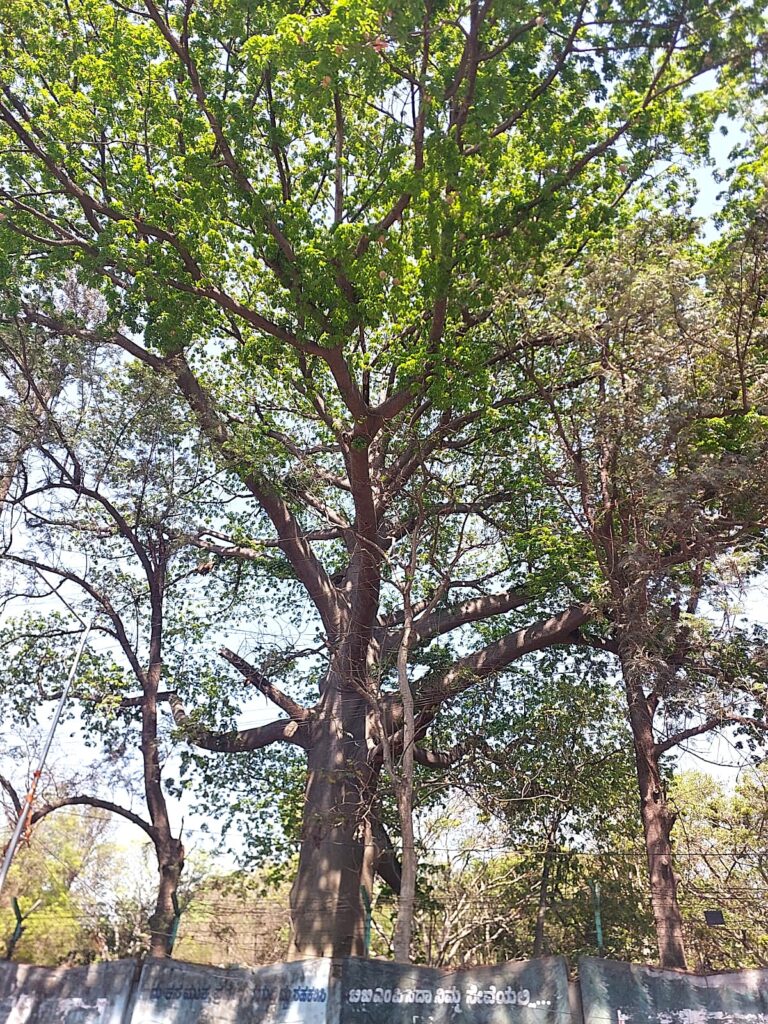
I have taken the same route home for over a decade, to glance at the extrovert — an unabashed show-off, jutting out like a mammoth trunk from Lalbagh toward Westgate Road. We greet each other regularly, this over 300-year-old silk cotton tree and I: me grateful for her presence, while she stands firm, marking the passage of time.
Routines foster familiarity, and through these daily interactions, we (my partner and I) engage in collective remembering, such as seasonal visits to Basavanagudi to buy jackfruit from the same street vendor. These interactions always lead to the same stories: “There were days when we would pick these from the trees on this very road.”
The vendors also recall gathering wood apples from trees within the city and from households that maintained large trees and shared their fruit freely. These vendors serve as memory keepers of trees, recalling their names, the hours spent beneath them, and the good and bad seasons they experienced together.
Over the years, we have begun to celebrate the changes and the little joys of victory too — whenever concrete, brick, or white-topping monstrosities give way to a tree’s deep-rooted persistence, allowing it to reemerge, or when a regrowing stump appears as an act of resilience.
What we stand to lose
Only during COVID did I witness people shed their inhibitions like never before. We cycled to Cubbon Park as often as we could. Each time, we searched for a new, more elaborate buttress to rest on and drink coffee.
We saw people hugging trees in silence. Many lay down next to one, many rested their heads or touched its leaves. Others looked up at the dancing canopy. For months, during COVID, this sight was common in both Cubbon Park and Lalbagh. Weeks of being confined indoors were enough to let go and openly embrace nature, receiving its gifts to heal.
Over the years, I have revisited the neighbourhoods where I once lived, only to find every available space transformed into asphalt—grey and lifeless. Each year, as more trees are removed, policymakers overlook the fact that urban spaces are not just patches of earth to be built upon. They house ecosystems that are layered with collective memories and ecological history; their environments are shaped by the diverse experiences of their inhabitants.
What about our sensory memories? Without trees, will rain smell the same, or the lingering scent of flowers on the summer wind? Will we continue to call streets Margosa or Sampige without their namesakes? Should policy decisions prioritise profit over lived experiences, untold stories, or those yet to unfold?
What are now mundane, homogeneous, impersonal developments full of tall glass buildings and gated communities are spaces that once fostered communal interaction. Now, under a growth-oriented city, such gatherings are deemed unproductive, prioritising efficiency for a privileged minority.
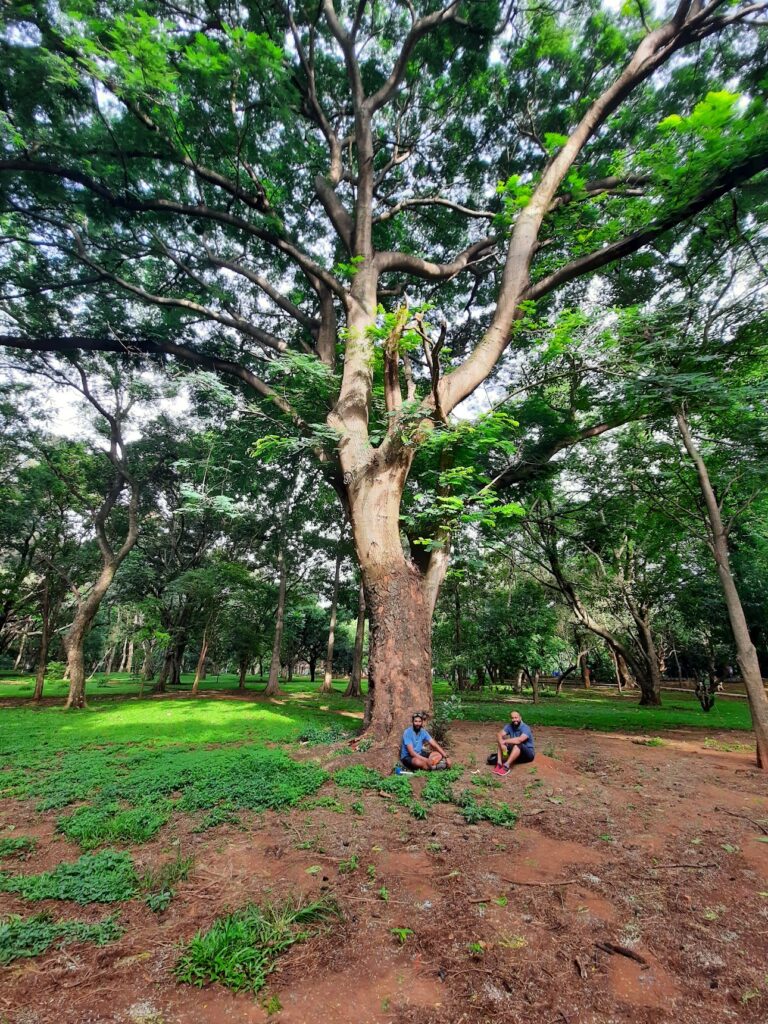
Nature as urban self-care
Restricting our appreciation of trees to only their immediate and quantifiable benefits doesn’t do justice to their broader significance. Trees in urban areas play a vital role in shaping and supporting communities and sustaining diverse ecosystems for humans and other animals.
When we speak of city development and growth, trees are usually the first to be sacrificed. Yet they represent opportunities for genuine progress, offering models of urban design that promote equity and collective advancement. In these models, nature and humans coexist, mutually benefiting and flourishing together.
Ultimately, recognising our dependence on trees is an act of self-care rooted in our lived environments and experiences. This deep connection cannot be uprooted by unsound policy choices.
Trees have long served as the perfect metaphor, even saving us from the cold isolation of modern urban design. Today, she is still a metaphor—this time for resistance. She stands against our growing foolishness, as we deny ourselves her perfect, free shade during a harsh, unequal summer.