After nearly four years of delay, Mumbai is finally set to hold its municipal elections on January 15. The last elected council completed its term in 2022, and in the absence of fresh polls, the city’s civic body was placed under an administrator for the first time in forty years.
The Brihanmumbai Municipal Corporation (BMC), established in 1888, is the governing authority responsible for delivering essential civic services — from water supply, sanitation, and solid waste management to public health, infrastructure, roads, and education. With a staggering budget of ₹74,427 crore for 2025–26, it is the wealthiest municipal body in India. The BMC oversees Greater Mumbai, stretching from Colaba in the south to Dahisar in the north, and from Mulund to Mankhurd in the east.
Structure of the BMC
The Brihanmumbai Municipal Corporation, also known as the Municipal Corporation of Greater Mumbai (MCGM), has two wings: the administrative wing, also called the executive wing, and the deliberative wing.
The head of the executive wing of the BMC is the Municipal Commissioner, who is appointed under Section 54 of the Mumbai Municipal Corporation Act,1888. The state government appoints the municipal commissioner, who is responsible for heading the administrative staff of the corporation, implementing its decisions and preparing its annual budget. Currently, Bhushan Gagrani is the Municipal Commissioner of Mumbai.
Read more: Conspicuous by absence in Mumbai election campaign: BMC elections
There are Additional Commissioners under the Municipal Commissioner. Departments and zones are distributed amongst them for supervision and execution. Currently, these are the four Additional Municipal Commissioners working under the Municipal Commissioner.
| Name of the Additional Municipal Commissioner | Distribution of work |
| Dr. Ashwini Joshi | Additional Municipal Commissioner (City) |
| Dr. Avinash Dhakne | Additional Municipal Commissioner (Eastern Suburbs) |
| Abhijit Bangar | Additional Municipal Commissioner (Project) |
| Dr. Vipin Sharma | Additional Municipal Commissioner (Western Suburbs) |
There are Deputy Commissioners under the Municipal Commissioner/Additional Municipal Commissioner. There are 24 Deputy Commissioner positions, out of which 23 are currently filled.
Followed by this are the Heads of Departments (HODs). There are HODs for departments like finance, disaster management, education, garden labour, legal, fire brigade, etc. There are 52 HODs appointed in MCGM. Each ward is headed by an Assistant Commissioner (formerly known as a ward officer).
Deliberative arm of the BMC
The deliberative arm of the BMC is made up of elected councillors. One councillor is elected from each of the electoral wards. They act as facilitators between the BMC and the citizens and oversee civic works through the local area development fund and discretionary funds allotted to them. They frame public policies and participate in budgetary allocations via different committees.
The role of councillors is cited as a part of the obligatory and discretionary functions of the BMC as mentioned in Section 61 of the MMC Act, 1888. The mayor is elected from among the councillors for a term of 2.5 years. The last mayor of Mumbai was Kishori Pednekar who served her term till March 2022.
You can read more about the role of councillors here.
Electoral wards
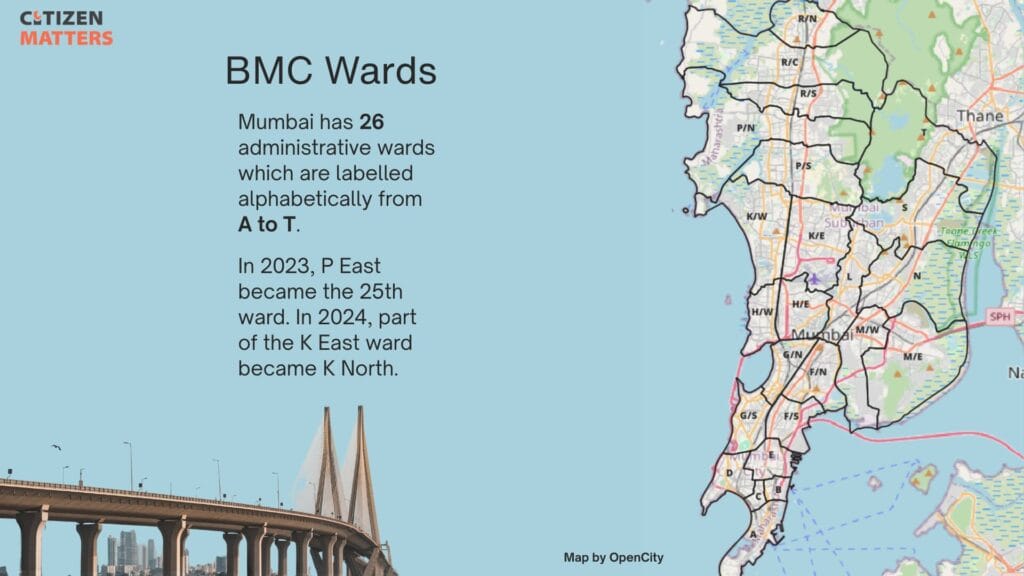
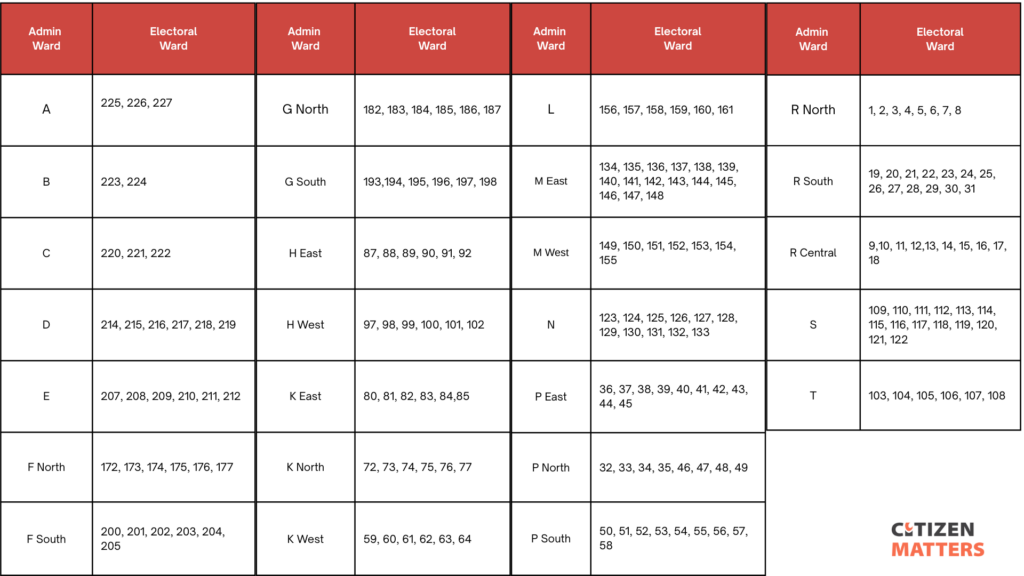
List of administrative and electoral wards
BMC elections
On January 15, voting will begin at 7.30 am and continue until 5.30 pm. The counting of votes will take place the following day. You can find the final list of candidates contesting elections from each ward here.
How to find your prabhag number or electoral ward number:
If you are not sure which prabhag or electoral ward you belong to, you can check in the prabhag maps uploaded on the BMC website. Follow these steps to find your electoral ward.
- Open this BMC web page.
- Click on Ward Formation under BMC General Elections 2025
- Click on Final under ward Formation
- Click on Final Prabhag Maps 2025
- Click on your ward.
- You will find a list of the prabhags in that ward. Clicking on each prabhag will show you a map of the prabhag.
- Look at each prabhag map till you find your address. That is your prabhag number.
As you get ready to cast your vote, check if your name is in the final voter list. Follow these steps to do that.
How to find your name in the voter list
- Open the final voter list here.
- Scroll to the name of your ward in the list.
- Click on the number of your electoral ward or prabhag given against the ward name
- Find the list number (prabhag Yadi) by looking for your address. This is given at the beginning of the document.
- Scroll down to that list and look for your name.
Finally, check where your polling booth is on this web page of the BMC.
Some citizen and civil society groups, such as the Chandivali Citizens Welfare Association and Praja Foundation, have also released their manifestos demanding infrastructure upgrades, relief from air pollution and transparency in governance.
How to make an informed choice
- Review information about the candidates on the ECI website.
- Track the issues that candidates and their parties are highlighting, and see whether they resonate with you.
- Compare candidates to better understand who is promoting citizens’ needs.
- Study the election manifestos of all the parties.
- Fact-check claims and do not fall for misinformation circulated on social media.
- Engage directly by attending debates, public meetings or meeting candidates in person.
For any queries, call BMC Election Helpline: 9619512847/022-22754028. For more information about the voting process and to register complaints, click on the voter service portal.