One cool morning in February 2012, I drove up across town to Hesaraghatta Lake. As we approached the embankment, my excitement rose and I ran up the steps. They had told me it was big. What I had not realized was just how big this lake was. I could not see the edges on the far side. All 3000 acres of it used to brim with water, fed by the Arkavati River.
That day, it was dry. Bone dry. For the first time in seven years there was no water in Hesaraghatta Lake. And, unfortunately, this was no exaggeration.
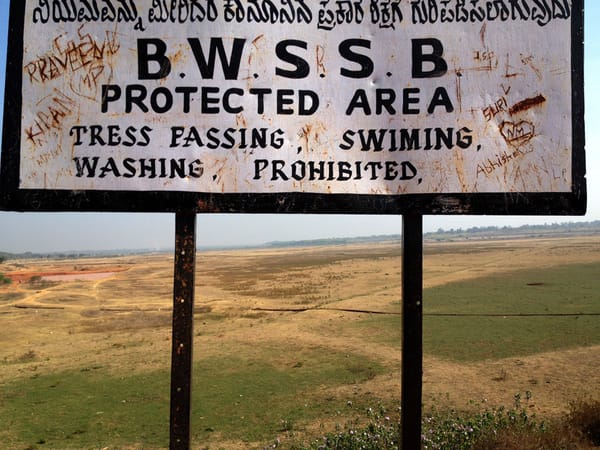
Hesarghatta Lake or what was once a lake. Pic: Arati Rao.
This is the situation today: What was once the lifeline for the city of Bangalore now runs dry. There are no feeder streams coming in from the Arkavati either. She is dry too. There is no water in the lake. And groundwater levels are dismally low. Where kids used to find water by digging with their hands during play, groundwater levels had sunk to over 1000ft.
Moreover, the groundwater in many areas had been declared unfit for drinking. And a very hot summer had just begun.
If there was one thought in my mind, it was this: Bangalore is in trouble. Water trouble. And it is serious.
The Arkavati rises as a series of springs in the Chikkarayappanahalli Hills in the Nandi Hills range. Or at least she used to. Those springs do not flow anymore. A chain reaction follows where tanks downstream then are not replenished and, consequently, neither is groundwater. And here is where we run into deep trouble.
The Bangalore Water Supply and Sewerage Board (BWSSB) supplies water to Bangalore from Cauvery (80%) and Arkavati Rivers (20%). Even with both sources available, there was a shortage of about 400 MLD (million liters per day). Today, there is no flow from Arkavati and her two reservoirs are languishing – with Hesaraghatta dry and no flow into Thippagondanahalli (TGR).
The Arkavati used to flow about 190 km before meeting the Cauvery. With much foresight, several tanks were built along the way for recharge and for various uses. All of which are in peril today.
While each issue is in itself grave, the status of groundwater in Bangalore is particularly alarming. A report issued by the Department of Mines and Geology, Government of Karnataka, last year has shown a crazed frenzy to sink borewells across the city. Bangalore purportedly pumps out a staggering 570 MLD of groundwater, to make up the shortfall from the river supply.
Why should we care?
Borewells – by some counts up to 2 lakh – have been sunk, but there is no Arkavati or Kumudvathi (that originates in Shivagange hills near Tumkur) that is flowing to replenish the groundwater.
Consider this: there was a time, about 35 years ago, when opens wells had water down 70 feet around the Hesaraghatta Lake area. Today water can be found only at 1000 ft! Borewells are not hitting water either for over 1000 ft. The water, even when struck, is not potable.
We visited the Nagara Kere in Doddaballapura which still had some water in it. Sewage was being pumped in to the lake at one end and at the other end, fish were washing up dead on the shores. In this same water local fishermen cast their nets, cattle washed and drank, while kids splashed and played about. If the lake cannot sustain its fish, one can only imagine what the quality of this water must be. And this is the same water that seeps and recharges groundwater.
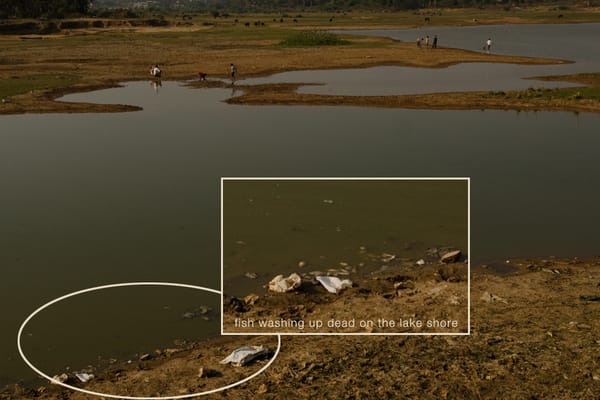
Dead fish washed up on Nagara Kere. Pic: Arati Rao.
Apparently, groundwater test results show elevated levels of Nitrates, fluorides, heavy metals – Zinc, Chromium, Manganese…
So we have shrinking water supplies from surface sources (lakes drying up, rivers not flowing), and diminished levels of groundwater which most likely is not potable. This, given Bangalore is burgeoning with new localities springing up (none of which have guaranteed BWSSB supplies) and industries mushrooming. Both guarantee sewage, effluents and consumption.
Demand is rising fast, supply is diminishing fast(er?). We may be sitting on a bomb and we don’t know how much time we have left on it.
It is imperative that we work to revive the Arkavati and give ourselves a fighting chance. For we know what they say, right? That the human body can go a few weeks, maybe a month without food, but not more than a day without water.
⊕
Is there anything we can do to revive Arkavati? – Do you know of anyone who is already working on it from a scientific and/or awareness perspective?