With Bengaluru expanding, its peripheral areas like Sarjapur and Attibele, which were once villages, are now experiencing suburbanisation. Suburbanisation has enhanced the need for good roads and related infrastructure in these areas. Plus housing demand here is leading to a change in land-use patterns and expanding urban sprawl.
One of the primary effects of this process is traffic congestion.
This area falls under the jurisdiction of the Attibele Town Municipal authority, with Attibele junction being the most congested on the Sarjapur-Attibele Road. It is the meeting point of seven roads from different directions, connecting different parts of this region to Bengaluru.
The junction connects Anekal, Sarjapura, Electronics City, and Hosur (Tamil Nadu). Overhead is a flyover that connects Attibele directly to Electronics City. Though meant to manage high-speed traffic in the area, the flyover is used only by heavy vehicles in the mornings and evenings. There is little other traffic on the flyover. Much of the traffic is on the roads at grade level, with some of the space being used for parking.
Read more: A sustainable plan to solve traffic woes at Iblur Junction
The Attibele police station is situated adjacent to the junction. The area around the junction is crammed with commercial establishments, especially restaurants and street food stalls. Besides private two-wheelers and cars, trucks frequently use the road to transport construction material. Public and private buses use the junction to transport industrial workers, construction labour, students, office goers and other commuters from the two bus stops located around the Attibele junction.
There is also an auto stand adjacent to one of the bus stops, but most people here prefer buses. The autos are primarily used by students and passengers who come from the highway. Sarjapur-Attibele has a high migrant population employed in low-paying informal jobs in the nearby industrial areas.
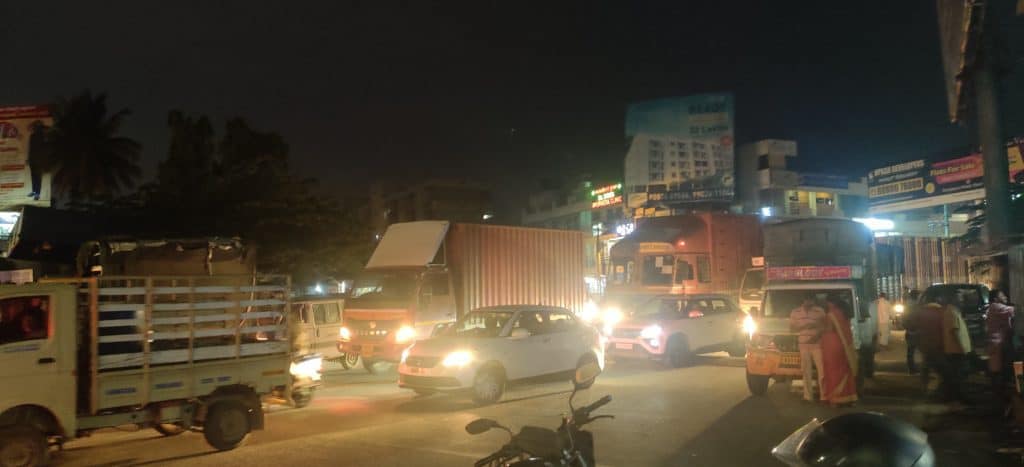
No signals, no footpaths, no traffic police. Only traffic congestion!
Although the junction is significant for commuters, there is little systematic regulation of heavy traffic. There are no traffic signals at the junction or street lights on either side of the road. There are no pedestrian paths or zebra crossings either.
Traffic management solutions like building flyovers, like in this case, have barely helped. Empty spaces below the flyover have been encroached, or are used for parking. Hardly any vehicles use the flyover. There are many CCTV boxes at the junction but without cameras. Despite being next door to the Attibele police station, there are no traffic booths or traffic police managing the busy junction.
Read more: Bengaluru’s traffic nightmare during floods: IISc study shows policy measures can help
According to Ravi, an auto driver in the area, there are regular traffic jams at the junction, particularly between 4 pm to 8 pm. Ravi says that police officials only get involved when the congestion get really bad, even though their continued presence at the junction is vital to clear the jam. “There are many accidents that happen in this place due to high speeding vehicles,” says Ravi.
“Sometimes I feel worried even to cross the road,” says Mohan, a regular commuter on the Attibele junction-Sarjapur Road stretch. “The police station is very close to the junction; if they deploy officers to manage traffic, it would be much better”.
Housing development alongside the Sarjapur-Attibelle road has led to an upsurge in the land value over the last 20 years, adds Mohan. From being rural, these areas are rapidly transitioning into urban spaces, which has promoted the use of personal vehicles adding to the traffic chaos on the road.