Where do the items in our homes come from, and what happens after we discard them? Let’s take a plastic bottle. Water, cola, buttermilk, and caffeinated drinks — all this comes in PET bottles. Indians collectively throw out 38,00,000 kg worth of PET bottles daily.
Where does a plastic bottle come from? Oil, gas, and other fossil fuels are processed into polymers. Polymer pellets are shipped to factories where a multi-step process turns them into bottles. These bottles are shipped to other factories to be filled and labelled. These bottles go to warehouses, wholesalers, and then retailers.
Crude oil from the U.A.E. travels thousands of kilometres to reach ports in Gujarat for processing, manufacturing, filling, and labelling.
What happens after you dispose of your bottle of Aquafina, Coca-Cola, or Amul Kool?
If you put out your dry and wet waste mixed together, then the bottle might get burned, releasing dioxins, heavy metals, and other toxins. Or the bottle might end up in a landfill or water body, creating toxic leachates that affect soil or water quality and poison wildlife. As the bottle degrades, microplastics enter our air, soil, water, and eventually our bodies.
On the other hand, if you segregate your waste, your PET bottle can be upcycled into polyester clothing, furniture, garbage bins, or other products. Processing waste plastic does have environmental effects, but upcycling is still far better environmentally than producing virgin plastic while burning/dumping old plastic.
Segregating waste: A catch-22
I work at the intersection of climate and human behaviour and have done fieldwork in multiple sectors: energy, mobility, and waste. Whether in Kolhapur with its 700,000 residents, or Auroville with a few thousand — the waste sector is a tough nut to crack.
Without waste segregation at source, effective downstream handling becomes impossible. But getting citizens to segregate is challenging. The main reason? Unlike some other pro-environmental behaviours — installing rooftop solar, using public transport — waste segregation offers citizens no financial benefit. (Households who turn wet waste into compost, or sell dry waste to aggregators, are still the exception. These actions do pay off but require effort and planning.)
This creates a Catch-22. Which comes first: getting citizens to segregate at source or getting municipal authorities to systematically collect and handle segregated waste? Everywhere I’ve worked, each side wants the other to take action first.
A friend who spent years leading waste-segregation efforts at her large, posh Bengaluru apartment summarises a key roadblock articulated by her neighbours: “Even if I segregate my waste, I can clearly see the BBMP guys dumping it all back together in the collection van. So why should I bother?” This complaint is echoed everywhere I’ve done fieldwork.
Meanwhile, in most of India, despite the mandate to segregate, municipal waste workers lack the authority to enforce segregation. So they’re forced to collect unsegregated waste. Municipal authorities are often willing, in principle, to invest in waste technologies: e.g. shredding and baling machines and biomethanation plants. But they prefer to defer such investments until an acceptable benchmark is achieved in segregation at source. However, absent this infrastructure for appropriate ultimate disposal of waste — landfill supervisors, waste-collection-route supervisors, and collection-van drivers are all disincentivised to ensure segregation.
Nobody wants to do something that feels meaningless.
Causal storytelling: Connecting citizens to a product’s lifecycle
While working with communities to drive segregation at source, one approach I’ve had some success with is illustrating the lifecycle of products. Specifically, when citizens understand how their everyday choices affect an item’s ultimate destiny, they often seem more willing to segregate.
We don’t really think about where the things we consume come from or where our waste is headed. My fieldwork suggests that the things we consume seem to come out of the void, and our waste seems to go back into the void. Yes: we see piles of mixed waste being burned along streetsides. But this has just become ‘how things are.’ We don’t explicitly connect it with the decisions we make while shopping, cooking, or putting out our waste. This can make a mandate to segregate feel like a meaningless act in a vacuum.
In Kolhapur, Maharashtra and Kuppam, Andhra Pradesh, I’ve led exploratory fieldwork – semi-structured interviews, surveys, and focus group discussions – whose results shaped interventions. Our informational, educational, and communication (IEC) materials, and the community engagement sessions we’ve structured around them, cover topics such as types of plastic, what type of waste goes into which bin, etc. The usual suspects.
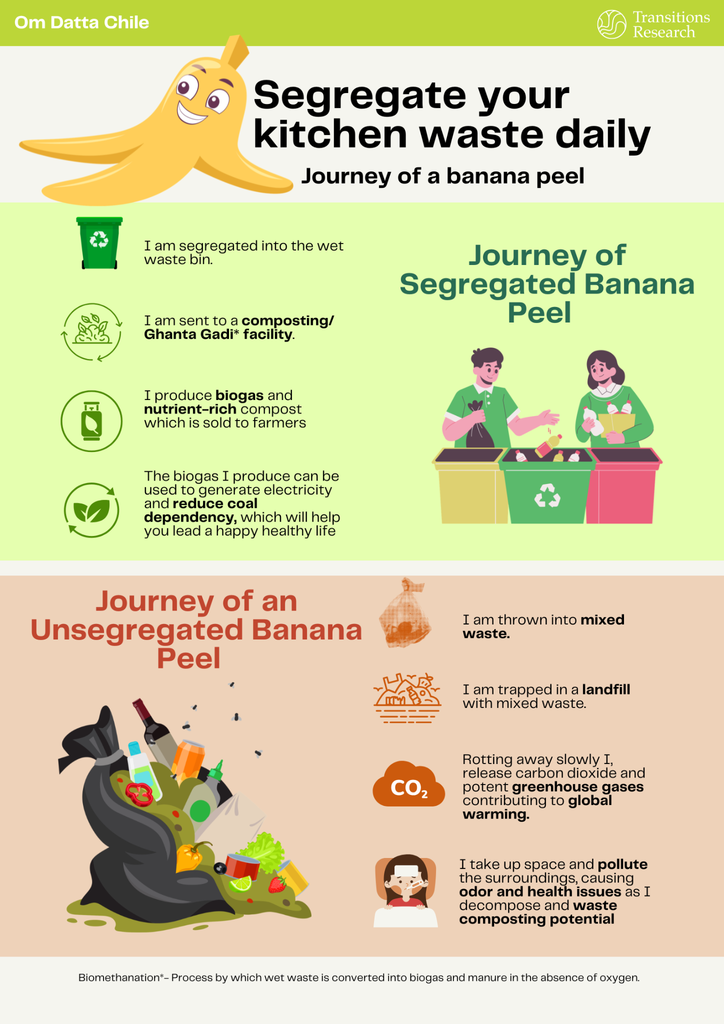
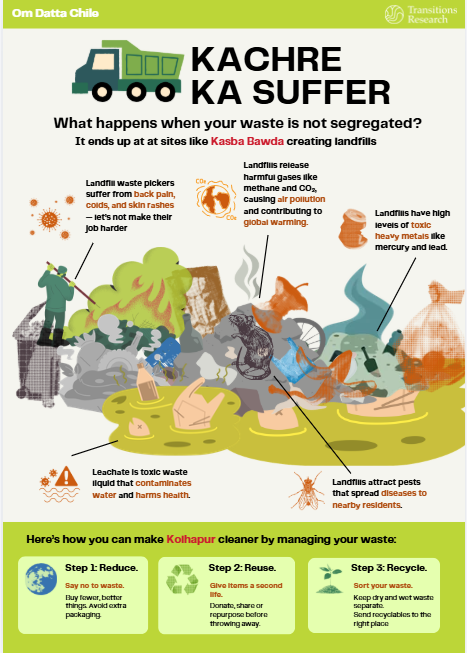
Knowledge is necessary but not sufficient for action. But certain kinds of knowledge do seem more promising than others. I’ve consistently observed an enthusiastic response when we discuss the downstream effects of segregation vs. non-segregation. Typical of this approach are our ‘Journey of a Banana Peel’ and ‘Journey of a Plastic Bottle’ posters.
We animate the given object as a character, and trace its journey, from production to ultimate disposal, under two scenarios: segregation and non-segregation. In pilot interventions across sites, discussions around these topics lead to a spike in segregation.
These posters exist in multiple forms. But their key elements include:
- Place of growing/manufacturing of the banana/plastic bottle
- Journey to reach the consumer
- Carbon footprint of each step, translated into daily-action equivalents. E.g. “The total carbon costs of manufacturing the PET bottles consumed by India per year are equivalent to 17 million round-trip flights between Mumbai and Delhi.”
- The item’s downstream journey (journey after leaving the citizen’s home) when waste is/is not segregated.
- Health and environmental effects of each pathway. Under segregation: banana peels become biogas/compost, and PET bottles become polyester garments. Under non-segregation: mixed waste is burned or dumped, poisoning our soil, water, and air.
Read more: Beyond the bin: How a Mumbai neighbourhood inspired a community waste recycling movement
Causal storytelling: Responses and effects
Participants in our research are often surprised by the long and counterintuitive supply chains behind everyday items. “I thought the bananas I ate came from my state,” says the secretary of the Residents Welfare Association of Anant Tulips, one of the two flatblocks in Kolhapur where Transitions ran pilot studies. “I thought most states in India grow bananas… I didn’t think about what types of bananas.”
What seems to surprise citizens even more is when they see how their everyday waste-related behaviours determine an item’s ultimate destiny. Concretely seeing the size of the city’s waste problem also helps. “I knew we had a waste problem,” says another Anant Tulip resident, “but I never thought about it as such.” Several other study participants told us that, while they had seen the quantity of streetside garbage dumps increasing, they had not known the size of the problem. “I did not know my segregating or not could have such a big impact. But, for that, the city also needs to do its part, no?”
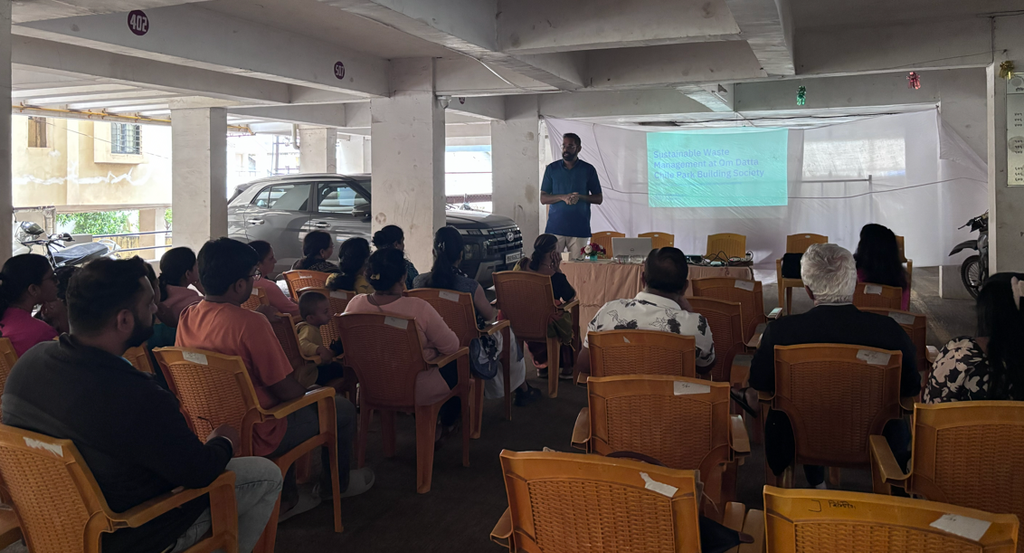
Over 20-week pilots across flatblocks and neighbourhoods, Transitions Research measured daily outputs of mixed, dry, wet, and total waste. We observed a significant spike in segregation after distributing and discussing IEC materials that illustrated the causal impacts of segregation behaviour. While response to these posters was consistently enthusiastic, behavioral changes tended to be short-lived, proving that lasting impact requires sustained intervention.
How stories resonate with citizens
Why do these ‘Journey of…’ materials work at all? First, everybody loves a story. To rearrange apparently unconnected events into a meaningful causal chain is a universal human need. Second, reimagining everyday items as cute characters invites us to reflect on our relationships with them. But I think the main reason is that these narratives create a sense of agency.
I, as a consumer facing long and opaque supply chains, might still feel powerless to decide where the things I buy come from. But the ‘Journey of…’ stories show me where I stand in the lifecycle of a consumable, and how my choices affect that item’s destiny after it leaves my home.
This boost in citizens’ sense of control emerges during community interactions around the ‘Journey of…’ posters. “I never really thought about what happens to these things after the truck collects them,” says a resident of Om Datta Chile, another flatblock in Kolhapur where we ran pilot interventions. “I never thought my mixing or not mixing had any effect,” says a resident of Kuppam, Andhra Pradesh. Granted, after such insights, citizens typically revert to invoking the tragedy of the commons: ‘I might now be willing to segregate, but unless my neighbours also segregate, and the municipality does its part, my efforts will be wasted.’
The role of incentives
Waste is the trickiest sector I’ve worked in. No single tactic, technology, or informational material will solve India’s waste problem on its own. Ultimately, I suspect the only reliable, scalable solution is the dead-simple one: financial incentives. Unless separating waste offers direct, immediate financial benefits, or non-segregation imposes inescapable penalties, segregation may never gain meaningful momentum.
But incremental change can still come from tactics that boost citizens’ knowledge, agency, ownership, and sense of community.
Among such promising nudges, I urge other practitioners to experiment with telling stories about the causal chains we play out every day with the items that enter our homes and workplaces. These stories tend to boost curiosity, empowerment, and maybe even the willingness to do one’s bit.
(Research participants’ names have been altered for privacy)
[This article is based on research led by Amita at Transitions Research between 2024-2026 on waste segregation in Kolhapur, Maharashtra and Kuppam, Andhra Pradesh, as well as Amita’s work as an independent researcher in Bangalore and Auroville. Exploratory research was conducted with 500+ households; pilot interventions were conducted with 150+ households.]