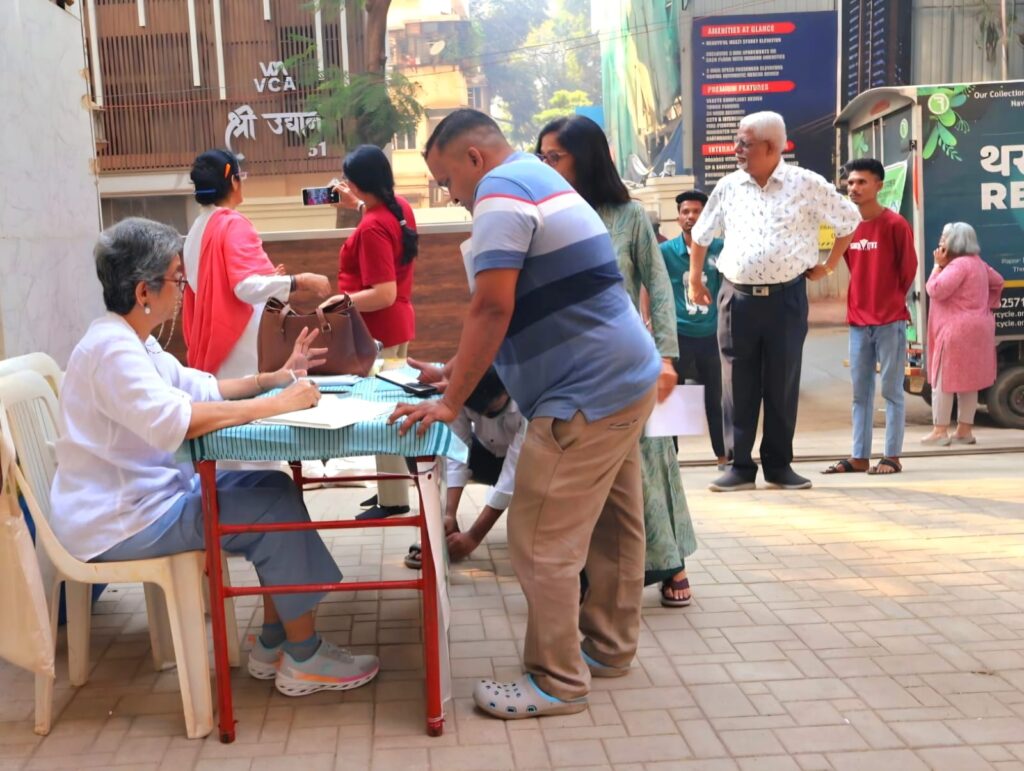
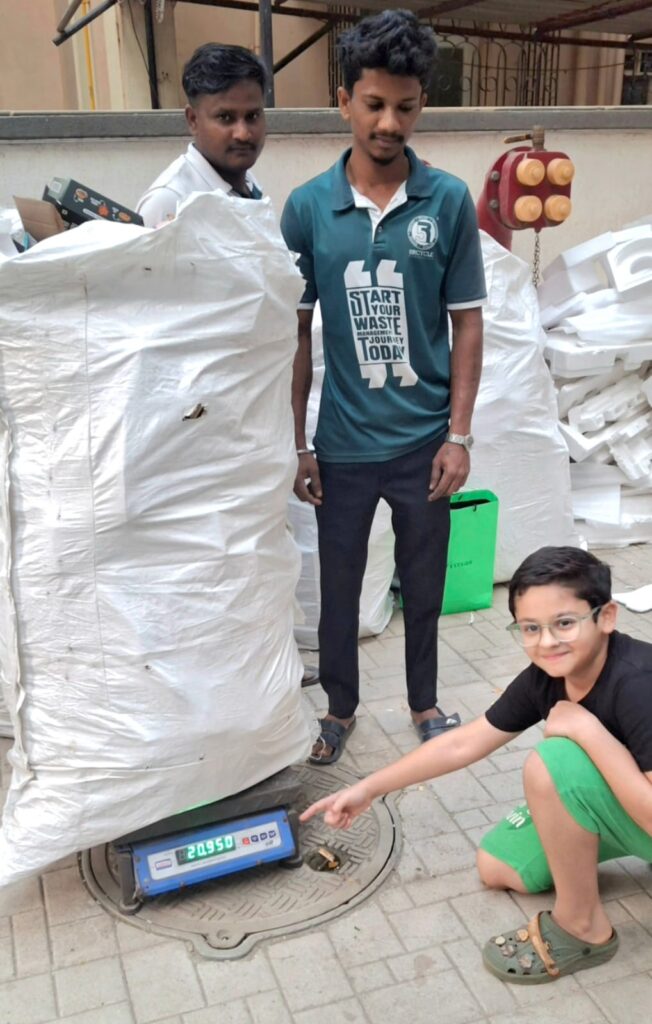
On the last Sunday of every month, a lane in Mumbai’s Shivaji Park becomes a collection point for dry waste. Residents bring paper, plastic, glass, e-waste, clothes, books and household items for recycling, reuse and upcycling. Volunteers receive, weigh and sort every donation before it is sent to the appropriate recycler or organisation.
What began with six volunteers and 450 grams of plastic has grown into a community initiative attracting participants from across Mumbai.
From Covid volunteers to community dry waste recyclers
The origins of the initiative lie in an entirely different crisis.
During the Covid-19 pandemic, residents of Madhli Galli on Dr M.B. Raut Road came together to support elderly neighbours and families who needed help with groceries, medicines and other essentials. For more than two years, volunteers worked within the neighbourhood, ensuring that vulnerable residents had someone to rely on during an uncertain time.
As the pandemic eased, we began asking what came next. The experience had shown us what a neighbourhood could achieve when people worked together. Rather than allowing that spirit of volunteering to fade away, we looked for another issue where collective action could make a tangible difference.
Waste emerged as an obvious choice. Mumbai generates more than 11,000 tonnes of dry waste every day. Around 70 per cent is collected, yet only about 15 per cent is eventually recycled. The remainder is sent to landfills despite containing enormous quantities of recoverable material. Those figures prompted a simple question: instead of blaming others, what could our own community do?
Read more: Explainer: Segregating waste manually to minimise the burden on landfills
Starting with 450 grams of dry waste
Our answer was modest. In September 2020, six volunteers gathered for a two-hour collection drive. We accepted only one category of waste: used plastic. By the end of the morning, we had collected just 450 grams.
The quantity was small, but it demonstrated that even a modest beginning could create momentum if people were willing to participate consistently. Encouraged by that first effort, we decided to continue. The collection drives became a monthly activity and residents slowly began hearing about them through conversations with neighbours, community WhatsApp groups and social media. Participation increased steadily, and so did the range of materials people wanted to recycle.
Dry waste recycling operations expand
Plastic was only the beginning. As more people joined the initiative, they began asking whether we could also accept paper, glass, metal, thermocol and electronic waste. We expanded gradually, making sure authorised recyclers were available before introducing each new category.
Reusable household items soon became part of the collections. Books, stationery, toys, electrical appliances, bedsheets and clothes in good condition found new homes instead of ending up as waste. We also began collecting mobility aids and support equipment for senior citizens so that they could continue serving someone else.
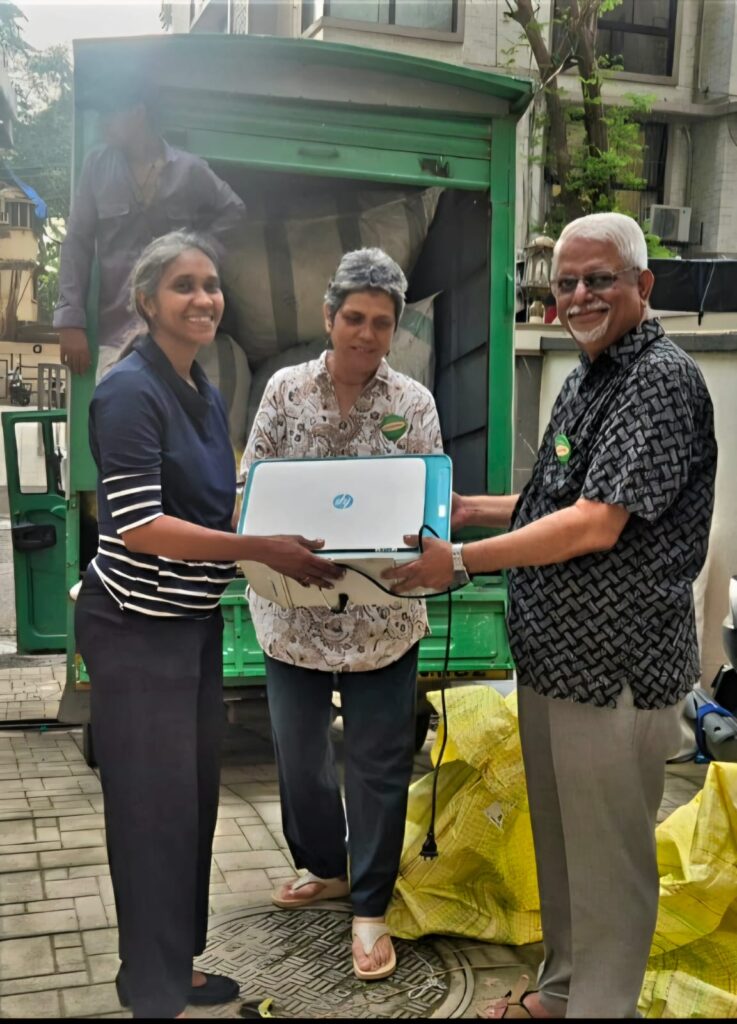
Some materials required more specialised handling. Cotton saris were collected separately and sent to an organisation that converts them into quilts, while torn clothes beyond repair were channelled to another organisation working on textile upcycling. We also collected more than 184 kilograms of dried seasonal fruit seeds, which were handed over to the authorised nursery at Maharashtra Nature Park in Dharavi for plantation.
As the initiative expanded, so did the community around it. Residents who initially came only to drop off waste returned as volunteers. Families encouraged neighbours to participate, and participation spread through community networks. What had begun with six volunteers gradually grew into a network of more than 700 donors from across Mumbai contributing seven categories of dry waste for recycling, reuse and upcycling.
By July 2026, the initiative had collected more than 32.6 tonnes of material, preventing an estimated 30.69 tonnes of carbon dioxide emissions, equivalent to planting and nurturing more than 3,000 trees.
By the numbers
- Initiative launched: September 2020
- First collection: 450 grams of used plastic
- Initial volunteers: 6
- Current community: 700+ donors from across Mumbai
- Dry waste collected (up to July 2026): Over 32.6 tonnes
- Estimated CO₂ emissions avoided: 30.69 tonnes
- Equivalent environmental benefit: About 3,070 trees
Taking the message of dry waste recycling beyond our lane
As the collections grew, we realised that gathering dry waste once a month was only one part of the solution. We also needed to change the way people thought about waste.
Over the years, we have organised awareness campaigns in more than 30 housing societies, educational institutions and community organisations across Mumbai. These sessions have covered practical aspects of dry waste segregation, recycling and responsible consumption.
Schools have played an especially encouraging role in this journey. Students from Bombay Scottish School and Balmohan Vidyamandir have undertaken projects on dry waste recycling under our guidance. We have also engaged with institutions such as Kasturba Gandhi Hospital, where discussions on waste management reached audiences beyond residential communities.
The initiative has also used occasions such as World Environment Day and Earth Day to bring residents together through activities focused on conservation and sustainable living. One memorable Earth Day visit was to Maharashtra Nature Park in Dharavi, a thriving urban forest created on what was once a garbage dumping ground.
Read more: Much of the segregated dry waste in Mumbai ends up in landfills; here’s why
Growing through partnerships
Like many community initiatives, we have benefited from partnerships with organisations that share our commitment to sustainability. Tata Power collaborated with us on campaigns promoting dry waste recycling and sustainable practices, helping us reach a wider audience.
During 2024-25, Madhli Galli Green Initiatives was selected as one of the grantees under the Kshirsagar Apte Foundation’s Mumbai Ekatra programme, which supports organisations working to improve the city. The opportunity also allowed us to present our experience at the National Centre for the Performing Arts (NCPA) in March 2025 alongside other community initiatives working across Mumbai.
Our work has also been featured on All India Radio Mumbai’s FM Rainbow and through podcasts discussing community-led environmental initiatives. Every opportunity to share our experience has introduced more people to the idea that effective waste management begins with citizens themselves.
Changing habits has not always been easy. In the beginning, many people felt waste management was solely the responsibility of the municipal corporation, while others believed they lacked the time or space to segregate waste. Rather than trying to convince everyone immediately, we focused on consistency through monthly collection drives, conversations and demonstrations. Over time, sceptics became participants, volunteers and advocates.
The next chapter in the dry waste journey
As participation continued to grow, it became clear that the monthly collection model had reached its limits. Residents from other parts of Mumbai wanted to participate, but travelling to one location on a fixed day every month was not always practical. To make the initiative more accessible and expand its reach, we decided to collaborate with a professional dry waste recycling organisation.
This month will mark the next phase of our journey under the Blue Bag Project. We will be partnering with SUN – Start Upcycling Now – a professional dry waste collection organisation with operations across Mumbai. Under the new model, the residents will be provided with a blue bag with a QR code and sealing tag. The residents are to put their dry waste in this bag, which will be collected every Thursday. The residents will be paid Rs 4/kg of dry waste collected from them.
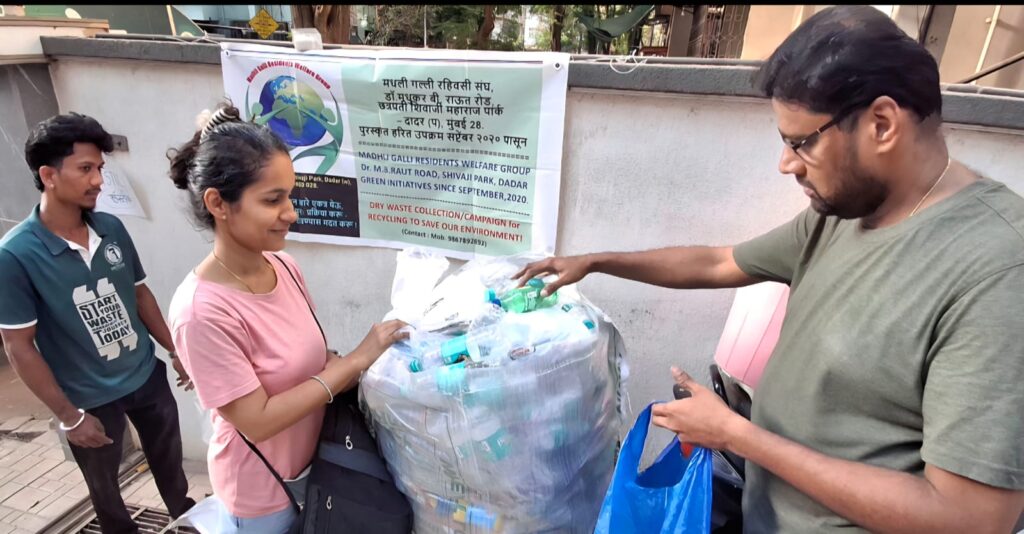
The most important change we have witnessed over the years has been in the way people think about waste. Materials that were once discarded are now segregated and reused, children grow up seeing environmental volunteering in action and conversations about sustainability have become part of everyday life.
No neighbourhood can solve a city’s waste problem on its own. However, every neighbourhood can aim to become a part of the solution.
How your neighbourhood can start a similar initiative
Our experience has taught us that community-led recycling does not require large budgets or complex infrastructure. What it does require is commitment and consistency.
Start small. Our first collection yielded just 450 grams of plastic. Every successful initiative begins somewhere.
Build a dependable volunteer team. A handful of committed people who show up regularly can accomplish far more than a large but inconsistent group.
Partner with authorised recyclers. Reliable downstream partners ensure that every material reaches the appropriate destination.
Expand gradually. Begin with one or two waste streams and add new categories only after establishing systems to handle them responsibly.
Keep engaging the community. Awareness sessions, demonstrations and conversations are just as important as collection drives. Participation grows when people understand why their efforts matter.
Be patient. Behaviour change happens slowly. Consistency, persistence and trust are built over time.
Thanks a lot for your kind consideration of our silent – but impactful community dry waste collections for recycling.
Just a slogan : “MY DRY WASTE – MY RESPONSIBILITY” can be really converted to a real passionate action like we did!
I am open to meet the CHS GROUPS / INSTITUTIONS or any ORGANISAYIONS desirous to start like what we did.
We will share our model with a presentation & demonstration followed by QA for a max 60 minutes all together!
You can reach to me addressing your email to – ravindra.waghmare@gmail.com
Happy Recycling Dry Waste!
Ravindra Waghmare: Author.