The bird of State, with blue throat!

It takes mud baths to cleanse itself and get rid of ticks. Our State’s bird, Indian Roller, is a bird-watcher's delight.

Everyone knows of the national bird, the Indian Peacock. But do you know what the State bird is? Karnataka, along with other States (Andhra Pradesh,Bihar, and Odisha) has chosen the Indian Roller.  It’s a bird that almost as beautiful as the Peacock, and as interesting too.

These birds can often be seen perched on telephone or telegraph wires, and they feed on  insects, spiders, small lizards, snakes and frogs, too.
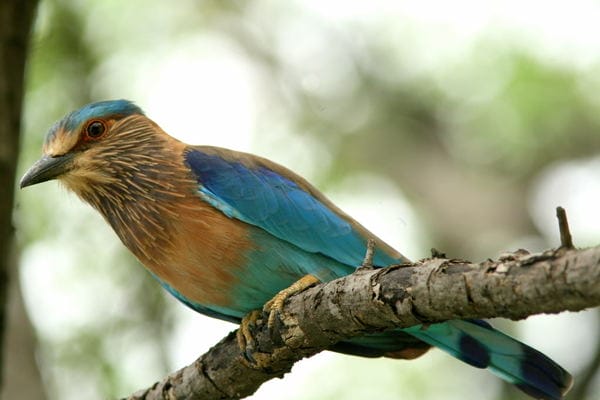
Pic: Deepa Mohan.

Contrary to the belief that birds are afraid of fire, these birds seem to know that fire attracts insects, and they can often be found swooping on insects near fire. Again, they have learnt to make use of artificial lights and feed on insects attracted to them.

This is a great way to adjust to humans and their lifestyles. My friend Naveen Toppo got this delightful shot, near the Bannerghatta Zoo, of a Roller having a mud bath, which many birds do, to cleanse themselves and get rid of ticks.
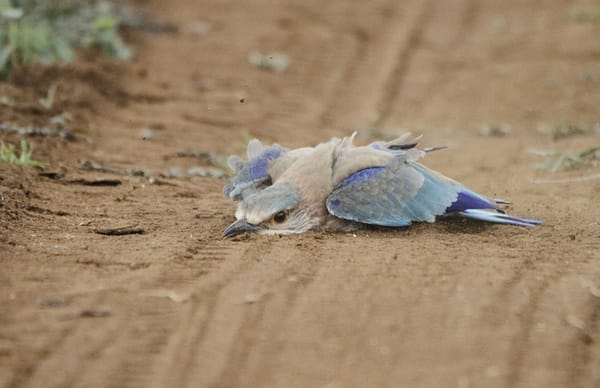
Pic: Naveen Kumar Toppo.

The bird has a beautiful aerobatic display, with the twists and turns that give this species its English name. In Karnataka, it is called the “Neel kanth,” a name associated with Shiva, who drank the Halahala poison that stayed in his throat and made it blue.

So, the next time you see a flash of bright blue in the suburbs of our city, look carefully, and you may see our State bird!

Comments:

  1. Usha Srinath says:

    Nice! Thanks for the information. Didn’t know it was the state bird. I have seen this bird many times while driving to Mysore. I thought it was called blue jay?

  2. Deepa Mohan says:

    It was, indeed, called the Blue Jay, but since that could confuse it with the American Blue Jay, the name is no longer valid.

  3. Santhosh Krishnamoorthy says:

    lovely pics and nice informative post……

  4. Deepa Mohan says:

    Thank you, Santosh 🙂

  5. Anusha says:

    awesome column Deepa… “Neelkanth” is really beautiful……… Delightful pic Naveen sir hats off 🙂 🙂 🙂

Leave a Reply

Your email address will not be published. Required fields are marked *

Similar Story

From Kuruvimedu to Besant Avenue, how Chennai breathes unequally

Ahead of the art exhibition ‘Pugai Padam’, this photo essay captures the contrasting realities of air and the lived experiences of air pollution in Chennai.

The chimneys of the NTECL Vallur Thermal Power Station, billowing smoke, loom over Kuruvimedu in Ponneri, Thiruvallur near Chennai. Wedged between the plant and its sprawling 300-acre ash pond, the hamlet lies under a blanket of kari (coal) and sambal (ash), coating its narrow streets, colourful homes, and trees. Kuruvimedu is hard to find on Google maps, just as its namesake bird. The main road leading to this place is flanked by factories and industrial complexes, its surface riddled with potholes that make every journey dangerous for motorists.  Home to mangroves, networks of canals, and fields, Kuruvimedu once buzzed with…

Similar Story

Pallikaranai’s 1-km buffer zone sparks debate on housing rights, encroachment and ecology

On World Wetland Day, Chennai's Pallikaranai marsh shows how decades of state‑sanctioned encroachment leave residents and ecology at risk.

Across Pallikaranai marshland, migratory birds can be spotted, searching for forage and water. Yet the wetland they depend on has steadily depleted. As Chennai has grown in an amoeba-like manner, ebbing with the promise of ‘development,’ the marsh has borne the brunt. In the 1990s, the marsh covered 2,450 hectares, nearly 70% of its original size. Today, barely 500 hectares remain. In recent years, the marshland has often entered public discourse. In September 2025, Chennai Metropolitan Development Authority (CMDA), acting on an order from the southern bench of the National Green Tribunal, halted planning permission for development within the Pallikaranai…