The bird of State, with blue throat!

It takes mud baths to cleanse itself and get rid of ticks. Our State’s bird, Indian Roller, is a bird-watcher's delight.

Everyone knows of the national bird, the Indian Peacock. But do you know what the State bird is? Karnataka, along with other States (Andhra Pradesh,Bihar, and Odisha) has chosen the Indian Roller.  It’s a bird that almost as beautiful as the Peacock, and as interesting too.

These birds can often be seen perched on telephone or telegraph wires, and they feed on  insects, spiders, small lizards, snakes and frogs, too.
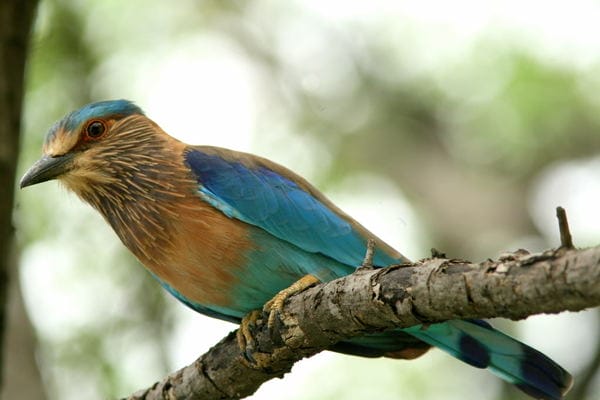
Pic: Deepa Mohan.

Contrary to the belief that birds are afraid of fire, these birds seem to know that fire attracts insects, and they can often be found swooping on insects near fire. Again, they have learnt to make use of artificial lights and feed on insects attracted to them.

This is a great way to adjust to humans and their lifestyles. My friend Naveen Toppo got this delightful shot, near the Bannerghatta Zoo, of a Roller having a mud bath, which many birds do, to cleanse themselves and get rid of ticks.
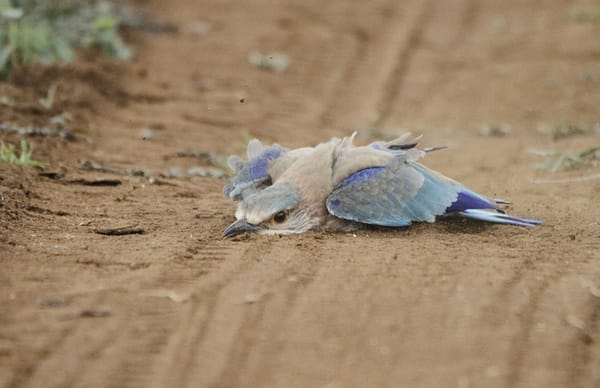
Pic: Naveen Kumar Toppo.

The bird has a beautiful aerobatic display, with the twists and turns that give this species its English name. In Karnataka, it is called the “Neel kanth,” a name associated with Shiva, who drank the Halahala poison that stayed in his throat and made it blue.

So, the next time you see a flash of bright blue in the suburbs of our city, look carefully, and you may see our State bird!

Comments:

  1. Usha Srinath says:

    Nice! Thanks for the information. Didn’t know it was the state bird. I have seen this bird many times while driving to Mysore. I thought it was called blue jay?

  2. Deepa Mohan says:

    It was, indeed, called the Blue Jay, but since that could confuse it with the American Blue Jay, the name is no longer valid.

  3. Santhosh Krishnamoorthy says:

    lovely pics and nice informative post……

  4. Deepa Mohan says:

    Thank you, Santosh 🙂

  5. Anusha says:

    awesome column Deepa… “Neelkanth” is really beautiful……… Delightful pic Naveen sir hats off 🙂 🙂 🙂

Leave a Reply

Your email address will not be published. Required fields are marked *

Similar Story

Notes from the field: Why Begur Lake is losing its waterbirds

71% of waterbirds at Begur Lake are declining. A visit to one of Bengaluru’s rapidly deteriorating lakes shows what's causing the collapse.

During the Open City biodiversity datajam held in December 2025, our group examined the ecological trends around Bengaluru’s lakes. Our analysis suggests a majority of waterbirds are declining across the city's lakes. Earlier, we addressed crucial questions on how migrant and resident waterbirds are surviving across 14 of Bengaluru’s lakes, how the shape of the lakes influence microhabitats, and how a scoring system can be used to record the decline in lake quality and bird populations. The last of our four-part series turns its attention to an individual site. As part of this study of waterbirds in 14 city lakes,…

Similar Story

Bengaluru lakes are changing, and birds are paying the price

From disappearing reedbeds to altered shores, here is why some of the city's lakes are thriving while others face ecological collapse.

While bird detection trends over the years clearly point to the decline of Bengaluru’s shoreline and vegetated-edge habitats, numbers alone tell only part of the story. In Part 3 of this four-part series on the state of the city's waterbirds, we have used a scoring system to understand how stressed the lakes and the microhabitats within the lake are, based on the bird diversity they support. We explore how lake shape, permanent inundation and shifts in citizen-led management might explain why some lakes may thrive as wetlands while others collapse.  For instance, at Kasavanahalli, the Pied Kingfisher and the Coot…