Citizen Matters and India Together co-founder Subramaniam (Subbu) Vincent has won the John S Knight (JSK) Journalism Fellowship at Stanford University for 2015-16.
He is one among eight awardees who have been awarded the fellowship to pursue proposals for journalism innovation at Stanford University during the 2015-16 academic year. The other fellows are from Ukraine, Venezuela, Kenya, Germany, China, Australia, and Brazil.
“I am thrilled and excited by receiving this award,” says Subramaniam Vincent. Explaining the project on which he will work on during the fellowship, he says: “Around the world, city newsrooms are often using reporters to both track city issues and civic engagement as well as report on it. This is not efficient, because tracking needs to happen all the time even when reporting is not going on. Otherwise newsrooms go out of sync very quickly when they are short of staff or when reporters change roles, etc. And the best of technologies and design are available today. I want to find a way to help newsrooms track issues better and seamlessly.”
Reproduced below, with permission, is the full news posting released by the JSK program at Stanford University on April 20th.
International JSK Journalism Fellows named for 2015-16
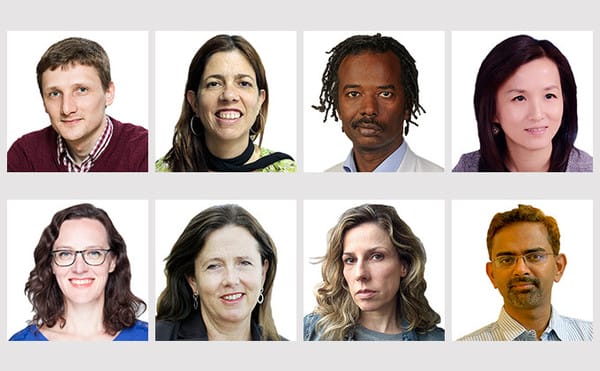
Oleksandr Akymenko, Nathalie Alvaray, Arif Elsaui, Ling Huawei, Astrid Maier, Jacqueline Park, Daniela Pinheiro, Subramaniam Vincent Pics: JSK Fellowships, Stanford University.
Eight international journalists have been awarded John S. Knight Journalism Fellowships to pursue proposals for journalism innovation at Stanford during the 2015-16 academic year.
They will develop a range of proposals for meeting journalism’s challenges. These include engaging the emerging middle class in Australia, new business models to sustain independent media, encouraging innovation in media, supporting media working under adverse political and economic conditions and leveraging technology to empower women to lead in newsrooms.
“We’re really excited about this group of international fellows,” said JSK Director James Bettinger. “We think they’re going to have a major impact on journalism in their home countries.”
The JSK program fosters journalistic innovation, entrepreneurship and leadership. Each year, it gives 20 outstanding individuals from around the world the resources to pursue and test their ideas for improving the quality of news and information reaching the public. Twelve U.S. fellows will be announced in late April.
The international fellows selected were among 436 applicants from 88 countries. The JSK Fellowships directors made the final selections with additional research by the International Center for Journalists. Financial support for international fellows comes from sources that
include the John S. and James L. Knight Foundation, the Lyle and Corrine Nelson International Journalism Fund, the Enlight Foundation and Yahoo! Inc. The 2015-16 academic term will be the 50th year of journalism fellowships at Stanford.
The 2015-16 International John S. Knight Journalism Fellows
Oleksandr Akymenko, publisher, platfor.ma, Kyiv, Ukraine (Lyle and Corrine Nelson International Fellow)
Journalism challenge: How can we implement new business models to sustain independent media in developing markets?
Nathalie Alvaray, director of content, runrun.es, Caracas, Venezuela (Yahoo! International Fellow)
Journalism challenge: How can we develop a journalist-centered innovation model to promote entrepreneurship and sustainable new media under adverse political and economic conditions?
Arif Elsaui, East African correspondent, Anadolu News Agency, Nairobi, Kenya
Journalism challenge: How can professional journalism be conducted in regimes with deterrent political, security and socio-economic conditions?
Ling Huawei, managing editor, Caixin Weekly, Beijing China (Enlight Foundation Fellow)
Journalism challenge: How can we structure news organizations to support continual innovation and restore the influence of professional media in the Internet Age?
Astrid Maier, chief technology correspondent, manager magazin, Hamburg, Germany
Journalism challenge: How can we use technology to empower women in newsrooms to take on leadership positions?
Jacqueline Park, executive director, The Walkley Foundation, Sydney, Australia
Journalism challenge: How can we create a program specifically tailored to journalists and media in Australia to encourage investment in new media and embed innovation in journalism?
Daniela Pinheiro, senior reporter, Revista Piauí, Rio de Janeiro, Brazil (Knight Foundation Latin American Fellow)
Journalism challenge: How can digital media engage Brazil’s emerging middle class with the news?
Subramaniam Vincent, managing director/editor-in-chief, Oorvani Media, Bangalore, India
Journalism challenge: How can city newsrooms systematically track and capture data from complex issues independent of reporters’ efforts?
Related Articles
Citizen Matters wins best e-news media award
Citizen Matters wins Namma Bengaluru Award
What another award for Citizen Matters means to me
Vaishnavi Vittal wins Laadli award for Citizen Matters article
Citizen Matters wins Manthan award in E-news and Journalism category for South Asia
A well deserved recognition. Congratulations.