Smart city spending: Where is Chennai putting its money?

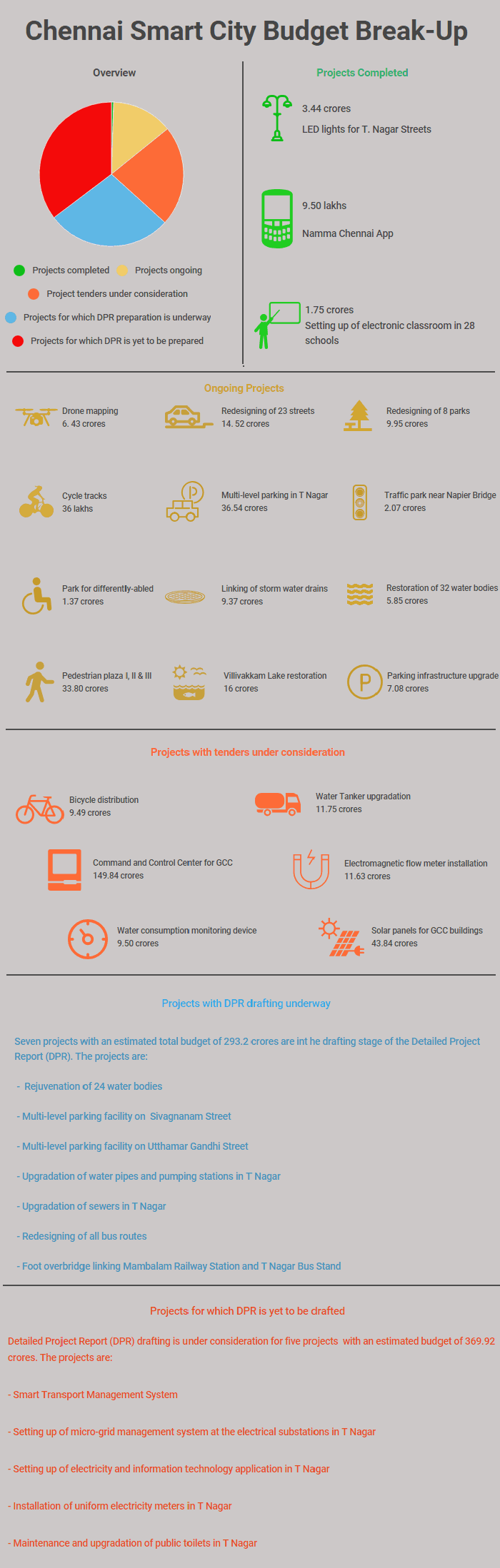
The Corporation of Chennai recently shared the budget break-up for the Chennai Smart City programme. With an allocation of more than Rs 36 crore, the multi-level parking in T Nagar is the most expensive among ongoing projects. Any guesses which are the others and where they stand?

The Union government launched the Smart Cities programme on June 25, 2015 with the objective to “promote sustainable and inclusive cities that provide core infrastructure and give a decent quality of life to its citizens, a clean and sustainable environment and application of ‘Smart’ Solutions”.

Chennai was one of the 20 cities selected in Round 1 of the smart cities mission in January 2016. Chennai’s smart city projects are funded by a Rs 500-crore allocation from the Centre and an additional Rs 500 crore from the state.

Chennai Smart City Projects

But for all the hype, the Corporation of Chennai has completed only three projects since the launch of the mission. The lax approach has seen Chennai ranked 37 out of 87 cities according to a release from the Union Ministry of Housing and Urban Affairs.

While the Minister for Municipal Administration, S.P. Velumani set a deadline for the launch of all projects in the city by March 31, many projects are yet to take off four months on.

So which are the completed, ongoing and proposed projects for Chennai under the Smart Cities Scheme? The graphic below throws some light on the progress of the mission.

However, the question is this. With 12 ongoing projects, six projects having tenders under consideration, seven projects in respect of which preparation of Detailed Project Reports (DPR) is underway, and a further five projects for which DPR is yet to be prepared, will Chennai meet the 2020 deadline for the completion of works under the Smart City Mission?

Here’s a quick look at where things stand:
Source: Corporation of Chennai

Comments:

  1. Gobalakrishnan Kuppanna says:

    good article. very detailed and presenting facts to trigger right questions.

Leave a Reply

Your email address will not be published. Required fields are marked *

Similar Story

Shaping Bengaluru: “Citizens can add real capacity through local knowledge, feedback”

We spoke to authors of the Janaagraha report, ‘Shaping Urban India’ to understand its recommendations in the context of Bengaluru.

“The road is broken, buses are overcrowded, traffic disrupts daily life, garbage piles up on the streets”—these are everyday complaints of citizens across Indian cities. In Bengaluru, these issues only seem to be worsening with passing time. Bengaluru’s built-up area grew by 85.19% between 2001 and 2020, resulting in commuters losing 168 hours (one week) annually to traffic congestion. As the city grows rapidly, governance systems, data frameworks, and citizen participation have failed to keep pace with its increasing complexity. What would it take to bridge this gap?  A report by Janaagraha, a non-profit working to improve the quality of…

Similar Story

India Civic Summit 2026: Spotlight on changemakers transforming cities

From waste management to urban forests, the Indian Civic Summit spotlights residents that are driving change in their cities

Cities are the heart of the Indian growth story. Vibrant. Crowded. Diverse. Multidimensional. And yet, as we look around us, we find that they are ridden with problems and face multiple threats to their ecology, habitats and human lives. The crises in our cities make it hard to imagine an urban future that is truly inclusive, sustainable and marked by high liveability standards. But as the oft-cited quote from anthropologist Margaret Mead goes, "Never doubt that a small group of thoughtful, committed, citizens can change the world. Indeed, it is the only thing that ever has."  That is perhaps the…