The Shakti Yojane has recently crossed 500 crore tickets in the two years since it was launched by the Karnataka government in June 2023. The scheme offers free rides to women (including transwomen) in ordinary public buses, as long as they have a valid ID. Despite the milestone, the Shakti scheme has been at the forefront of political debate in the state. Opposition parties have labelled it a ‘scam’ that “betrays the people.” A common argument is that male passengers are disproportionately burdened by Shakti, as they have to pay for tickets while women’s travel is fully subsidised.
This criticism is part of the BJP’s broader campaign against what it calls ‘revdi culture,’ the practice of offering freebies. Before the 2023 Karnataka assembly elections, Prime Minister Modi had warned that schemes like Shakti would “submerge the state in debt.” Even the Bangalore Metropolitan Transport Corporation (BMTC), in its 2023–24 report, partly blamed the scheme for its financial losses.
However, has the Shakti scheme increased Karnataka’s debt and caused significant losses to the Bengaluru Metropolitan Transport Corporation (BMTC) compared to the period immediately preceding its launch? A financial analysis of the BMTC, which provides intra-city buses in Bengaluru — where the scheme has had the greatest impact — proves otherwise.
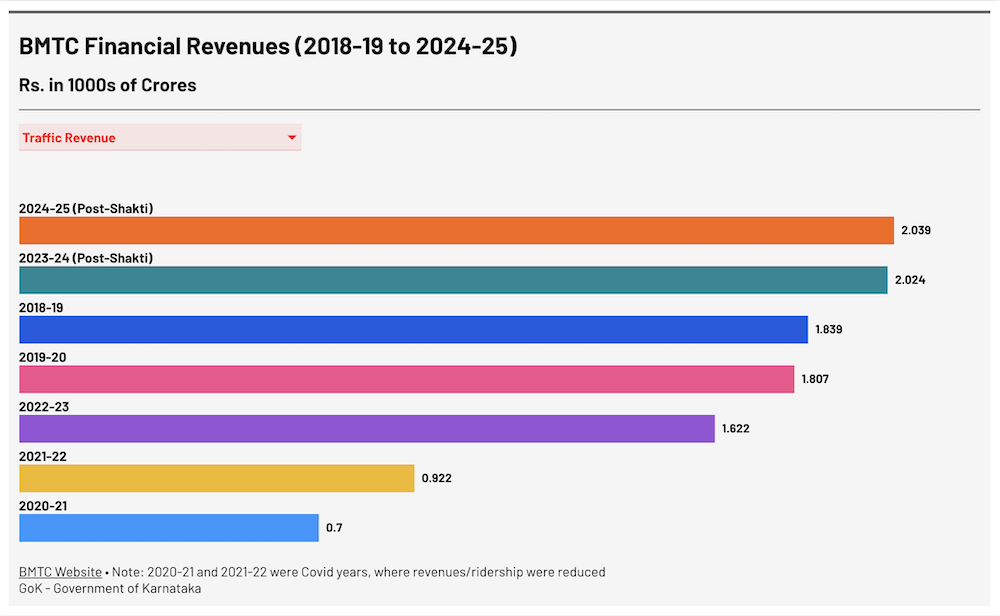
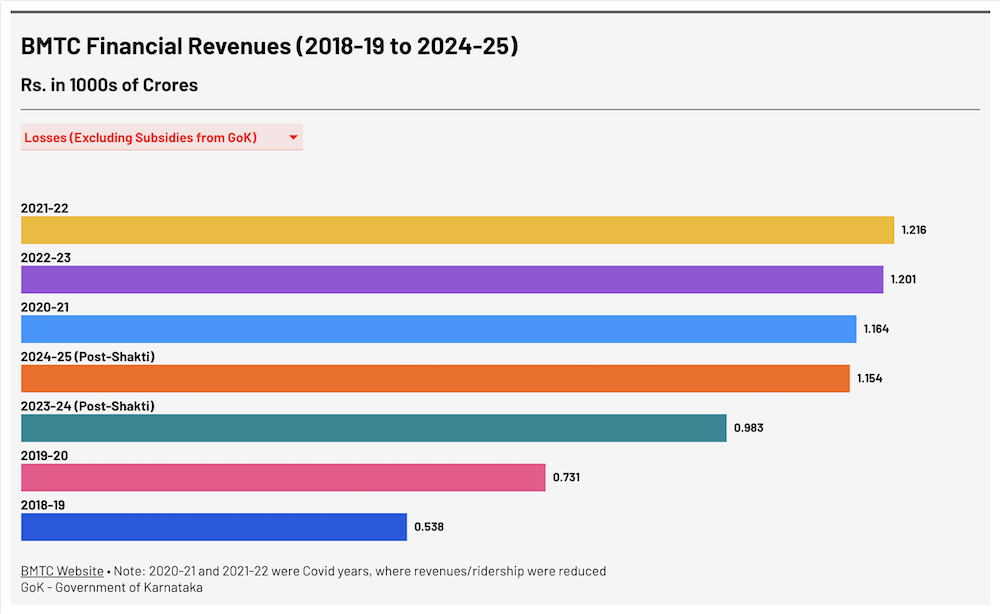
The analysis found that after excluding financial assistance from the Karnataka government, BMTC continues to report losses similar to those it incurred between 2020 and 2023, before the introduction of the Shakti scheme. In fact, traffic revenue and passenger ridership have returned to pre-COVID levels since the scheme was launched.
Rather than focusing solely on the financial performance of public transport operators (albeit important), there is a pressing need to shift public discourse to make buses more accessible and affordable, a challenge Bengaluru continues to face.
Read more: Bus fare hike: Why we need alternative measures to make BMTC sustainable
What do BMTC finances reveal?
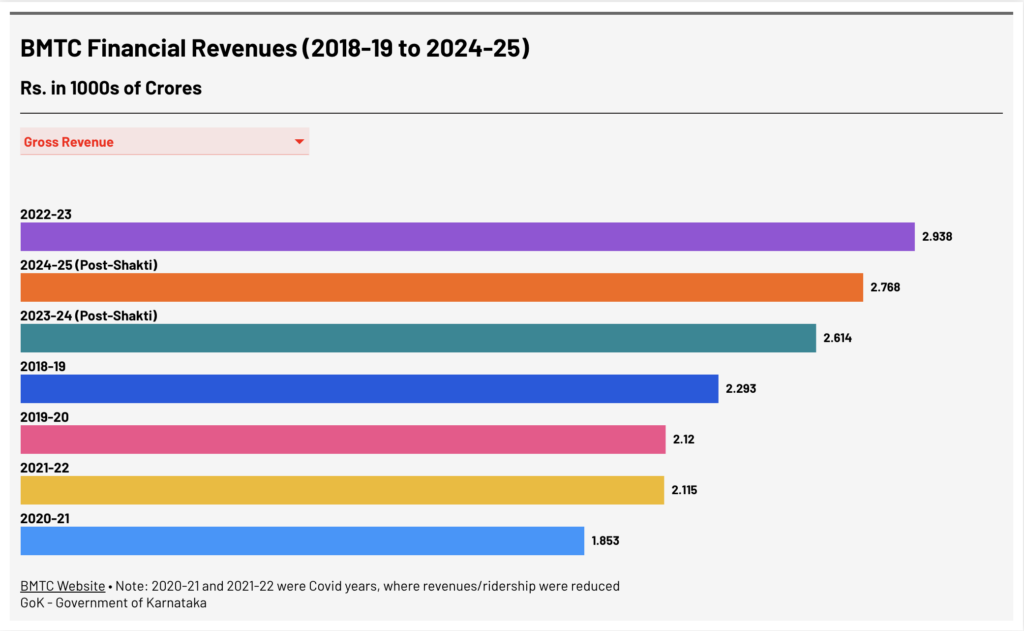
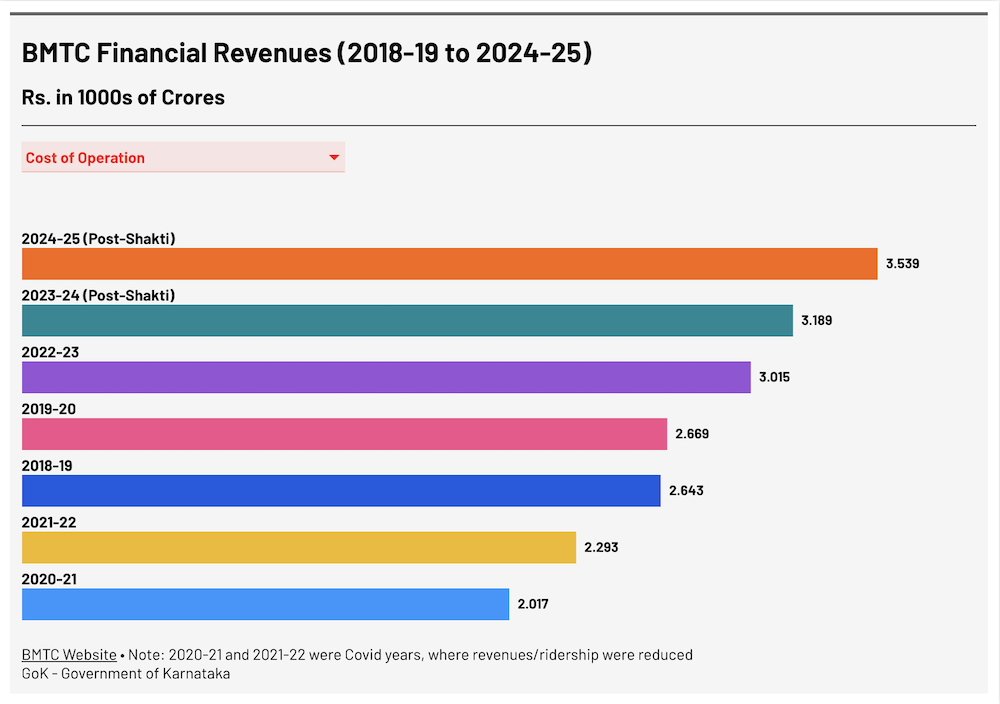
Since 2018, BMTC recorded its highest gross revenue in 2022–23 (before the Shakti scheme), at ₹2,938 crore. This shows that BMTC bounced back well after the COVID years. At first glance, it may seem like the Shakti scheme led to financial losses, but a deeper look tells a different story.
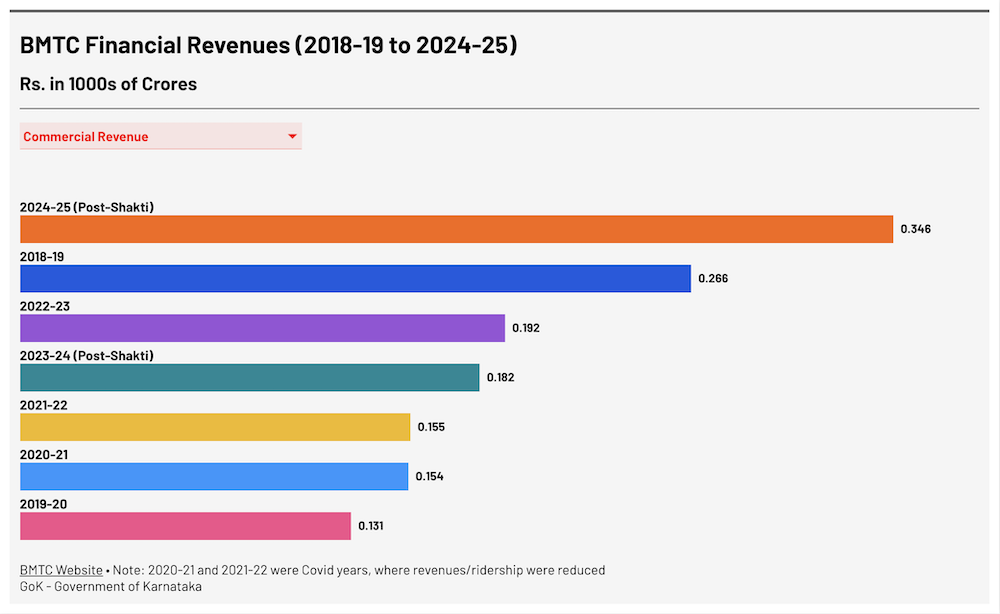
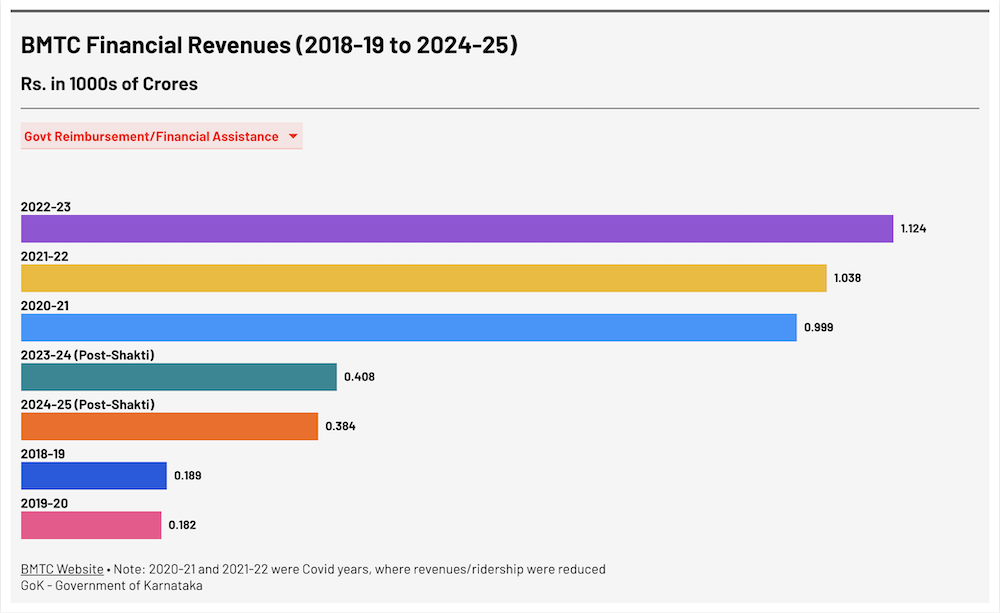
During the years when the Shakti scheme has been active, BMTC’s traffic revenue (money earned from actual bus operations) has been the highest since 2018. To understand the full financial picture, it is important to consider government reimbursements, which are funds given by the Karnataka government to cover subsidised travel for students, senior citizens, and now, Shakti scheme users:
- In the COVID years: FY 2020–21 and FY 2021–22, BMTC received about ₹1,000 crore each year in government support.
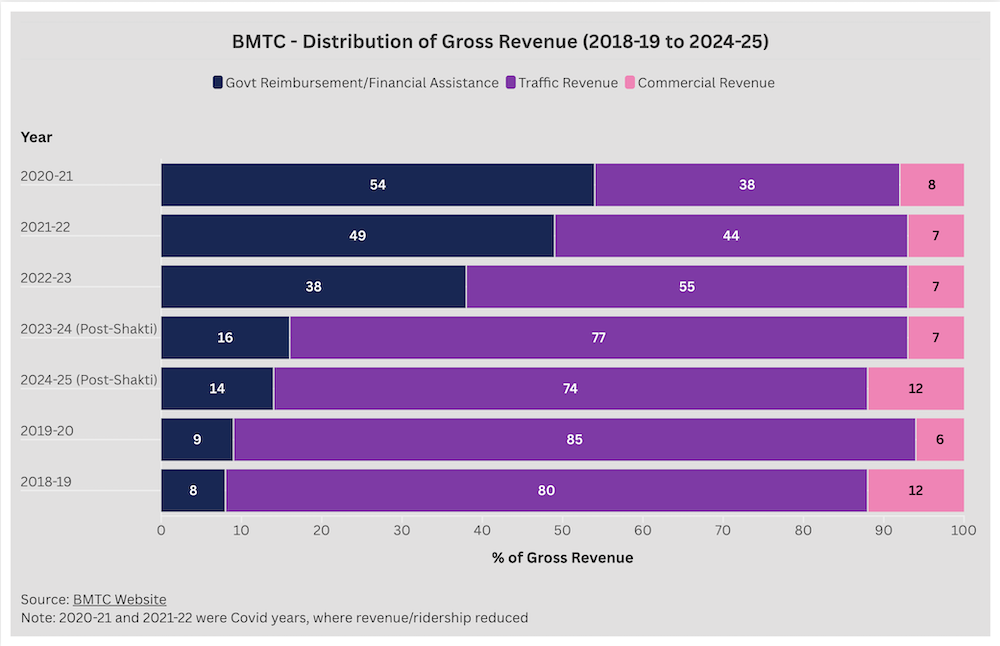
- In FY 2022–23, 40% of BMTC’s revenue came from state reimbursements.
- In the same financial year, BMTC recorded its highest gross earnings, but also received the most government assistance.
- Compared to FY 2022–23, during the Shakti years (FY 2023–24 and FY 2024–25), just 16% and 14% came from state reimbursements.
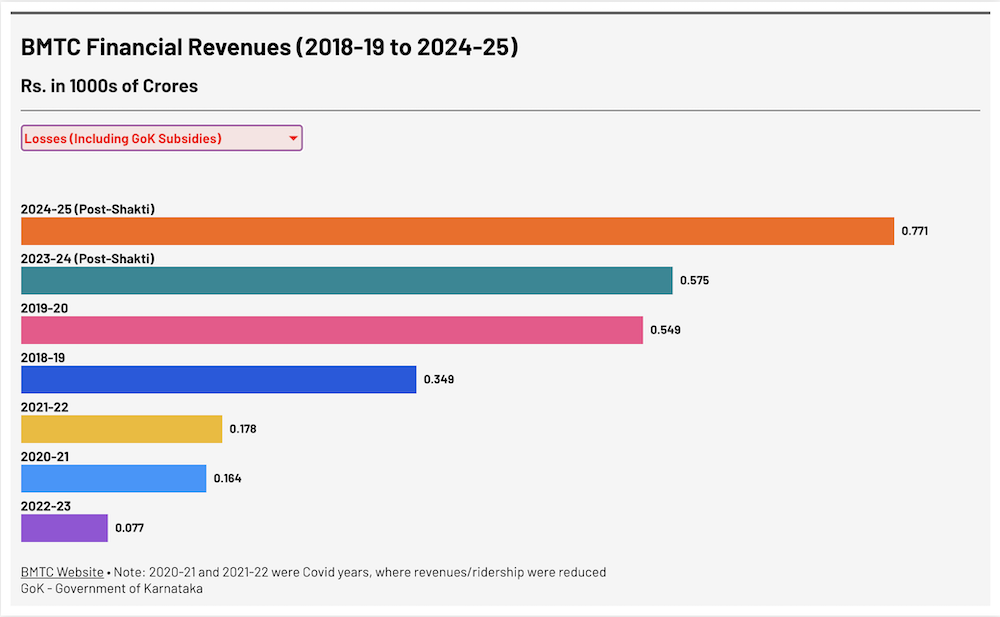
When we subtract government support from total revenue (to calculate net losses), the Shakti scheme years actually show the lowest net losses since COVID began. This means the free bus travel scheme hasn’t worsened BMTC’s financial health, as some critics have suggested.
A need for more expansive discourse on accessible public transport
In January 2025, all state-run buses saw a 15% price increase, and this included fares in BMTC buses. The state government has said that this was necessary for the smooth running of bus services, simultaneously justifying how the Shakti scheme has generated over ₹300 crores in GST for the state in 2023-24 alone. Transport Minister Ramalinga Reddy, in August 2025, cited the Sustainable Mobility Network report (2025) to show how women’s employment rose 23% in Bengaluru due to this scheme. Clearly, most of the discussions around the Shakti Yojane have been around justifying its financial outputs.
While that’s logical, there is also a need for a deeper understanding of the BMTC’s functions beyond its finances. Measuring the increase in ridership under the Shakti scheme does not fully capture how it has improved women’s access to the city. For instance, some benefits go beyond easier travel and better jobs, such as creating a ‘new sense of self.’ Women are able to plan leisure travel with friends, visit their children in hostels and reduce dependency on others for their travels overall.
Thus, one’s social, cultural and economic relationship with the city depends on how accessible, cheap and reliable commuters consider public transport. From this perspective, there are a host of other challenges faced by the BMTC that currently need to be addressed.
Going beyond the Shakti scheme: Challenges for BMTC
One of these is the efficiency of the bus service. Commuters in Bengaluru often complain that buses are late and/or overcrowded. This is exemplified by a 2024 survey conducted by the Comptroller and Auditor General (CAG) of India, which revealed that longer travel times and infrequent services were major reasons not to opt for BMTC bus travel.
The Karnataka government attributes the low frequency of buses to practical difficulties, noting that peripheral regions may have only one scheduled bus while central areas see more regular bus services. However, the CAG rejects this claim because over 64% of the BMTC’s buses only operate on one schedule. Moreover, compared to 2014–15, the BMTC has been operating almost 25% fewer routes and covering about 20% fewer ‘effective kilometres’ in 2023–2024.
An OMI Foundation study from 2024 reveals that one of the major factors behind taking public buses in Bengaluru has been its relative affordability. BMTC claims that traffic revenue is its highest source of income, and ridership has not dropped significantly since ticket prices increased in January 2025. However, this steady ridership is less about service quality and more about the lack of affordable alternatives, since many commuters have no choice but to pay higher fares.
With around 40 lakh people relying on BMTC buses daily for work and education, the fare hike has hit low-income groups especially hard. To reduce this burden, the CAG report suggests BMTC could improve its financial health by generating revenue from unused government land.
In terms of accessibility, too, while Shakti has had a powerful impact on women commuters, the BMTC is lagging in implementing other measures. Only 20% of its intra-city fleet is fully accessible for wheelchair users, while the Whitefield Rising’s civic audit from Mahadevapura and Whitefield reveals that two-thirds of bus shelters do not have adequate infrastructure, inhibiting easy travel during heavy rains and high heat, for example.
So, contrary to common belief, the Shakti scheme in Karnataka has not put undue burden on the BMTC’s finances. Knowing this, there is a need to expand discourse around public bus services in Bengaluru that are more in tune with addressing commuters’ grievances.
Suggested improvements for BMTC services
- Increasing the frequency and number of buses: The BMTC was profitable just a decade ago, a time when the buses carried more passengers daily than today. There is a need to scale up the number of buses and their schedules per route.
- Improved information for travellers: Provide electronic boards with accurate real-time bus timings, as well as a map of every bus and their estimated arrivals at every bus station.
- Maximise fleet utilisation: Fleet utilisation has hovered around 85% since 2018. Repair and upgradation of these buses would be cheaper than buying new ones.
It’s very useful to analyze the Financials to be able to put critics to rest. Is it possible to look at:
– Govt budget and the impact of giving to this scheme on its overall budget?
– A cost – benefit analysis showing some factors that have positively changed as a direct result.
– Does this analysis mean that the BMTC did better financially after the scheme launched, or the scheme had no positive or negative impact compared to earlier. It would be good to know this in simple terms.
Thank you.
I don’t think BMTC had done financially better. The comparison should have been based on the fares which was there earlier. After raising the fare if BMTC is at 2018 levels it essentially means the increase in fares on Men commuters has contributed a lot to the reduction in losses and not the government.
First get the bus users to stand in orderly queues at bus stop. the goddamn women elbow us older ppl quite forcefully. make bus stops have queue railings and conductors and drivers shd co-operate to bring this system. very irritating that bus stops are treated as auto and taxi idling areas.
I think it is a convoluted analysis. Losses remains the same justification is because of increased prices which the male counterparts are paying. If analysed from a family standpoint the scheme has not helped but burdened actual male users. Another missing analysis is the portion of revenue coming from Vajra series which will be higher than the normal buses. So this scheme is just partial. If the revenue was used to bring in more buses, it would have helped all users. This is also a all state scheme. So analysing BTMC only is a wrong data set.
there is no discussion or consideration about the fair pre Covid and now (to expensive for the male passangers).
Pls don’t address this schemes as freebies, it’s the previlage for women’s. Not only karnataka has introduced this,even before many of the neighbouring states have this scheme but no one said or opposed that it’s losses for state revenue, those who oppose this also better keep in mind that all women are not financially independent and not affordable,may be keeping in mind all these points present govt has taken measures to empower women
This is a completely misleading and biased article intended at deflecting the real problem about this freebie, that is, gender inequality and discrimination against men at a time when society and women lecture about gender equality everywhere. But when it comes to getting freebies and alimony, women have no problem with discriminatory laws against men. Those who support this gender discrimination against men should answer these questions 1) Why is this scheme only for women? Are there no men who are poor and deserving of a free ride? 2) Are all women poor and cannot afford a bus ticket? We know that the answer is negative. Then why give free bus rides to women who can easily afford bus tickets? 3) How can this article claim that men aren’t unfairly treated by making us pay while women get free rides? why should men pay for free rides of women? what kind of logic and justice is this? 4) Should poor men pay for wealthy women’s free rides? 5) Should men pay and stand in the buses while women get to sit with free rides? Is this justice? 6) Just reverse the genders and see what an outrage would be there if men had got free rides and women had to pay for that. I think our society has just gone insane and insensitive.
So what next according to the author? free metro, free trains, free flights, free everything for women but men have to pay 1000 times more that fare? My message to the author: Stop supporting and defending the indefensible. You cannot fool all the people all the time.
If the Government has Reimbursed the Amount for free Shakti Scheme, then where did the money come from? The Tax Payers paid for the Shakti Scheme. It’s not The CONGRESS PARTY THAT PAID FROM ITS POCKET.
on transport, one big issue everyone misses is what is the allowed capacity of buses as per RTO. I had filed an RTI, it states that the gangway can allow standing of passenger with the formula of distance of gangway x 1.84. so most city buses are of 6 meters lenght. so total passenger carrying capacity is around 60.
but most buses run with more than 60 passengers. this reduces life of bus and road. it is better to invest on getting more buses then giving freebies to all ladies.
freebies should be given only to handicapped and old people who have no means to earn. by giving freebies to all, people will become entitled.
this is pure slavery culture, where the govt of the day is trying to create dumb followers who will vote
A laughable analysis.Was the financial assistance before government going in for acquiring/ modernizing the fleet. Radio silence on that. The author himself says more money is needed for additional buses and why did the money for this stop? The answer is clear as daylight. but, what takes the cake is 300 cr GST gain due to Shakti scheme.Neither the minister cared to explain how nor the author has anything to add. If this was a smart government they would have either designated specific buses for Shakti or given smart cards to women who really deserve it. Thankfully this scheme ends with the rickety buses and the virus hasnt spread to ac buses.Yes, this scheme disproportionately hurts men.
Why bring “BJP” here? It’s clear that this is appeasement. Who do you think is covering for the free tickets? If analyzed from a family standpoint the scheme has burdened actual male users. Why is the revenue coming from Vajra buses missing?
You know this is the reason people do not like people like you. They see through you.