Indian laws currently don’t recognise gig workers either as organised or unorganised workers. While organised workers are protected by their agreements, unorganised workers like wage labourers, at least theoretically, can access some benefits under the Unorganised Workers’ Social Security Act, 2008.
The exclusion of one of the most conspicuous types of workers today from both these categories seem to contribute to the invisibilisation of their work.
In Part 1 of this series, we saw how platform workers in Hyderabad become more vulnerable during extreme rains and flash floods. In this part, we explore what protections are available to them under labour laws.
New central law defines platform workers but offers little protection
The Code on Social Security is the first piece of legislation to formally recognise ‘platform workers’. The Code, enacted in 2020, is expected to replace various social security legislations, including the Unorganised Workers’ Social Security Act. Clause 2 of the Code, however, defines platform work as a “work arrangement outside of the traditional employer-employee relationship.”
This falls in line with how platforms see workers: not as their employees but as ‘partners’ or ‘contractors’, wherein the two parties enter into ‘partnership agreements’ rather than formal employer-employee agreements. However, the Code has provisions to constitute a National Social Security Board for the welfare of gig and platform workers.
In 2019, the Indian Federation of App-based Transport Workers (IFAT) filed a petition with the Supreme Court arguing that ‘partnership agreements’ between the platforms and workers violate Articles 14 (Equality before law), 21(Protection of life and personal liberty) and 23 (Prohibition of traffic in human beings and forced labour) of the Constitution of India. Delay in implementing the Social Security Code, that recognises platform workers, violates workers’ rights under these Articles, the petition added.
Hence, the petition urges that platform workers be categorised as unorganised workers/wage workers under the Unorganised Workers’ Social Security Act. Or, to cover workers under existing social security laws since their relationship with the aggregators is of employee and employer.
Interestingly, the government has not yet included gig and platform workers in the Periodic Labour Force Survey (PLFS). In the Parliament session of August 2025 the government also clarified that it is not considering doing so.
No real benefits yet from e-Shram registration: Workers’ union
Since 2024, the union government has been pushing platform workers to register on its e-Shram portal. The portal is aimed at building a national database of unorganised workers and to extend them health benefits under the Ayushman Bharat-Pradhan Mantri Jan Arogya Yojana.
Read more: E-shram report card: Workers complain of lack of information and interest from city agencies
But has this translated into real change? “Most workers registered, but they still don’t see actual benefits or social security coverage flowing from it,” Shaik Salauddin, Co-Founder and National General Secretary of IFAT and Founder President of the Telangana Gig and Platform Workers Union (TGPWU), said. “At TGPWU, we have helped more than 40,000 workers register on e-Shram through free camps. We continue to push the government to connect this database with real entitlements like health coverage and accident insurance. Without that, it remains just a card with no value.”
Telangana’s Bill has some strong provisions to protect workers
The Telangana Gig and Platform Workers’ (Registration, Social Security and Welfare) Bill, 2025, has provisions for social security and regulation of work in the sector. The Bill was circulated this April for comments. Like most similar legislations in other states, its provisions include:
- a Welfare Board that will oversee the implementation of the law
- dispersal of social security schemes and assignment of unique IDs to workers. This will be based on workers’ self-registration, subject to a minimum number of their transactions with a platform per quarter. Aggregators too have to register with the Board.
- a Welfare Fund Fee that the state government will levy on platforms, which will be 1–2% of their payout to workers in each transaction. This, along with other funds including state/central grants and donations, will make up the Welfare Fund. To this end, the Bill also proposes a Welfare Fund Fee Verification System (WFFVS) to map platforms’ transactions.
- appointment of a Grievance Redressal Officer and an appellate authority to address workers’ complaints related to the Bill’s provisions
The Bill also has provisions relating to the functioning of aggregators and how they treat workers:
- Section 12 mandates aggregators to disclose to the worker how they can seek information on the app’s systems that impact their working conditions, such as earnings and customer feedback. Aggregators should provide information in English as well as regional languages.
Currently, the apps infamously function with their opaque ‘blackbox’ algorithms that command workers’ fares and earnings.
The opaqueness is intensified by tactics like ‘gamification’ of workers’ tasks. That is, adding bonuses and incentives when the worker meets set ‘goals’ as if in a game. “There is the usual delivery fee per order, but if I complete 50 orders in a single day, they credit an extra Rs 800,” AK*, a delivery worker with Swiggy Instamart, said. “Similarly, if we are at the dark store to deliver orders between 6 am to 12 pm, and then between 6 pm and 12 am, we get extra Rs 400. This helps me cover the fuel cost.” As explained in Part 1 of this series, platforms apply gamification to workers’ health insurance too.
Read more: How can one ensure fair rights for workers in the gig economy?
Luca Perrig, researcher at the University of St. Gallen, Switzerland, who studies gig work, argues that such tactics makes aggregators “depart from their ideal role of mere intermediaries in order to facilitate transactions” between customers and the delivery person. Rather, such practices help platforms “manufacture consent” of the workers to accept more and more orders. Luca argues: “The attainment of goals to earn bonuses is displayed [on their dashboard continuously] in order to convey a sense of urgency and prompt couriers [delivery workers] to increase their acceptance rate.”
The Bill also has provisions to create a robust system for workers’ protection from unfair working conditions:
- Section 15 says platforms must provide a working environment that is safe and without health risks to workers. This, as we have seen in Part 1, is far from how the platforms currently work.
- Section 16 says every platform should designate a person as the Point of Contact to address workers’ queries.
- According to Section 23, any platform with at least 100 registered workers must constitute an Internal Dispute Resolution Committee.
- Section 24 mandates that information on the dispute resolution mechanism be easily accessible on the respective platforms.
Currently, quick commerce workers’ role as ‘partners’ who choose the terms of work melts away quite quickly. “I come here at 6 am and work till 12 am. Most of us do, actually,” SR, a delivery worker with Blinkit, said. Several reports across the country confirm that platform workers often slog for long hours.
The dark store SR and another worker SK are deployed at has four managers overseeing 70-80 delivery workers. The worker picks up items from the store, deliver them and return to the same store. Asked if they can request the next order from the dark store nearest to their delivery location, SR said they will have to ask for “relocation” on the app for this.
“The managers cut money or suspend IDs if there are customer complaints, if the bags are lost or if some items are missing,” AK said, adding the platform has no standard guidelines or clauses for such penalties. In the absence of structured dispute resolution mechanisms, reports of arbitrary blocking of IDs have cropped up across the country.
Key provisions still missing from state laws
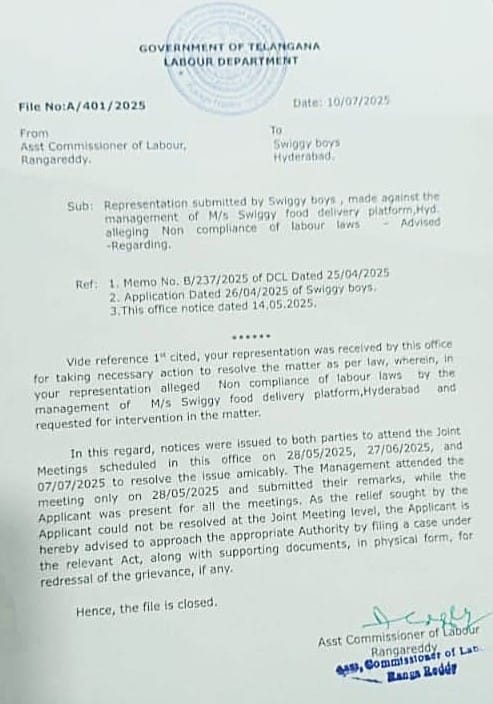
This August, some delivery workers protested alleging labour law violations by Swiggy. The Telangana Labour Department registered their complaint and scheduled joint meetings with the platform and workers. But when the meetings turned futile, the department closed the complaint, advising protestors to approach the “appropriate” authority. DAK, a Swiggy worker, said the department didn’t take up the matter further saying aggregators are outside their purview.
The introduction of Telangana’s Welfare Bill and similar versions enacted in states like Rajasthan, Karnataka and Bihar is a good first step towards recognising gig and platform workers.
However, these laws also lack provisions like ensuring a uniform fare policy. “A uniform fare policy is essential because workers are currently at the mercy of algorithmic pricing, which changes constantly and lacks transparency. Workers don’t know why they’re paid a certain amount per kilometre or per delivery. Moreover, there are huge discrepancies between cities and platforms. A uniform policy would mean setting a clear minimum fare per kilometre (for ride-hailing) and per order (for delivery), with fair base rates, waiting charges, and surge multipliers—all regulated by state or central government,” said Shaik, adding this would also ensure predictable, fair fares for customers.
Something that came up in conversations with the workers interviewed for this series was the cycle of survival and how they continue to jump through the hoops. This, even as the online platforms keep changing the diameter of those hoops as per their internal policies with little to no obligation to explain to workers or to the public. It is then up to the state and civil society to acknowledge their work and do everything in their power to dignify it.
What gig workers need
- Access to schemes that offer health coverage and accident insurance
- A uniform and transparent fare policy with minimum fare/rates.
- Provisions that protect workers from arbitrary penalties and unfair working conditions.
*Note: Workers’ names have been obscured on request to protect their identity.