On August 9, Syed Farhan, a Zomato delivery worker, fell into an open drain in Hyderabad while completing a delivery. In a video tweeted by Telangana Gig and Platform Workers Union (TGPWU) on X, Farhan is seen narrating his ordeal: “The water was [at a high] level and it was hard to understand the depth since nothing else was parked. My bike drowned and my phone, worth ₹20,000, also stopped working. My bike was worth ₹1.4 lakhs…I was still paying for it monthly.” In the video, he says he has been working for Zomato for the past seven years and yet there has been no response from the company about the loss of his bike and phone.
In the past few years, similar incidents have taken place in cities like Ahmedabad, New Delhi and Mumbai.
But it’s not just health risks that hurt workers during rains.
Frequent cancellations, surge fee inactivation during rains
DAK*, a food delivery worker with Swiggy in Hyderabad, said that a cycle of order and cancellation has become quite frequent during rains: “The aggregators are assigning us back orders—sometimes orders placed two hours ago are assigned. After battling rains and waterlogging, when we get to the customer’s door, they refuse to take the order because of the late arrival. They shout at us even though we have no say in the assignment. After all of this, the aggregator not only refuses to pay us the delivery fee and rain surge fee, but also issues penalties to us because of the failure of the order.”
In such cases, delivery workers also have to bear the fuel cost for picking up and returning the orders to the restaurant, with the platform sometimes paying them only for the return.
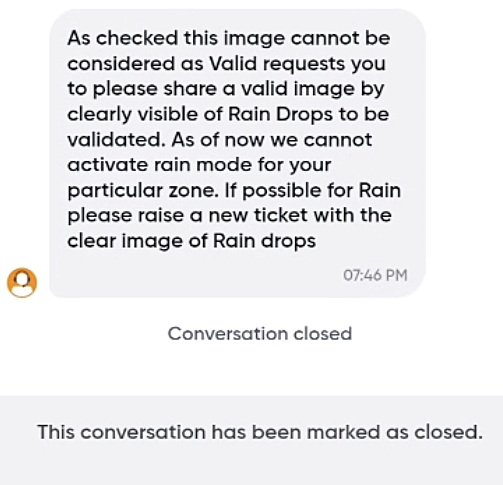
Besides, if rain mode is not already activated on the Swiggy app for a certain location, the worker has to request activation by sending a photo proving rainfall in the area. This has to be validated by the system, which in some cases can be declined. The following screenshot shows how the system asks for “clear image of rain drops” for rain mode activation.
We asked Swiggy to confirm if back orders from hours ago were being assigned to delivery workers in Hyderabad. We also asked for clarification on the mechanism for rain mode activation on the app. Swiggy is yet to respond. We will update the story as and when we receive their response.
Conditional health insurance of no use in extreme rains
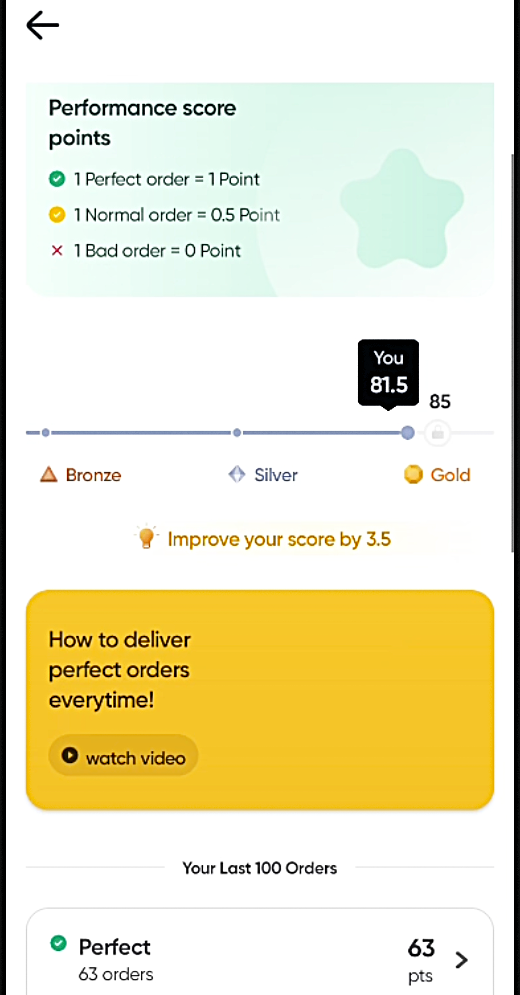
Another “incentive” the platforms provide is health insurance conditional on weekly performance. DAK disclosed how the number and “quality” of deliveries completed are converted into points, which they can use to secure health insurance. The insurance is up for renewal every six days. A worker who wants to maintain it will have to consistently deliver more frequently and “perfectly”.
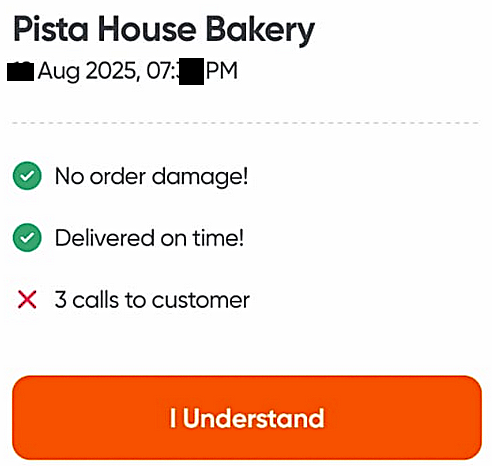
The points for quality are based on the number of times the worker calls the customer, delays in delivery, etc. One “perfect order” equals one point, as shown in the screenshot below. Three calls to the customer, and the performance slips from “perfect” to “normal”.
The insurance plans are in four levels: bronze, silver, gold, and platinum, based on the number of points. For example, a Swiggy worker in the ‘silver’ performance tier can get a health cover of Rs 1 lakh, and an accident cover of Rs 10 lakh for death and Rs 2 lakh for hospitalisation.
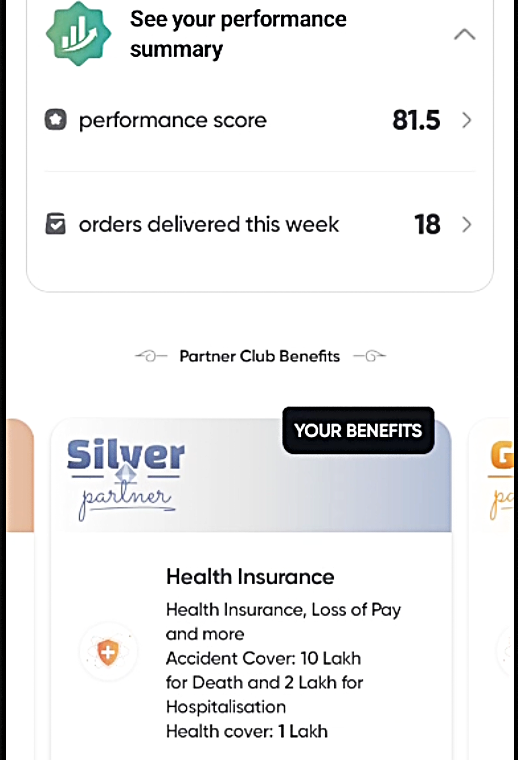
The points needed to secure these plans also change from time to time without prior notice, workers say. Earlier, 75 points were sufficient to secure gold plans, but now 85 are required, DAK added.
During the recent rains, chaos unfolded quickly, both on the roads and in restaurants, resulting in unforeseen delays. Because of this, workers may lose the conditional health insurance when they need it the most, in harsh conditions.
“If we die, the insurance company may or may not give Rs 5 lakh. But the real question is, what do we get when we are alive? What about the daily struggles our bodies go through?” MK, another food delivery worker with Swiggy, asked. “Roads are broken, and we can’t see potholes if there is waterlogging during the rains. If we go to the ‘Support’ chat and ask for help, they just tell us to complete the order somehow. If you don’t complete the order on time, you get a penalty.”
Read more: Meet the men who satisfy your midnight hunger pangs
While the usual rhetoric is that the “partners” are given choices, the web of incentives and goals doesn’t leave much to them to choose. “We get to reject one order per day. If we reject another order, we have to bear a penalty of Rs 40, and then the incentive of Rs 300 for completing 30 orders is also not credited. In case our order receives complaints like wet packaging, we get a penalty. If we try to reason with the management, even our ID can be blocked,” MK explained. In a screenshot shared with us by a delivery worker, it’s seen that Swiggy currently offers its delivery partners a base pay of just Rs 20 per order, which increases with the distance of delivery.
We asked Swiggy the reason for having workers renew their insurance every week. The company is yet to respond.
Pushed to frontlines with no benefits or recognition
Since August, the Hyderabad Metropolitan Region (HMR) has received single downpours of more than 100 mm on several occasions. Flash floods even led to a youth’s death on September 17. With the India Meterological Department issuing warnings throughout August, the usual caution was, don’t step out unless necessary. The government declared days off for schools and offices, and also requested offices to allow employees to work from home.
However, such benefits don’t extend to all workers. Be it the 2020 Hyderabad floods or the COVID-19 pandemic, the categorisation of platform workers as ‘essential workers’ has repeatedly pushed them to the frontlines. At the same time, their essential role in urban society takes a backseat when it comes to recognition.
“Our job doesn’t involve typing into computers. We have to be out [on the road] in order to earn,” AK, a delivery worker with Swiggy Instamart said. “Either you come here and earn, or sit at home and earn nothing,” TK, another delivery worker with the company, added, snickering.
But why can’t the apps just stop taking the orders if it’s raining that badly? “Because it makes them money and they’re greedy for it. And it makes us money and we are greedy for it too,” SK, a delivery worker with Blinkit, said matter-of-factly. So what do they do during a bad case of waterlogging? “All you have to do is wait it out,” he said. “We get extra money. Rs 15 per order if it’s raining lightly, Rs 30 if it’s raining heavily.”
“Conditions in 10-minute or 15-minute delivery models are worse [than food deliveries] because workers are forced to take extreme risks on the road due to strict time targets. This has led to higher accident risks, stress and unsafe working conditions,” Shaik Salauddin, Co-Founder and National General Secretary of the Indian Federation of App-based Transport Workers (IFAT), and Founder President of the Telangana Gig and Platform Workers Union (TGPWU), explained.
Platforms maintain strategic distance from delivery workers
Notably, delivery workers are not a monolithic category. Small-scale surveys show that gig and platform workers overwhelmingly belong to marginalised castes. The lack of recognition of their work compounds their marginalisation.
Read more: Delivery workers prefer to work for smaller companies that offer better work conditions
The creation of this one-arm-distance by the aggregators from the workers by calling them “partners”, mystifies the latter’s work conditions. How many hours does a delivery person work? What can they do and not do during their working hours? Are they allowed to take breaks? Every question one has about a workplace is met with the same response: “They are contractors, not employees. Hence, it doesn’t concern us.”
“Delivery work is often dismissed as something ‘casual’ or ‘time-pass’ rather than proper employment. But in reality, delivery workers are the backbone of urban supply chains. During disasters like floods, heatwaves or heavy rains, when most people are indoors, it is these workers who are still expected to be on the road—often risking their lives. Yet, companies call them ‘partners’ to escape employer responsibility, and society still doesn’t recognise their labour as dignified work,” Shaik asserted.
Recently, a top food aggregator published a LinkedIn post inviting lay people to their offices to witness how they work. This clear demarcation between the “cool” work culture within high rise buildings and the constant and insistent invisibilsation of labour on the roads that keep the high rises going is something that should make all of us stop in our tracks. We must ask ourselves if we can continue to define ‘professional work’ in traditional terms in light of the “booming” gig economy.
*Note: The names of workers have been obscured on request to protect their identity.
In Part 2 of this series, we explore what protection Indian laws offer to platform workers and how a few states like Telangana are trying to address gaps in the law.