Malar, a widowed pensioner resettled to Perumbakkam by the State government, had to reapply for her benefits after they were discontinued due to her address change. Despite gathering the necessary documents and reapplying for the National Social Assistance Pension Scheme (NSAP), her application was rejected because the eligibility criteria had changed since she first enrolled.
The NSAP, implemented by the Revenue Department, provides monetary support to elderly, differently-abled, and widowed individuals below the poverty line. Funds are allocated at the taluk level, and recipients must reside within the same jurisdiction to access benefits. The Revenue Department ensures that pensions are discontinued for those moving out of the taluk, often causing resettled poor to lose their benefits. Unfortunately, the Tamil Nadu Urban Habitat Development Board (TNUHDB), the resettling authority, does not make special arrangements to ensure pension continuity.
Read more: Are we refugees? Residents of resettlement site in Chennai’s Vyasarpadi ask the government
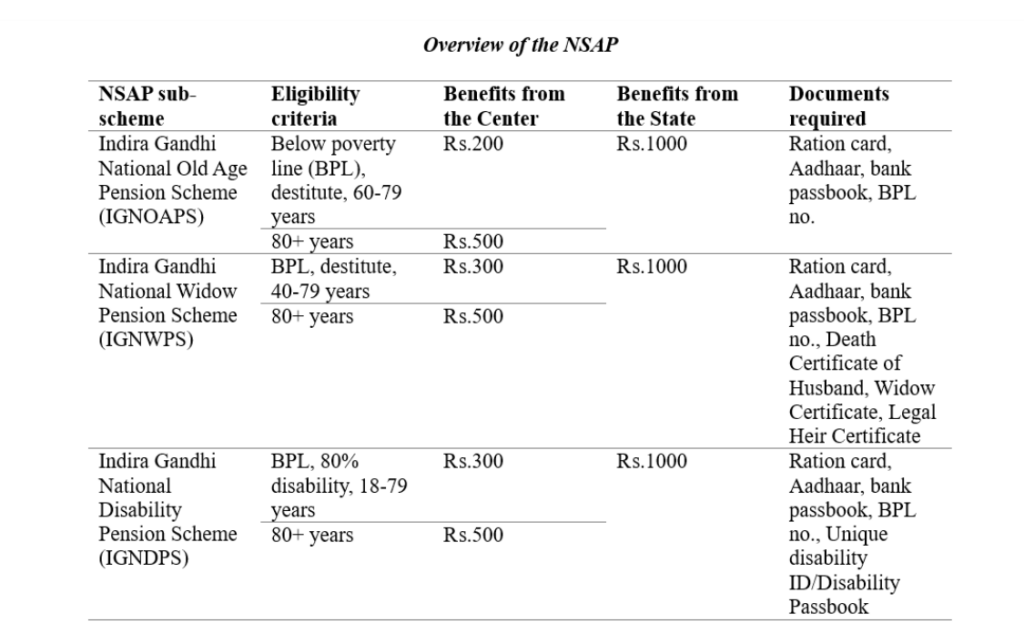
Resettled pensioners are forced to reapply for their benefits — a lengthy process discussed in an earlier article — that involves submitting various forms of proof after the new address is updated. Applicants without an ID must get one from scratch. Reapplying for the scheme doesn’t end with document submission as the government re-evaluates their eligibility, causing anxiety among pensioners. Because of changes in NSAP eligibility criteria, many, who previously qualified, may be denied benefits.
Reapplying under shifting criteria
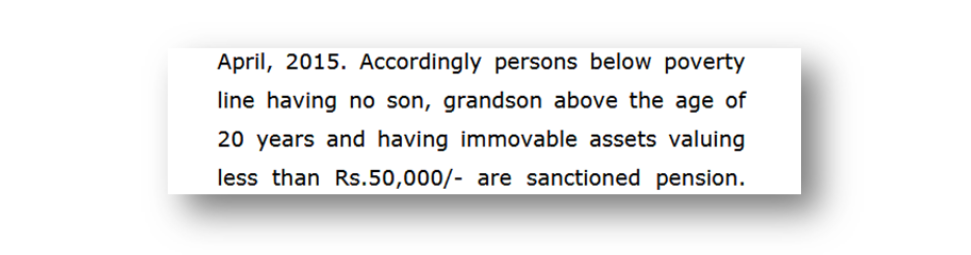
In 2017, the Tamil Nadu Revenue Department introduced a rule wherein pensioners having sons were ineligible for the scheme. This change coincided with some major resettlements in the city.
Sumathi, 70, was relocated in 2016 and narrowly escaped this criterion change. She previously shelled prawns in Chintadripet to support herself but is now out of work and, unable to walk because of her old age.
“I live alone, but my son, who lives with his family, is on my ration card. He takes the ration, arguing that I have a pension. When my pension was cut, I had no money or livelihood and depended entirely on my neighbours for food,” says Sumathi. If she had needed to reapply after 2017, she would have been ineligible unless her son applied for a separate ration card — a task beyond her control.
Malar, whose husband passed away in 2008, was not as fortunate. She had been receiving her pension since his passing but following her resettlement in 2017, Malar’s pension was cut the next year. “I officially changed my address and submitted the required documents, but because my son is named in my ration card, I have stopped getting pension. I have a son and a daughter, but they don’t support me. My son keeps my ration card and tells me there’s no need to get a new one,” she says.
Complicated procedures for meagre benefits
Sandhya, a staff member of the Information and Resource Centre for Deprived Urban Communities (IRCDUC) and a resident leader active in reconnecting people to their pensions, questions this system. “These people were already verified and approved for pensions earlier by the State. What is the need to reassess them now?”
Apart from the rule that makes pensioners with sons named in their ration cards ineligible, a few other changes in criteria further complicate the reapplication process. Widows are now required to provide a legal heir certificate and a widow certificate in addition to the previously mandated husband’s death certificate. Similarly, persons with disabilities (PWDs) must obtain a new form of identification introduced in 2016 — the Unique Disability ID card — even if they already possess a disability passbook.
Additionally, officials conduct random house visits for verification, as part of re-evaluation.
Anxiety of rejection
State-issued ID proofs are the main way for the marginalised to show their welfare eligibility, but these documents often misrepresent their situation. The NSAP uses the ration card to determine household members and financial support, mainly to check if applicants have sons. However, children may still be listed on their parents’ cards even if they don’t live with them or support them, due to poverty. Or, married children with separate ration cards may still live with their parents.
Nirmala, a 63-year-old pensioner, says her IGNOAPS application was repeatedly rejected because her sons’ names appeared on her ration card, and her neighbours had told officials she was “well off.” However, her children, who have been married and living separately for 20 years, do not support her. Only after her sons applied for new cards were their names removed from Nirmala’s ration card, and her application was approved.
Similarly, IGNWPS applicants must provide a widow certificate apart from the husband’s death certificate to get benefits. Yet, the possession of this document doesn’t rule out the possibility that the widow may be in a new relationship. Documentation here provides limited information.
State reliance on physical verification
Since identity proofs cannot fully capture the changing nature of the family structure, the government depends heavily on physical verification. “Some people whose husbands have died may remarry, and that’s why the widow certificate is required. But in every case, we conduct an enquiry to get clarity,” explains a revenue official.
Applicants must submit a BPL number for NSAP benefits, as it covers individuals below the poverty line. “For every scheme, the government order specifies that benefits should go to those below the poverty line, but the reality is that there is no updated list. The last census was in 2011, who is maintaining these lists?” says another revenue official, on condition of anonymity.
Then, assessment happens through a visual understanding of what ‘looks’ like poverty. Revenue officials report visiting applicants’ homes, observing factors such as how much jewellery the applicants are wearing, and what appliances they possess, and cross-checking the applicant’s financial status with neighbours, whose statements may be biased.
Why the procedural excess?
While officials rely on documentary proofs, they place greater trust in physical verification, raising the question: why demand excess documents when they hold little practical value?
A revenue official, highlighting the gap between policy and operational realities, states, “The poorest and most deserving individuals often don’t have any documents and are left outside the system. Creating proof is challenging; they might have a small chit as a trace of legality, but turning that into valid proof is difficult. If we strictly follow the rules, we won’t be able to give pensions to anyone. Policymakers are disconnected from ground realities, they demand proof, but many people don’t have any.”
While reevaluation threatens disqualification based on updated rules, physical verification risks exclusion based on subjective assessments. This dual burden disproportionately affects the poorest and most marginalised, who are often unable to produce documents.
What can be done?
The government must rethink the requirement for too many documents. A revenue official remarks, “Actually, the Aadhaar and ration cards are enough.” Simplifying the process would not only reduce stress but, also ensure that those most in need are not left behind.
Resettlement should not disrupt pensions to begin with, let alone create the trauma of a trial. Having been verified under the eligibility rules of the time they initially applied, pensions of those resettled to Perumbakkam should simply be transferred to their new address.
[The author’s research project examined the challenges pensioners in resettlement sites face to get welfare benefits. Her project is part of a fellowship programme with Impact and Policy Research Institute (IMPRI)].
Your examples illustrate the points you make very well. very effective way to communicate Rithika.