When I go for my daily run in the mornings I always carry a bottle of water in my hand. As I run around the periphery of Kaggadasapura Lake, my lungs heaving and me struggling on, I see several individuals joining me with similar bottles in hand.The bottles are intended for different purposes though: one to quench thirst and the other for open defecation.
Unlike me, however, these individuals are not trying to attain the higher needs of life, such as running for fitness in the morning. They are here to fulfil the basic needs of a human being: answering nature’s call. It is just an unfortunate coincidence that both these needs are met in the same place.
As I clutch my bottle in my hand, so do they. Me, running on breathlessly but with confidence, they walking ahead with downcast eyes looking for some privacy.
The irony of the situation doesn’t escape me. Different places mean different things to different people. While I use the lake periphery for my fitness, the migrant labourers use the space to defecate in some privacy.
Read more: Why the COVID surge calls for immediate attention to public toilets in our cities
The inconveniences caused by lake redevelopment
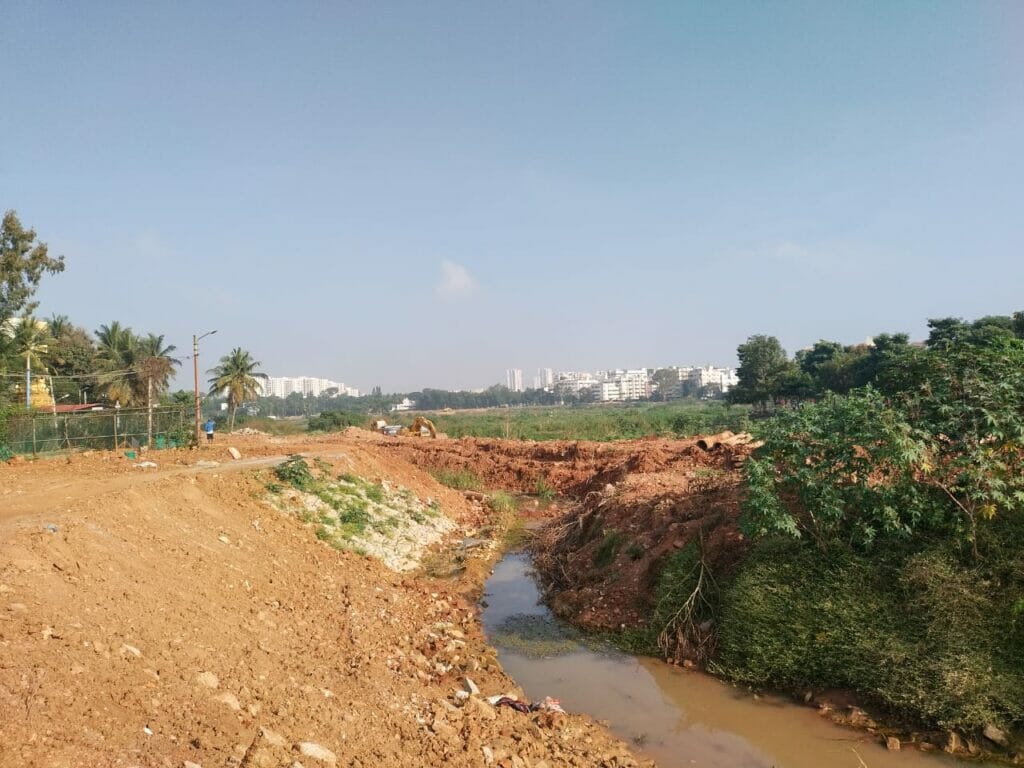
The Kaggadasapura lake had almost turned into a wetland. It was vast, covered with weeds, and was a roosting place for purple swamphens and other birds. Until a few years ago there was a particular spot, which was covered with trees and dense bushes, used as a spot for open defecation. Even with the milling crowd of walkers, the spot gave considerable privacy for defecation.
A few years ago, a lake redevelopment plan was launched by then Chief Minister Yediyurappa with great fanfare with big billboards of PM Modi, CM Yediyurappa and the local MLA S. Raghu. Under the redevelopment, the first thing to go was the dense cover of trees and bushes taking away the little privacy the poor had.
While the work is going at a snail’s pace, people are still running and walking around the lake and open defecation goes on as well. The only thing lost is the little bit of supposed privacy to meet the basics.
Swachh Bharat Urban guidelines
The focus on Swachh Bharat has led to the building of a lot of toilets across the country and overall there is an improvement in the number of people not defecating in the open. But, what about the floating crowd? Millions of citizens of this country migrate daily for work. Some are seasonal, some permanent, and many are almost nomads, migrating based on wherever work is available.
Even as the BBMP claimed in 2018 that all wards in the city are open defecation free, the lack of public toilets continue to be an issue. Citizen Matters reported that Bangalore Political Action Committee (B.PAC), in collaboration with CGI, conducted a safety audit of 260 public places for women, including public toilets, besides public health centres, bus stops etc, in Malleshwaram and Mahadevapura Assembly Constituencies as a pilot project. The audit found that in Malleshwaram 15 of the 18 public toilets audited need to be free toilets and in Mahadevapura, out of 14 public toilets, seven of them need to be open full time. The audit included accessibility to clean toilets as a Must-Have.
In a country where people are migrating from place to place all the time, how do we address such basic needs? Swachh Bharat Urban clearly provides guidelines for the community and public toilets, but is it possible to address this need considering the increasing pressure and fight for resources such as land and water?
Read more: It’s time to tell BBMP whether Bengaluru is ‘Open Defecation-Free’
While slums serve as vote banks for the political class and are able to wrest basic minimum rights in exchange for votes, the migrants do not have such clout as their votes continue to remain in their hometowns. We saw a classic example of this during the lockdown, during which it was assumed that every citizen in the country had a house to be locked down into. There was a mass exodus of migrants returning to their hometowns in spite of severe hardships on the way.
Considering the circumstances, though we have made incremental progress we are still miles away from being Swachh Bharat.
Also read:
- Women construction workers face serious health and safety hazards at work and beyond
- Migrant workers deal with unhygienic living conditions, poor nutrition
- End YellowSpots, improve footpaths, improve quality of parks—Citizens’ wish list for ward level budgets
- “Policy changes can help make Bengaluru an equal city for women”