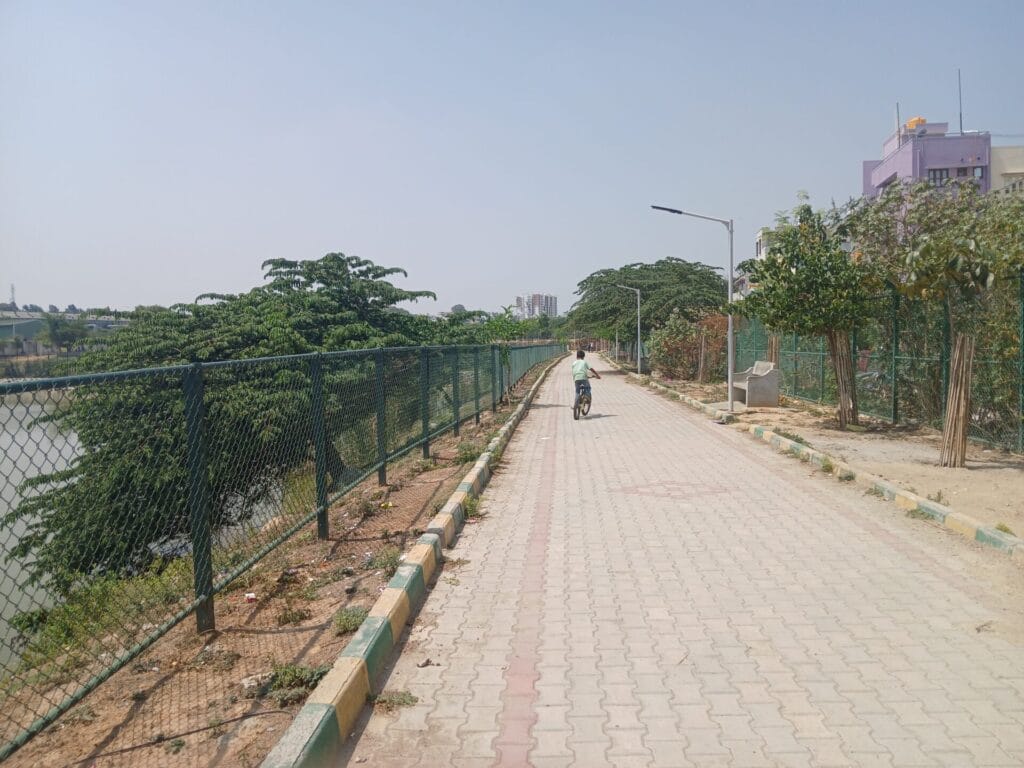
It’s 6.45 am, and the first rays of sunlight bounce off the dense foliage at Sundaravana, an urban forest located in HSR Layout, Bengaluru. A gentle breeze carries the scent of wet earth. Calls of birds like the Gray Heron, Black Drongos and even the occasional peacock add to the morning chorus. A few early risers and joggers walk on a wide trail around Somansundarapalya Lake.
The land around Somasundarapalya Lake wasn’t always a lush canopy. For years, it served as an RDF (Refuse-Derived Fuel) dump yard, with layers of processed plastic waste piling sky-high. But afforestation turned the tide. “We called it the Black Himalayas. It used to catch fire in summer. We pushed and pushed until the BBMP (Bruhat Bengaluru Mahanagara Palike) finally cleared it,” said Lalithamba BV, HaSiRu Mithra co-founder.
In 2020, residents, NGOs, and volunteers came together to transform this toxic zone into Sundaravana, an urban forest using the Miyawaki method. Within three years, the saplings soared to 20 feet. The soil now holds bamboo groves, flowering trees, and native fruit-bearing plants. On hot summer days, it’s at least 2°C cooler inside than on the adjacent road.
Need for a green imperative
With Bengaluru undergoing rampant urbanisation, afforestation is no longer a feel-good initiative. It’s an urgent public necessity. But what exactly is afforestation, and how is it different from the common ‘plantation drive’?
Afforestation involves planting trees in areas that were never forested, like the transformation of a garbage dump into Sundaravana. Reforestation means replanting trees in areas that once had forests but have been cleared. For example, restoration work around Lower Ambalipura Lake, led by citizens, is a classic case of reforestation. A plantation drive is a broader term that includes both.
The consequences of ignoring green cover are already visible. The “Urban Heat Island” (UHI) effect describes how cities become significantly warmer than their surrounding rural areas due to heat-absorbing concrete, asphalt, and reduced tree canopy. According to environmentalist Dattatraya T. Devare, the felling of trees for infrastructure projects like the Metro, flyovers, and suburban rail has directly contributed to this phenomenon. Fewer trees mean less shade, poorer air quality, and disrupted rainfall patterns.
Tree loss is not just a climate issue. It’s a public health concern. When Bengaluru loses its trees, it loses its temperature regulation, its ability to recharge groundwater, and its shield against pollutants.
Read more: Bengaluru’s tree census: Flawed data undermines efforts to protect city’s green cover
Policy pitfalls
Several national-level policies support urban afforestation in theory. These include:
- Green India Mission aimed at increasing carbon sinks through forestry.
- AMRUT 2.0 allocates funds for green infrastructure, such as parks and lakes.
- Compensatory Afforestation (CAMPA) mandates developers to plant trees for every one cut.
- “Green Credit” Programme allows entities to earn tradeable credits for afforestation.
Yet, loopholes weaken implementation. Namitha Nayak, a researcher at WELL Labs, said that “While CAMPA mandates compensatory planting, there’s little transparency on whether restoration actually happens.” Discrepancies in public data and “broken” government websites add to the problem. The Forest Conservation Amendment Act (2023) has also diluted the safeguarding of trees. This has allowed forest land to be diverted for projects without proper Environmental Impact Assessments.
Dattatraya points out that even state-level protections, like the Karnataka Preservation of Trees Act 1976, only kick in after project alignments are finalised. “We need tree audits at the planning stage, not when construction is halfway,” he said. Another significant loophole is that fees for felling trees range from a mere ₹2,000 to ₹10,000 for private land. But they are free for public BBMP areas, making it alarmingly easy to remove mature trees.
“Monetary compensations hardly equate to the ecological benefits of a 60 or 70-year-old tree,” Namitha said. Furthermore, green funding for urban local bodies is tightly bound as they rely on private donations or CSR funds, unlike mega grey-infrastructure projects.
While policy drags its feet, communities are stepping up. Citizen-led afforestation ensures on-ground monitoring, deeper engagement, and higher survival rates of saplings.
Power of community efforts
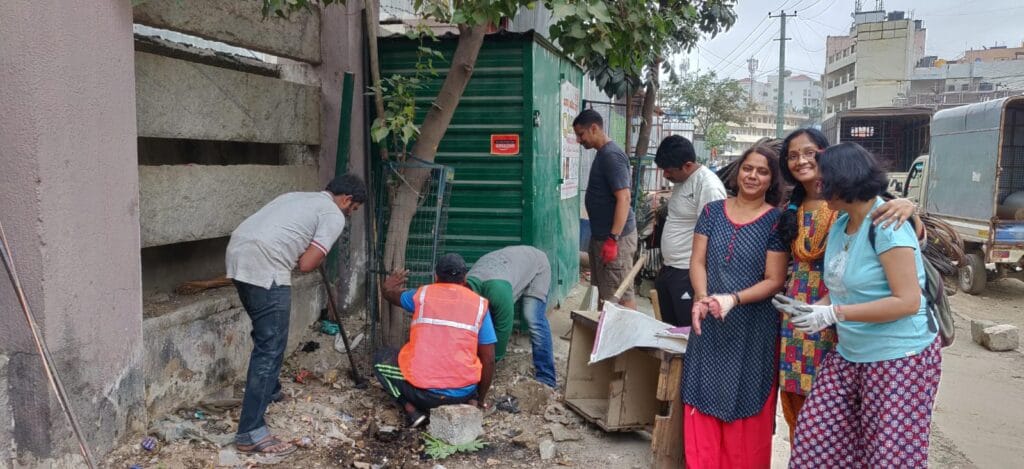
Bellandur’s Lower Ambalipura Lake, once stilt-ridden and contaminated by sewage, had lost much of its green cover. The BBMP and community members, including Kavitha Kishore, an environmental sustainability consultant and Kere Mithra, worked together to restore it. A study using green audits and GIS tagging showed that temperatures inside the lake area were 3°C cooler than on the nearby roads.
Sundaravana’s vegetation was grown using the Miyawaki method, a Japanese technique for growing dense forests in small spaces using enriched soil and close planting. In a 10×10 foot area, the Miyawaki method can accommodate 50 to 60 saplings, compared to just two to six in a traditional planting method. “The trees compete for sunlight and grow vertically faster,” said Lalithamba. “In three years, they’re towering.”
The Supreme Court has even recognised the monetary value of a tree, estimating a single tree to be worth ₹74,500 annually, with a 100-year-old tree valued at over ₹1 crore. “If you want to see the real value of green spaces,” Namitha Nayak, a research associate at WELL Labs, points out, “just look at Sadashivanagar. People are willing to pay higher property prices to live near its parks and tree-lined streets.” Green cover isn’t just good for the environment; it adds significant economic value.
Part 2 of this two-part series gives a detailed guide for active citizens and communities who are interested in taking up afforestation and plantation drives in their neighbourhoods.