On October 15th, the Karnataka government released the Draft Karnataka Domestic Workers (Social Security and Welfare) Bill, 2025, for public consultation. This move follows the Supreme Court’s directive calling for a well-defined legal framework to safeguard and regulate the rights of domestic workers.
Stakeholders have welcomed the state government’s proposed legislation, but concerns remain about key provisions in the draft bill. Domestic workers’ unions and Bengaluru apartment groups have addressed a letter to the Karnataka Labour Minister highlighting these issues, including insights from an Oorvani Foundation roundtable.
Also, scroll further down for a report on citizen feedback gathered by Civis through a public consultation chatbot run in partnership with Oorvani Foundation.
Letter on the draft bill
The Minister of Labour
Government of Karnataka
No: 342 & 342A
3rd Floor, Vidhana Soudha
Bengaluru – 560001
CC: Principal Secretary to Government
No. 414, 4th floor, Vikasa Soudha,
Dr. B. R. Ambedkar Veedhi
Bengaluru – 560001
CC: Commissioner of Labour,
Karmika Bhavan, Dairy Circle,
Bannerghatta Road,
Bengaluru- 560029
SUB: Objections/Suggestions to the Karnataka Domestic Workers (Social Security and Welfare), Bill 2025
Dear Mr Santosh Lad,
This is regarding the Domestic Workers (Social Security and Welfare) Bill placed in the public domain by the Labour Department, Government of Karnataka. At the outset, we would like to acknowledge and appreciate the GoK’s initiative to draft the Bill, marking a historical step forward in ensuring the rights and dignity of a long-overlooked, critical mass of workers in the country.
However, based on our discussions with domestic workers, employers and social workers working with the community for decades, we would like to raise a few procedural and substantive concerns shared as an attachment. Addressing these would be critical to ensuring an effective law, both in letter and spirit.
We also believe more time is required to gather feedback given there are lakhs of workers, employers, placement agencies and other stakeholders across the state. It will also help for the draft to be translated into multiple languages with even video explainers.
We also request that the department come out with an impact guide to explain how the law will work in conjunction with the rules, and will be executed in the short term and long term. The government must also socialise the information to ensure workers understand the need and the process for registration and employment record processes. The rollout must include pilot phases to capture feedback and gaps in implementation, so registration and other systems can be improved as required.
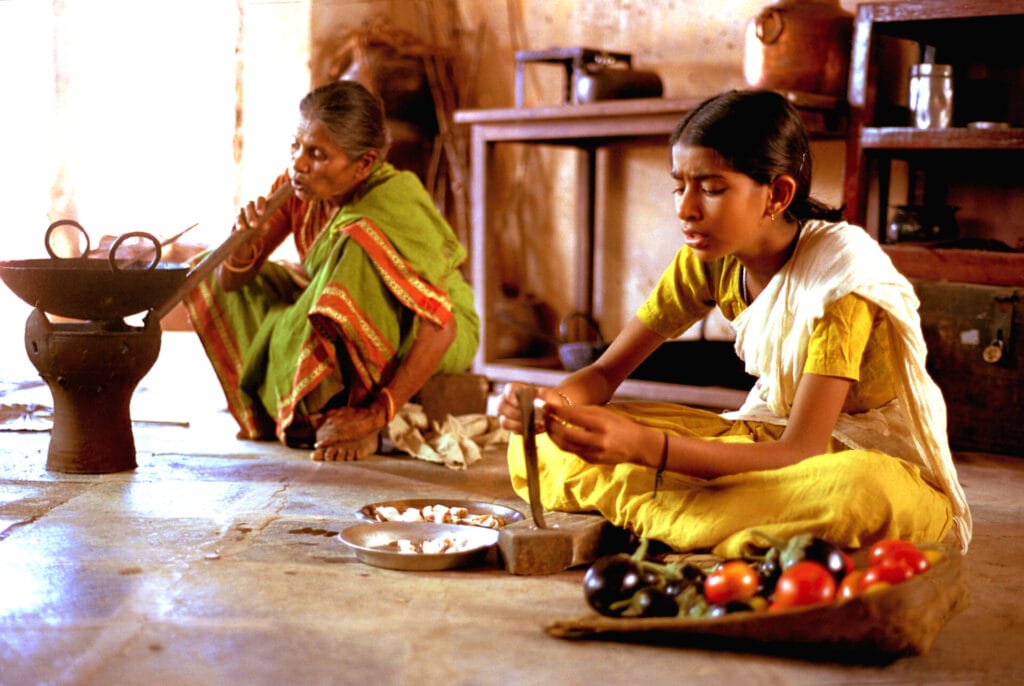
A step towards dignity: Karnataka’s Draft Domestic Workers Bill explained
Feedback on Karnataka Domestic Workers (Social Security and Welfare), Bill 2025
Domestic workers have long been excluded from formal labour protections, current laws being mostly inactive or ineffective. A separate law is therefore essential to secure their rights, as they do not fit into existing categories such as casual or migrant workers, or even platform-based workers. The lack of formal recognition for domestic workers creates significant challenges in terms of enabling their access to benefits and rights.
The Karnataka government’s initiative as the first state to draft such a bill marks a historic step forward. However the current draft leaves several questions unanswered, particularly regarding enforcement and implementation. The bill must address both procedural and substantive aspects. The goal should be to structure the informal labour sector while keeping it practical and easy to enforce.
While the law’s effectiveness will largely depend on the rules formulated after its passage, it is important to ensure it is framed well to ensure it is unambiguous, realistic and responsive to community needs.
We have two key concerns:
1. Mandatory registration with rigid timelines
- The law for domestic workers should focus on empowerment and inclusion rather than punishment, offering identity, security, and access to benefits like pensions and maternity leave.
- Registration must be simple, transparent, and supported by clear incentives such as social security and legal protections. When workers see tangible benefits, they will be more motivated to complete the registration process, either by themselves or with their employer’s help.
- However, penal provisions in case of failure like fines or jail time may cause resistance and unintended consequences.
- A one-month registration deadline for employers to register workers is impractical, especially when workers are highly mobile or temporary. Enforcement is a challenge given the informal and transient nature of domestic work.
Recommendation:
Registration can be better enabled with state supported, multi channel options.
- Digital system with user friendly, multilingual workflow available online and through Whatsapp. This has to be complemented with physical services at all municipal Citizen Service Centres like Bangalore One.
- Allow aggregators and third party service providers as facilitators for registration. This role could be fulfilled by interested RWAs (Resident Welfare Associations) and placement agencies.
There needs to be a threshold for registration, say six months of employment, to account for short term associations.
2. Mandatory employment agreement
Preparing an agreement document and the subsequent management of physical records is an unnecessary additional burden on both workers and employers. It also creates dependencies on printing and legal advice.
- It would also be much harder for the blue-collar workers to understand or comply with such agreements.
- There will be challenges to enforcing notice periods.
- For employers with multiple employees, having separate agreements for each employee might be difficult to enforce.
Recommendation:
- In lieu of a formal Agreement, employers can file an “Employment Record” through an online tool (either a form or whatsapp bot) capturing worker id, payment, and other details.
- Simply submitting this form with identity verified, can serve as a formal record of employment.
- Only a limited set of parameters (like wages) can be an enforceable commitment with other aspects like notice period left as guidelines.
- Requiring workers applying for benefits to upload their employment record will make sure they get their employers to file it. This will also minimise the need for inspection and enforcement.
Additional concerns:
- No mention of benefits: Registration alone doesn’t ensure economic security; it should be paired with income support schemes and social security measures. A model, like the Karnataka Social Security Fund for construction workers, could provide long-term protection for domestic workers as well.
- Welfare contributions: There is a need for a system regulating contributions and disbursement of benefits. Employers should contribute to a common social security pool, managed by the Social Security and Welfare Board to be constituted, ensuring that benefits are delivered uniformly and collectively, rather than depending on individual arrangements or voluntary payments. Employers’ contribution could be made compulsory only for contracts of a minimum duration of six months to a year, ensuring fairness and practicality.
- Definition of adolescents: In the absence of opportunities for education, skills training, or alternative livelihoods, many adolescent girls aged 15 to 18, are currently employed or need to work to earn a livelihood. In such cases, extra protections are crucial, as they are still minors. These protections should include access to helplines and gradual interventions wherever required.
- Definition of family: Regarding the definition of family in the draft, the language seems too narrow, referring only to male/female members or spouses. it’s important to clarify that if the primary employer is unavailable, any responsible adult in the household should be able to act in their place. This makes the legislation practical and inclusive of different household structures.
- Privacy risks: A significant concern about the privacy risks of creating a new registration database for domestic workers and employers. Collecting and integrating this data could lead to increased surveillance, misuse, and data correlation with other systems like property records, which may infringe on individuals’ privacy. This poses a significant risk, exposing workers’ locations and employment details, and potentially leading to privacy violations or unwanted tracking.
It is important to ensure these systems collect only minimal and basic information.
We urge the Government of Karnataka to positively consider these suggestions and ensure that it passes legislation for domestic workers that sets the highest standards of social justice, dignity and accountability for the country to follow.
With regards,
- Geetha Menon, Domestic Workers Rights Union
- Sujatha, Satish Mallya, Valli Srinivasan, Vikram Rai and Vishwa V Reddy, Bangalore Apartment Federation (BAF)
- Malarvizhi Ponnambalam – Uniservice Apartment Solutions
Citizen feedback on the draft bill
Responses to the consultation on this Bill were also collected via the Civis (a non-profit platform encouraging citizens to participate in the lawmaking process) public consultation bot, to gather public views on the draft law. A total of 30 citizen responses were received, covering both English and Kannada inputs (translated for analysis). The following is a snapshot of what emerged:
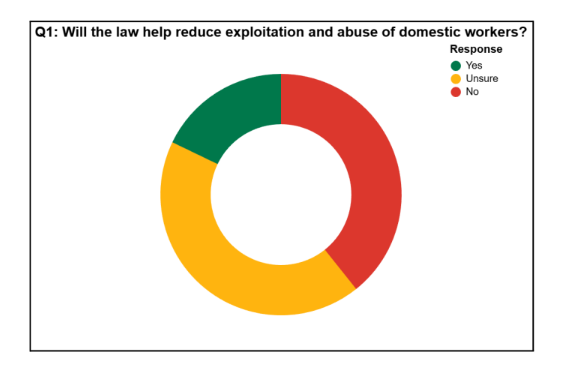
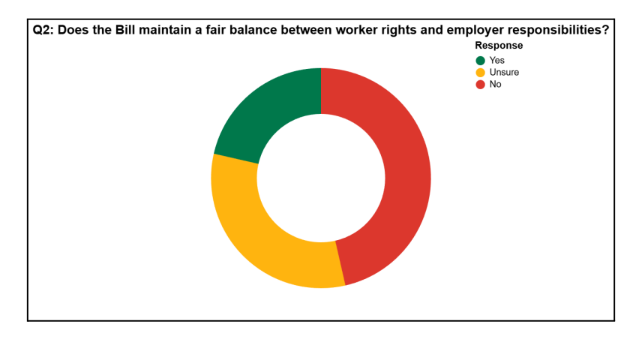
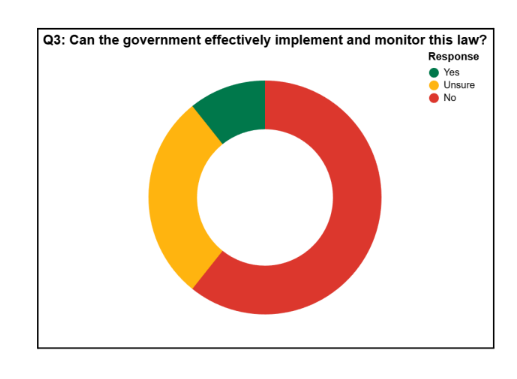
- Persistent doubts about real-world execution: Most participants believe that implementation will be difficult.
- Challenges in enforcement: While the feedback generally supports the intent to protect domestic workers, several participants expressed distrust in the government’s ability to enforce and monitor the proposed provisions effectively.
- Accountability for work hours: Since domestic workers typically work at multiple houses, the key challenge is understanding how to ensure accountability for work hours and working conditions, as this responsibility is not borne by one employer alone.
- Welfare contribution responsibility: Clarity is needed on whether employers who utilise the same worker are equally responsible for their welfare contribution, or if responsibility is proportional to their payment or the time engaged.
- Registration requirements: Citizens expressed that there wasn’t enough clarity about whether each employer of the same domestic help/car cleaner would be required to register the help.
- Risk of harassment and corruption: Many participants believed that the compliance requirements would lead to harassment of employers and that the welfare provision might lead to corruption.
- Employer verification burden: The Bill places the responsibility for the verification of the employee’s credentials on the employer, but it does not specify how the employer will carry out this verification.
- Simplifying collections: To ease compliance, one suggestion proposed merging the employer’s contribution into existing structures, like property tax or the Atal Pension scheme, to avoid multiple collections.