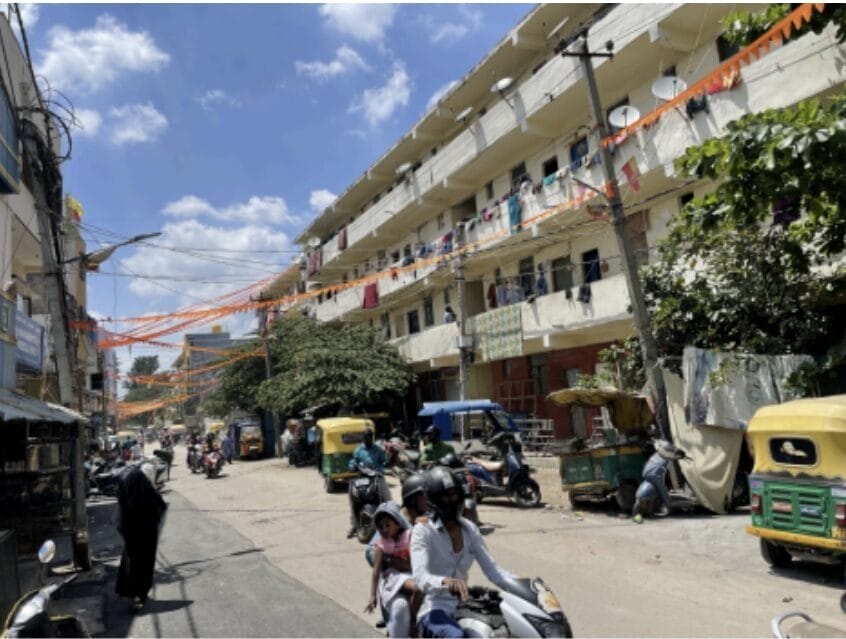
The Public Distribution System (PDS) in India is one of the world’s largest food security initiatives, covering approximately 800 million people. It provides free or subsidised food grains to over 75% of the rural population and 50% of the urban population. Yet, Rajendra Nagar, one of Bengaluru’s largest informal clusters with over 15,000 families living across a two-square-kilometre area, offers a stark example of how gaps in the Public Distribution System (PDS) leave thousands vulnerable.
As many as 44% of households surveyed in this slum between September and November 2024 reported not receiving rations, despite being eligible.
Households in the slum without PDS access had significantly higher vulnerability, and lower income, expenses and assets compared to those covered by the schemes. These findings, based on a survey we conducted, mirror broader patterns in Bangalore’s slums, where leakages and inefficiencies in PDS undermine food security and perpetuate poverty.
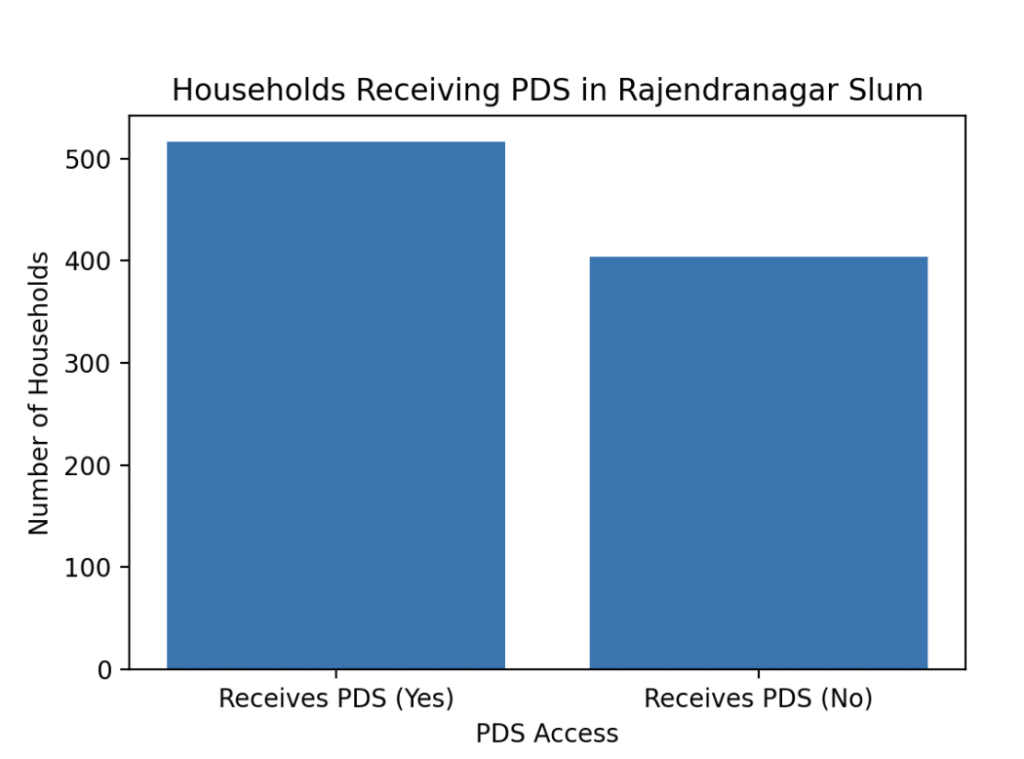
The Rajendra Nagar cluster of slums has 15,000 families and covers an area of two square kilometres. We divided the cluster into 10 blocks, and the 3rd house of each block was surveyed to collect data on income and consumption expenditure. Data was collected through representatives of the Swabhimaan Foundation, a local NGO working for the welfare of slum residents. We asked these questions to households over 12 weeks from September to November of 2024.
Read more: Interview Amit Basole: “PDS the most effective safety net, cash transfers the worst”
Key findings from the survey
The average monthly household income of 920 surveyed households was ₹21,019. Upon analysis, average monthly income of households without PDS were found to be ₹2,871 lower than those with access to PDS. Households without PDS had ₹4,22,409 lower assets than those with access to PDS.
We also gathered the data on pre-COVID income for 570 households. Adjusted for inflation, their incomes have declined on average by ₹5,881 from 2019 to 2024. Declining real wages can push the already poor into further poverty; therefore, providing food security is critical support for these underserved individuals.
What do the people want?
When asked to rank their requirements from the government according to priority, Rajendra Nagar residents placed better PDS access on top, followed closely by healthcare and education for children. While healthcare had high responses, the average rank was lowest for PDS, indicating that access to PDS was the most important request from the residents. The rank is based on a scale from 1 to 5, where a 1 indicates the highest importance for slum residents and a 5 indicates the lowest importance. The mean rank was determined by calculating the average of all the rankings provided by slum residents in the survey.
| Top requests from the Government | Mean rank |
| PDS | 1.54 |
| Education | 1.67 |
| Healthcare | 1.66 |
Barriers to access
Many slum dwellers are migrants who don’t have local proof of address such as Aadhaar or BPL card, making them ineligible for PDS in Bengaluru. While digitisation (e.g., ePoS machines, Aadhaar linkage) has reduced identity fraud, leakages persist. National studies estimate PDS leakages at 30–40%, with urban areas particularly affected due to weak monitoring and accountability.
While PDS leakages have come down to 14% to 22% in Karnataka, several forms of diversion or exclusion continue to persist. This is made worse by the lack of mechanisms for beneficiaries to report issues of shortfall or corruption.
Read more: Gruha Lakshmi eludes many women in Bengaluru: Funds delayed or discontinued
Recommendations
There are opportunities to strengthen the PDS, as well as opportunities to complement the PDS through subsidised cooked meals through government-run canteens and support from local organisations.
- Strengthening the PDS:
- PDS coverage in slums must be universalised by proactively identifying and enrolling all eligible households, including migrants and those in unnotified settlements. This can be done through targeted drives and mobile registration camps.
- Secondly, accessible mechanisms for grievance redressal (hotlines, SMS, social media) must be created, which allow anonymous reporting of under-delivery.
- Digital transparency and accountability can be enhanced through SMS alerts notifying beneficiaries of monthly entitlements and transactions.
- Finally, audits and strict penalties for dealers guilty of diversion or under-delivery would improve access and ensure benefits reach those who need them most.
2. Complementing PDS
- There is a need to promote community canteens for nutritional complements to PDS provisions. Affordable government-run community kitchens (like Amma/Indira Canteens) that provide nutritious cooked meals at subsidised rates should be expanded in urban slums and low-income areas.
- Additionally, local NGO support is also vital, as they play an important role in identifying food security needs that cannot be served by the government effectively.
Filling the gaps
While the PDS provides grains, many urban poor, like migrants and the homeless, lack kitchens or even the time to cook. State-run canteens, such as Tamil Nadu’s Amma Canteens (serving over two million meals daily) and Karnataka’s Indira Canteens, fill this gap by offering safe, cooked meals at ₹5–₹10.
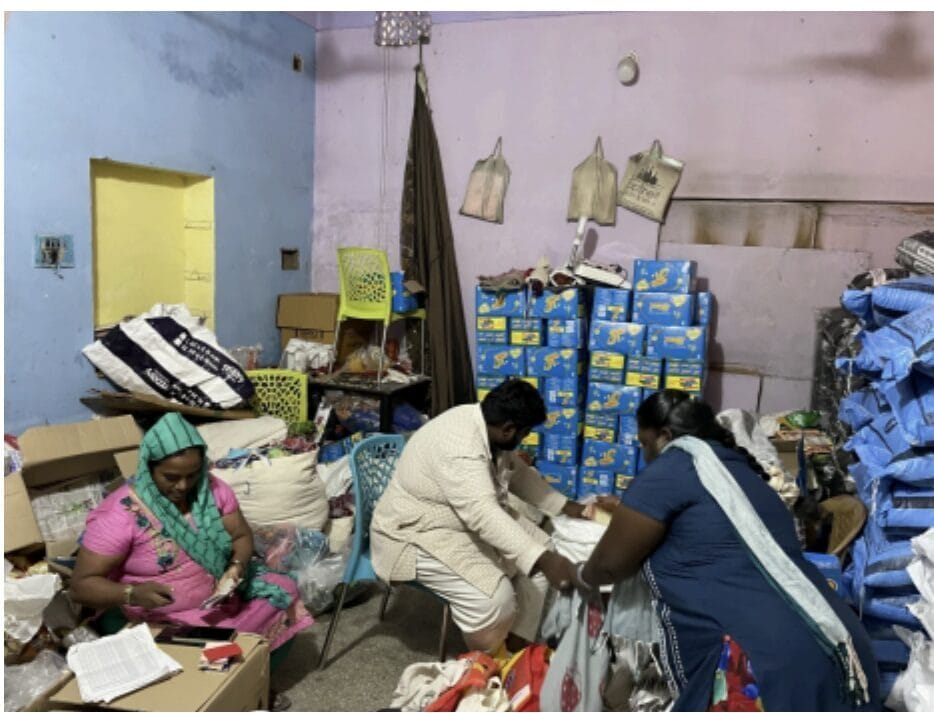
Local non-government organisations (NGO) such as Swabhimaan Foundation also understand the needs of the residents better and can serve those who are below the poverty line (BPL) and don’t have access to PDS. Swabhimaan Foundation delivers free groceries every month to over 2,500 such families. Also, they distribute food most days of the week for 1,500 aged or terminally ill residents who don’t have a family to take care of them.
In summary, therefore, the Rajendranagar study shows that the government must act urgently to universalise access, strengthen accountability, and empower slum residents to claim their rights. Complementing the PDS with accessible community canteens can further safeguard urban food security, ensuring that no citizen is left behind in Bengaluru’s growth story.
[Note: The author would like to thank the numerous volunteers who helped in conducting the survey. Special thanks to Prof. Claudia Francis at University of Notre Dame and Prof. Reetika Khera at IIT Delhi for their feedback on the article and pointing to the right resources to fine tune the policy memo and recommendations.]