Residents of North Chennai have been vehemently opposing the Greater Chennai Corporation’s (GCC) proposed Waste-to-Energy (WTE) plant set to come up in Kodungaiyur. Over the past few months, they have made several representations to GCC officials and Mayor Priya Rajan, and even organised a human chain protest.
During their research into the dangers of WTE plants, the group found that these facilities release pollutants including sulphur oxides (SOx), nitrogen oxides (NOx), particulate matter (PM2.5 and PM10), hydrogen chloride (HCl), heavy metals, dioxins, and furans — contaminating the air, water, and soil. Waste incineration, in particular, contributes significantly to elevated PM2.5 chloride levels, triggering haze and fog that impact air quality in urban centres like Delhi.
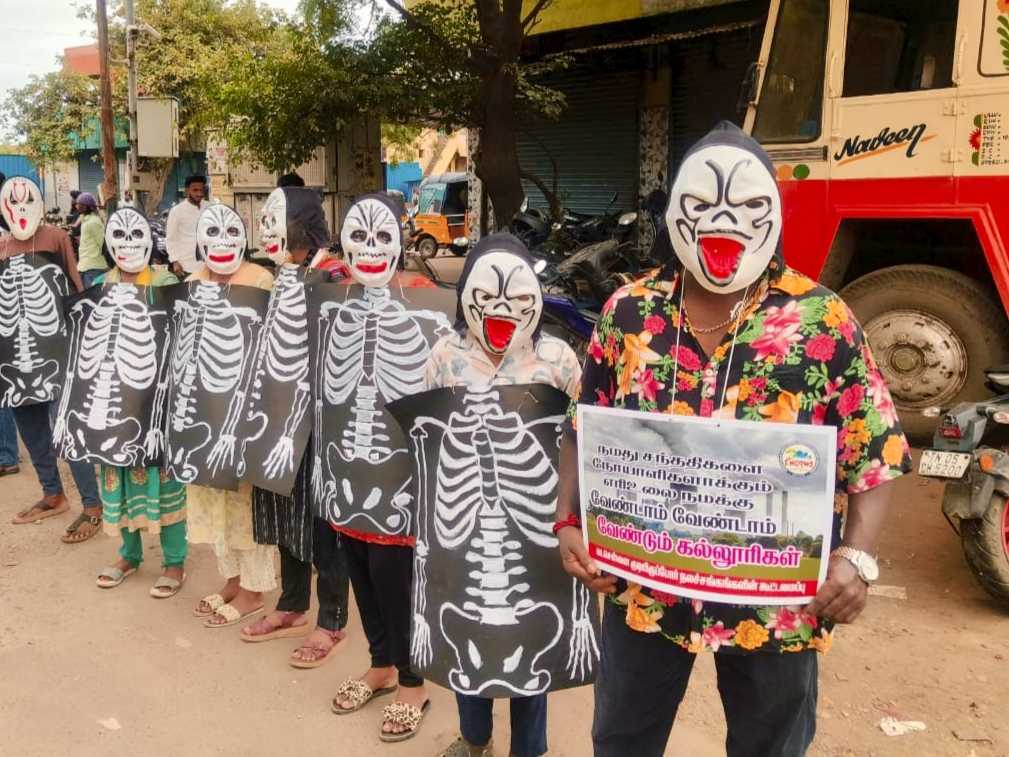
In response, a coalition of residents and environmental experts has developed an alternative proposal, the ‘Green Chennai Initiative (GCI): A Path Towards India’s First People-Centric Zero-Waste City’. This proposal has also been shared with the mayor.
In this interview, we speak with the key contributors to the proposal:
- TK Shanmugam, President, Federation of North Chennai Residents’ Welfare Association
- Vishvaja Sambath, Environmental and Health Researcher
- DK Chythenyen from Centre for Financial Accountability
You can access the Green Chennai Initiative document here.
How the Green Chennai Initiative was envisioned
You have submitted a document called ‘Green Chennai Initiative (GCI), A Path Towards India’s First People-Centric Zero-Waste City’. What prompted you to come up with this document in the first place?
Shanmugam: We began by trying to understand the potential impacts of the proposed WTE plant. In doing so, we realised these impacts were not only real but also far more dangerous than previously anticipated. As we became more engaged on the ground, it became increasingly evident, supported by credible evidence, that the negative consequences were significant.
This led us to encounter two recurring questions, from both the public and government officials:
- From the public: “If we do not want landfills, then where should we dump the waste?”
- From officials, often in a pressurising manner: “If we do not burn the waste, how else should we dispose of it?”
While the public’s concerns stemmed from genuine curiosity, the questions from officials were clearly intended to corner us. Even during our meeting with Mayor Priya Rajan, she raised the same concern.
Given the legitimacy of these questions, we felt it was our responsibility to present a viable, sustainable solution. This resulted in the Green Chennai Initiative. Although the federation initiated the plan, environmental experts played a major role in shaping its structure and direction.
Importantly, this plan is not limited to North Chennai. It is designed for the entire Chennai Metropolitan Area and is structured around five key global themes:
- The proposition
- A roadmap for change
- The associated risks
- A new chapter
- Global best practices
Read more: Why a waste-to-energy plant is not the answer to Chennai’s garbage problems
Community-led alternatives to Waste-to-Energy
What do you propose as the alternative to WTE in your plan? How can communities be involved in this plan?
Vishvaja: We began by analysing the composition of waste in Chennai and found that approximately 65% of it is wet waste. If we manage this effectively, only 35% remains to be handled. However, managing wet waste requires active community participation.
People can contribute by simply segregating waste at source and practising home composting. For bulk generators such as apartment complexes, we recommend in-situ biogas plants. These recommendations are based on field visits to successfully operated micro-composting centres.
There is a viable market for plastic recycling, but because the waste received is often mixed, we are unable to capitalise on it. This makes household-level segregation crucial. We suggest implementing colour-coded bins and incentives for compliant households. This will significantly improve the processing of plastic waste.
That said, there will still be waste that cannot be recycled or processed, such as multi-layered plastic packaging. To address this, we propose establishing a Zero Waste Institute, a research facility dedicated to developing solutions for such materials.
It is also vital to recognise that production is the core issue. If a product cannot be recycled, it should not be manufactured. Policy-level interventions are essential to regulate this.
Your plan includes green jobs and start-up potential. Can you elaborate?
Chythenyen: The Green Chennai Initiative will not only provide quality jobs but also usher in an entire ecosystem of start-ups in the waste management sector. The initiative has the potential to create about 286 new start-ups and generate over 6,356 new jobs in the management of biodegradable treatment facilities, community-level biogas units, compressed CNG units and dry waste material recovery facilities. Apart from these jobs, the “Zero Waste Institute” will foster research in sustainable packaging and phasing out single-use plastics.
Read more: Invisible champions: How waste pickers reduce the burden on Chennai’s landfills
Countering environmental and health impacts through the Green Chennai Initiative
What are the benefits of the model you propose?
Vishvaja: We see employment generation as one of the model’s most important benefits. Multiple studies suggest that the WTE plant would undermine the existing circular economy, which already supports many livelihoods. Our plan, in contrast, enhances job creation.
Moreover, there are numerous documented cases linking WTE plants to negative health and environmental impacts. North Chennai is already environmentally burdened due to industrial activity. Our model avoids exacerbating these issues and instead focuses on community well-being and ecological balance.
How do you think Chennai can achieve this plan? What is the roadmap you propose?
Vishvaja: We are clear that this is not a plan solely for North Chennai, it is for all of Chennai. We propose to begin with pilot projects, which can then be scaled up across the city. Key features of the roadmap include:
- App-based monitoring of public compliance
- AI-assisted material segregation
- Waste tracking mechanisms to ensure transparency and accountability
- Public awareness campaigns to drive behavioural change
Your proposal mentions making Kodungaiyur India’s first just transition model. How do you envision that?
Vishvaja: When we talk about a just transition, we acknowledge that every change has both benefits and costs. For example, the Kodungaiyur dump yard is a significant source of pollution, but it also provides livelihoods for many, including waste pickers and sanitation workers.
These vulnerable communities are themselves seeking better alternatives. A just transition ensures that they are included in the shift towards a cleaner future. Our plan is inclusive, considering both human and ecological needs.
This is why we urge the government to establish educational facilities, such as learning centres, and create an eco-park on the reclaimed land after bio-mining. When we say eco-park, we mean a space that is open to the public yet preserves the natural environment, avoiding unnecessary concretisation.