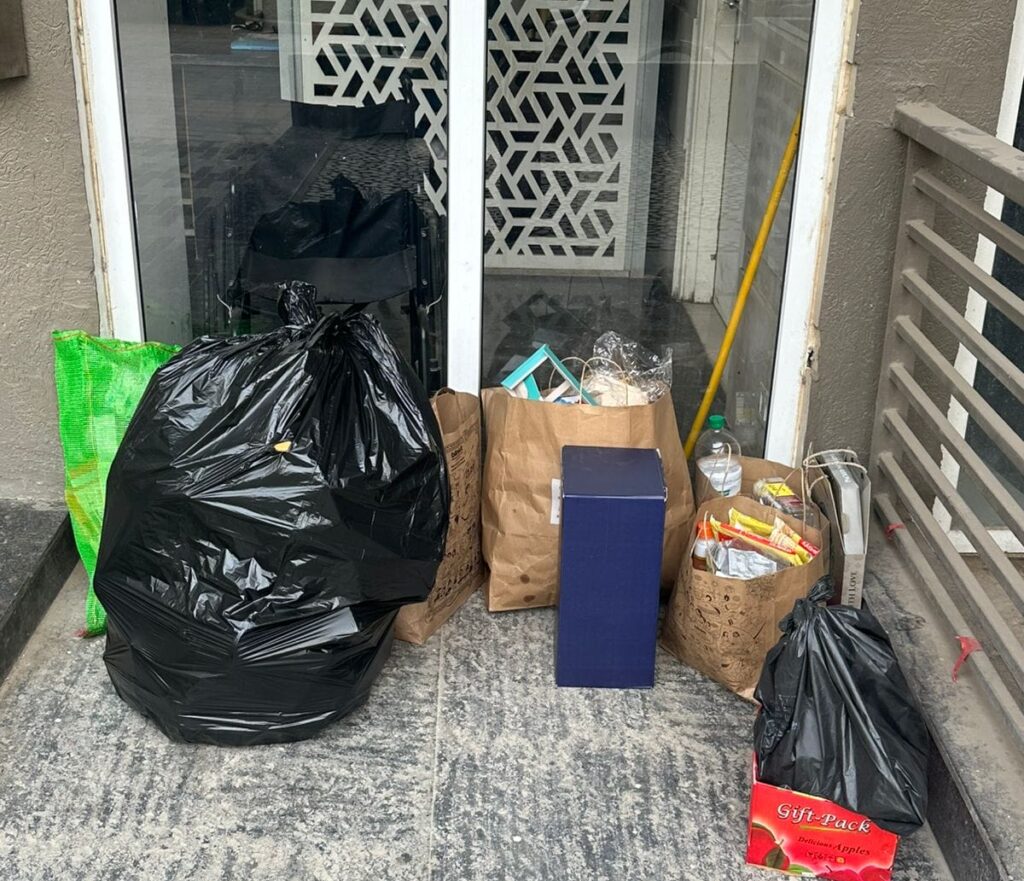
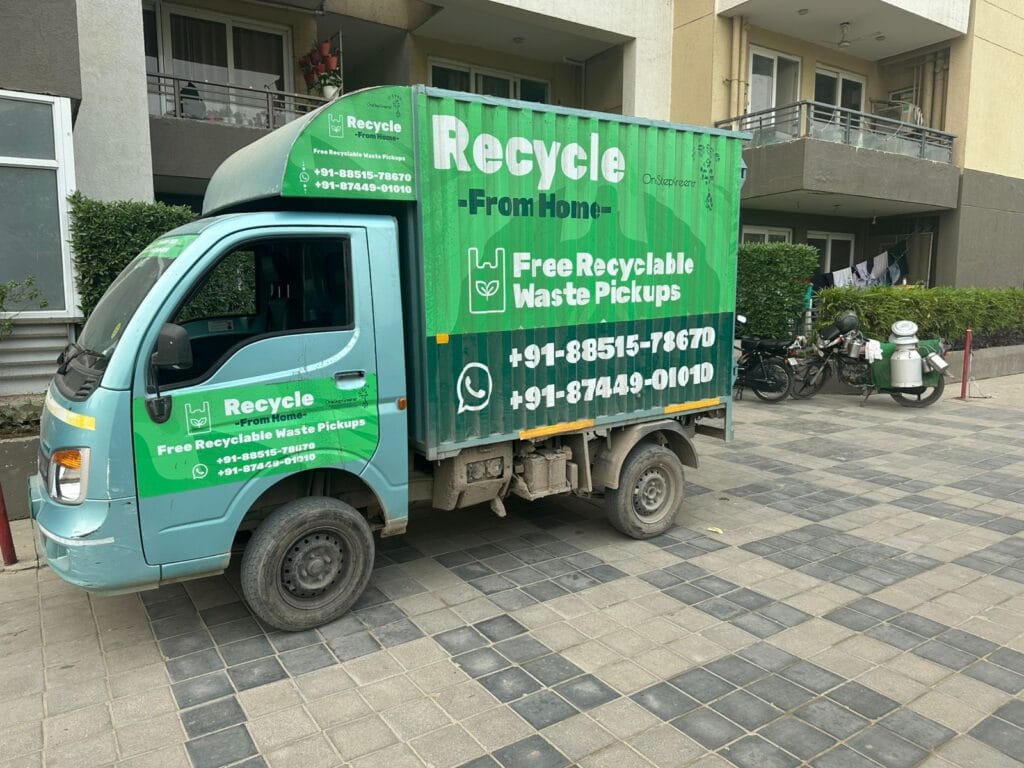
Every Saturday morning, between 8 am and 10 am, Harsha Tiwary, a resident of Tulip Violet Society, deposits her bag of dry waste at the reception area of her tower. The Tulip Violet Society is a gated complex in Gurugram’s Sector 69, housing nearly 1,000 families. In more than 200 households, this is a regular practice, where dry waste is segregated and stored during the week. This includes items such as plastic bottles, milk pouches, glass, metal and cardboard. Every Saturday, they carry it to their respective reception areas, from where the NGO OneStepGreener picks it up for recycling.
“All dry waste is sent to our Material Recovery Facility (MRF), where it undergoes hyper segregation into 50 categories, and each material is then processed differently to make it recycling-ready,” says Vihaan Agarwal, Co-founder, OneStepGreener. The products made from recycled dry waste can be anything, he says: from bottles and clothing to mobile covers. The NGO claims to collect 80 to 100 tonnes of dry waste every month from apartments and individual households in the city.
“It’s so heartening to see how this small initiative has turned into a collective movement,” says Harsha, “What started with a few concerned citizens has now become a community-wide movement.”
Read more: Struggle to stay sustainable: Learnings from a Mumbai community aiming to go zero waste
What inspired Tulip residents to initiate a dry waste collection initiative?
“Before I moved to this society, I was in Mumbai where I found waste segregation to be taken much more seriously. The city sported big hoardings affirming ‘Majha Kachra, Majha Zimmedari (My waste, my responsibility)’. But the scene in Gurugram was different,” says Divya Dhingra, another resident of the society. Here, Divya found that while residents segregated dry and wet waste, they weren’t being processed in the same way by waste workers who came to collect it. Eventually, they ended up being mixed with wet waste.
This triggered her, and she connected with like-minded people to discuss and find a solution. “We then looked for some NGOs nearby that collect dry waste. Initially, the volume of waste collected was too low — 31 kg over an entire fortnight — so most organisations declined to pick it. But OneStepGreener agreed to go ahead regardless of the low volume, and also educated us about segregation and their collection process.”
Harsha adds, “Every year, we hear about the rising levels of pollution. We are living in a time where the effects of climate change are no longer distant warnings—they are happening all around us, not just in metro cities but even in remote villages and once-pristine places. Plastic and trash are visible everywhere—on roadsides, in water bodies, and, shockingly, even being consumed by cows and other animals. This disturbing reality is what inspired us to take action.”
Gaining momentum through persistence
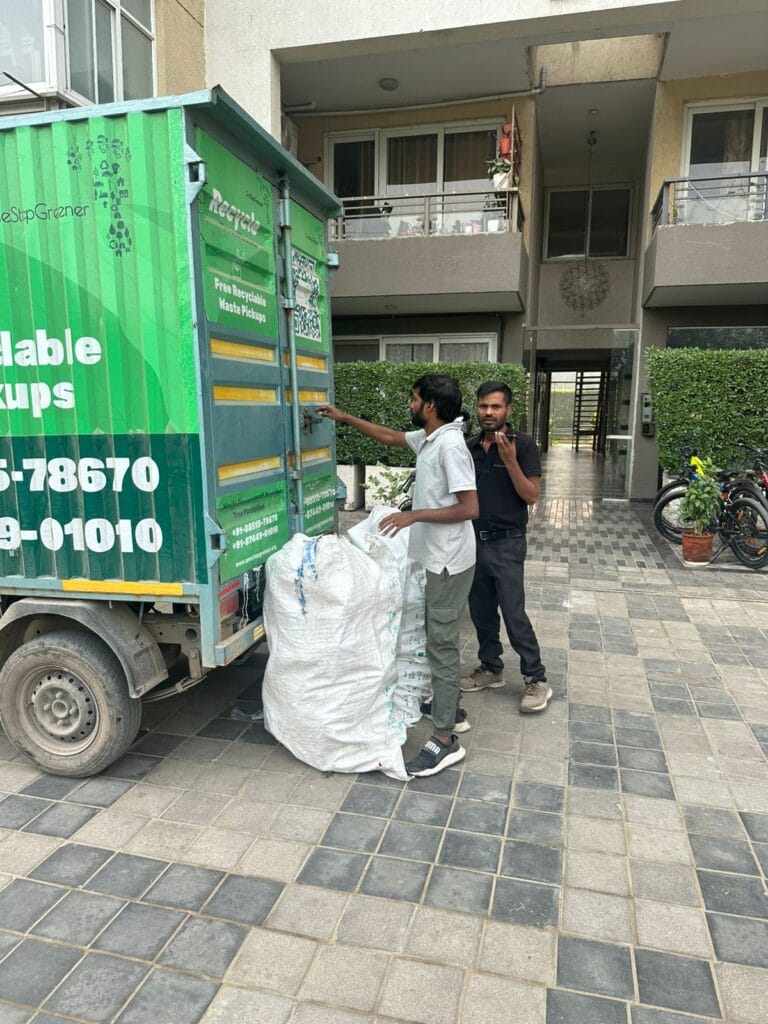
Despite a strong environmental focus, the initiative didn’t take off from day one. Initially, the response was lukewarm at best. There were only a handful of environmentally conscious residents who stepped forward. “We got some 6–7 queries and had some 50–60 people showing interest. But that has changed now,” says Harsha.
She attributes the shift to sustained grassroots efforts. “We relied on word of mouth and consistently raised pressing issues of sustainability and cleanliness in our WhatsApp group and discussions. The information about this initiative is shared regularly to encourage more members to join us,” she adds.
Kopal Rastogi, a resident who recently joined the initiative, says, “The information about this initiative had been circulating for a while, but we weren’t paying attention. It was the consistent effort that finally moved us. Since there’s no restriction on the type of dry waste we can dispose of, it’s convenient. Earlier, we had to store it and wait for kabaadiwallahs, who weren’t willing to take everything. Now, we’ve also become more conscious of how much waste we generate.”
Presently, the community segregates and collects approximately 150 kg of dry waste every week. “We even educated and trained our domestic help not to throw the dry waste in the bin, but keep it separately. It took us a few months, but they learnt this trade eventually,” says Divya.
A growing community-led initiative
In just two years, the response has grown immensely. The residents have rerouted 10,000 kg of dry waste to the NGO for recycling. “We’re proud to have played a role in minimising this impact and promoting responsible waste management,” she adds.
Yet Divya explains that limited space remains the biggest barrier to scaling this initiative. “Even as we build awareness, some residents are discouraged by their parents or in-laws because the waste has to be stored for a week at home. A shared space could work, but without proper monitoring and clear rules, people may start dumping mixed or wet waste there. This will defeat the purpose and create unhygienic conditions. We are looking forward to the RWA’s support on this with clear rules, regular checks, and awareness for all residents,” she adds.
Read more: How Project Mumbai helped divert 70 tonnes of plastic from landfills
| At a Glance: Tulip Violet Society’s Dry Waste Management Process Home Sorting: Residents separate dry waste throughout the week—items such as plastic bottles, milk pouches, metal, and cardboard, and rinse them clean. Wet and other organic waste are handed over daily to the household staff of the society for disposal. Saturday drop-off: Every Saturday between 8 am and 10 am, over 200 households bring their dry waste to the reception area of their respective towers. NGO collection: The NGO OneStepGreener collects the dry waste and transports it to their Material Recovery Facility (MRF) for further segregation and recycling. |
Inspiring others
What’s encouraging is that their initiative has had a ripple effect, inspiring nearby societies to join hands with them and replicate the model. Says Anika Manglik, a resident of Shri Vardhaman Victoria Society, Sector 70, “Plastic waste was a major concern for me. While exploring ways to recycle it responsibly, I discovered the initiative by Tulip Violet Society residents. Currently, around 20 families in our society are actively segregating and handing dry waste to the same NGO. What’s truly noteworthy is that the latter collects the material right from the doorstep, making it easier for residents to stay committed. It’s been a year since we began, and we are gearing up to scale it more aggressively.”
What began as a quiet effort has matured into a fairly well-oiled system now. In recognition of its sustained impact and growing momentum, the Resident Welfare Association (RWA) of Tulip Violet Society felicitated drivers of this initiative on August 15th this year.
Residents today are also mindful of contamination and clean all items before handing them over. Families exchange practical tips on reducing waste and living mindfully. “Even while travelling, I keep used items until I can dispose of them in the right place; Our goal is to reduce plastic generation, and ensure that whatever waste is generated is handled responsibly,” says Harsha.
“We try to reduce usage in the first place itself, by taking our own bags for shopping or buying in bulk,” says Divya.
Taking urban waste management to the next level
Offering a broader perspective on urban waste practices, Monika Khanna Gulati, Founder of the citizen awareness and action group NCR Waste Matters, says, “In Gurugram, the issue is not as much about knowledge gaps, and has more to do with structural and behavioural barriers.” She explains that while many households see segregation as an extra effort, the task is often delegated to domestic staff who may lack training or continuity. “Even when residents comply, waste is frequently mixed during collection, eroding trust in the system.”
Monika also flags poorly drafted Request for Proposals (RFPs) between the government and contractors, which do not mandate segregated waste collection and often compensate the collector based on payment through tipping fees by weight; this naturally discourages segregation or performance. “Lack of vision and leadership in the city, with Commissioners being rotated every few months, disrupts any successes achieved in the short term. Limited ward-level composting and processing facilities mean segregated waste often ends up at landfills anyway.”
Read more: Himalayan group urges action on plastic: Less waste, reform, producer accountability
Need for stricter regulations in waste management
She emphasises the need for stronger integration, investment, and enforcement to translate reforms into real outcomes.
Vihaan of OneStepGreener, who is setting up the company’s own recycling plant now, echoes the need for systematic reforms and highlights the urgency of scalable and collaborative solutions. He points to the growing importance of Extended Producer Responsibility (EPR), with stricter regulations set to take effect from March 2026 and expanding beyond plastics. “These changes will push brands to design products in a way that manages waste, and also introduce take-back programmes, implementing reverse supply chains,” he says.
Vihaan also draws attention to the growing innovation in the use of waste materials—from crop residue to plastic, but notes that scaling these efforts remains a challenge. “To move the needle for comprehensive waste management in India,” he says, “we need more research funding in the sector, a stronger pool of skilled professionals and entrepreneurs, and deeper collaborations with large corporations that can operate at scale.”
The need for scale, however, does not detract from the significance of initiatives such as Tulip’s. Gurugram’s source segregation rates (essential for effective waste management) have dropped to a measly 10%, according to recent Swachhta rankings, and a whopping 1,600-2,000 tonnes of waste find its way daily to the Bandhwari landfill site shared by Faridabad and Gurugram. In such a scenario, citizen-led models like this offer a glimmer of hope. While the reduction in landfill volumes from this initiative, or other similar ones, remains to be measured, it has already transformed waste habits across two residential societies, turning passive disposal into active, community-led responsibility.
Note: Verification of the back-end recycling processes of dry waste collected is underway. This story focuses on citizen-led habit formation and community mobilisation.
Also read:
- Let’s rethink waste: Why cities must move from incineration to cleaner solutions
- Green Chennai Initiative: North Chennai coalition challenges toxic Waste-to-Energy plans
- Invisible workers, visible waste: Bengaluru’s waste pickers struggle without recognition