In September 2021, a mother-daughter duo was killed due to a fire that broke out in an apartment near Bannerghatta Road. After the incident, whether in the media or discussions with friends and colleagues, there was a sudden interest and surge of questions on who can be held accountable for fire accidents in high-rise buildings. Just last week, another fire in an apartment near Electronic City brought the issue into focus again.
Often, people conclude that fire accidents occur due to the negligence of builders. The builders might either construct buildings in violation of the sanctioned plan or resort to corruption and procure Occupancy Certificates (OC) without complying with applicable laws.
However, what about the residents and owners of apartments in these buildings? Are residents merely victims or do they also have responsibilities under the law? If yes, where does the builder’s responsibility end and residents’ responsibility begin?
Read more: Find out if your building is too secure to be safe
What do rules say?
On 7th July 2011, pursuant to the orders passed by the Hon’ble High Court of Karnataka in a writ petition filed by the Beyond Carlton Trust, the Government of Karnataka issued a notification specifying the measures to be followed by builders, owners and residents to prevent fire hazards in high-rise buildings, that is, buildings measuring 15 metres and above in height.
One such measure which was notified, is the requirement to receive Fire Safety Certificate, which we generally refer to as the NOC from the Fire Department, before the BBMP can issue an Occupancy Certificate. The builder usually takes on this responsibility.
But, what happens once an OC is procured, by which time the builder would have exited the project? Interestingly, the notification concerns ensuring of fire safety after occupancy as well.
Residents’ obligations for fire safety compliance
Under the notification, to ensure regular compliance with fire safety laws, three main obligations have been imposed on residents and Resident Welfare Associations (RWAs). These come into play once residents start occupying apartments.
First, the Fire Safety Certificate issued by the Fire Department must be renewed once in two years with the BBMP.
Second, residents must ensure that biennial checking of the apartment complex is conducted by a Fire Officer along with a representative of the RWA. At this juncture, a report will be formulated by the Fire Department explaining the compliances and lapses.
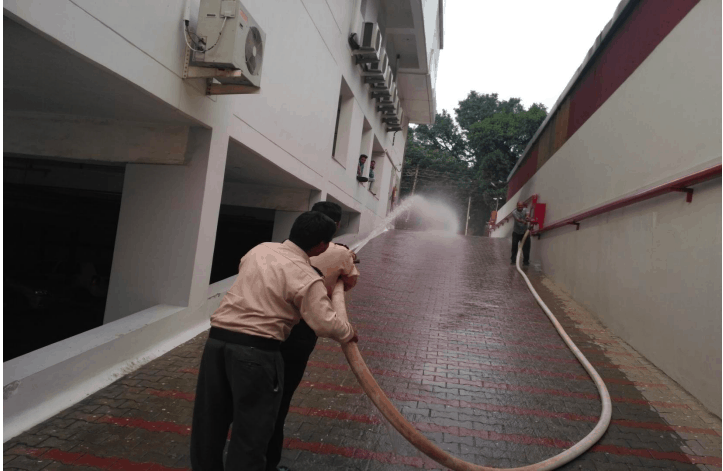
Finally, every two years, the RWA should furnish an affidavit explaining the working condition of the fire safety system along with the report of the Fire Officer, to the Fire Department and the BBMP. Surprise checking could also be conducted by the inspecting officer nominated by the Fire Department once in two years to ascertain the same.
The notification clearly says the residents and the RWA are responsible for renewing the certificate, conducting biennial checking and submitting an affidavit of compliance. Their failure to comply could result in consequences under the law.
What are the consequences of failing fire safety compliances?
If the lapses notified in the report are either not rectified or if rectified are not informed to the officer of the Fire Department within three months of such notice, not only will BESCOM (Bangalore Electricity Supply Company Ltd) disconnect electricity connections to the building but the building itself will be sealed to prevent fire hazard. BBMP will also have to suspend the Occupancy Certificate issued.
Read more: “Apartments are at greater risk for fire than firecracker factories”
Residents can enter or exit the building only after the lapses notified in the report are rectified. Further, Occupancy Certificate will have to be procured afresh from BBMP after producing certificate of compliance issued by the Fire Officer. Failure to comply with the notifications can result in the Fire Department launching criminal prosecution under the provisions of applicable laws.
Whenever people come across gruesome accidents, whether it be the fire accident at Carlton Towers or the apartment fire near Bannerghatta, they tend to assume they will never be at the receiving end. However, residents and owners can no longer avoid accountability for fire hazards that may or may not occur due to their neglect and ignorance by merely blaming the builder.
As a resident, we may avoid fire hazards, but we cannot avoid accountability under law.