File your objections or suggestions on plastic ban before Nov 27, 2015

There won't be plastic cups and plates, sheets and carry bags if the ban comes into effect. This is your chance to file objections or suggestions on the issue.

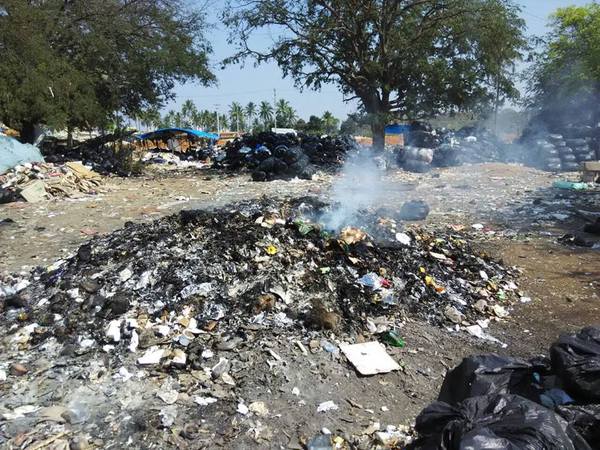
Heap of plastic burnt at one of the illegal garbage burning sites in Seegehalli. Pic: BWRCA’s FB page

The State Ministry of Forest, Environment and Ecology has invited objections / suggestions from public on the draft notification for plastic ban in the State.

The government issued draft notifications on October 28 that seeks to ban various plastic based products. The draft notification proposes to prohibit the manufacture, supply, store, transport, sale and distribution of plastic carry bags, banners, buntings, flex, plastic plates, plastic cups and plastic sheets, irrespective of thickness.

However, the draft notification gives exemption to manufacturing plastic carry bags for the purpose of export. It also exempts the use of plastic bags or plastic based products used in nurseries, dairy industry, health sector and any other sector for non-consumptive use.

Public can file objections / suggestions within 30 days of the date of issuing draft notification, i.e on or before November 27, 2015.

Read the draft notification below.

Plastic Ban in Karnataka – Notification Gazette

Related Articles

Sanjay Nagar shopkeepers stop giving plastic carry bags, launch ‘Rent a Bag’
Yes or no to plastic bags?
Plastic can be dangerous in many ways
BBMP wakes up, plastic carry bag ban from today
Paper or plastic? Styrofoam or glass?
New campaign to cut down plastic launched
Plastic producers vow to help enforce ban on plastic below 40 microns

Comments:

  1. deepak says:

    Banning complete plastic is not good
    Many jobs will be lost
    Kindly provide alternative of plastic to public
    Instead of complete ban think of waste management solutions

Leave a Reply

Your email address will not be published. Required fields are marked *

Similar Story

The wild in the city: What citizen scientists tell us about Bengaluru’s biodiversity

Spatial and temporal biodiversity patterns, as observed by citizen scientists in the city during 2016-2025, were studied at a datajam in December 2025.

Imagine you’re out on a morning walk, phone in hand, when you spot a butterfly you’ve never seen before. You snap a photo, log it into a citizen science app, and voila! You’ve just contributed to crucial biodiversity monitoring. This isn’t just a hobby; it’s part of a global movement where ordinary people collect, record, and sometimes analyse data about plants, animals, and ecosystems. Citizen science stretches the reach of ecological research. Every observation adds to unique longitudinal datasets that reveal phenology — periodic events in the life cycle of a species — along with species distribution shifts and population…

Similar Story

Air quality management is a governance problem, not just an environmental one

Despite massive funding, Indian cities face weak governance, poor data, and limited capacity, as air pollution continues to worsen.

Indian cities are struggling to breathe. Air pollution is a year-round governance challenge. In 2024, 35 of the 50 most polluted cities globally were in India, with PM2.5 concentrations above 66.4 μg/m3. This is at least 13 times the World Health Organization (WHO) guidelines and at least 1.6 times the National Ambient Air Quality Standards (NAAQS) in India. Citizens continue to bear the brunt of worsening air quality, and urban local governments (ULGs) are at the forefront of the problem, being primarily accountable for their citizens' first mile. While they do have a role to play in addressing this threat,…