File your objections or suggestions on plastic ban before Nov 27, 2015

There won't be plastic cups and plates, sheets and carry bags if the ban comes into effect. This is your chance to file objections or suggestions on the issue.

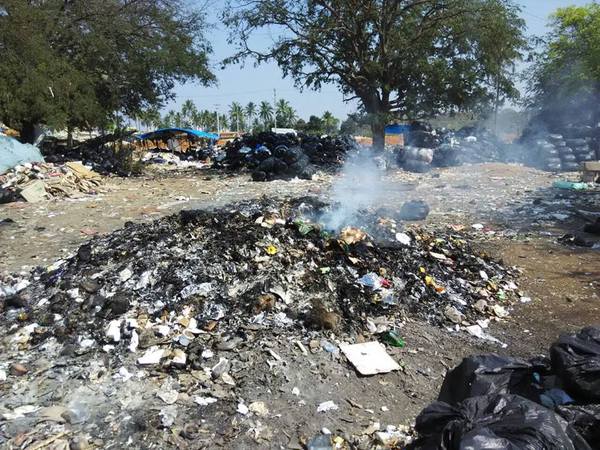
Heap of plastic burnt at one of the illegal garbage burning sites in Seegehalli. Pic: BWRCA’s FB page

The State Ministry of Forest, Environment and Ecology has invited objections / suggestions from public on the draft notification for plastic ban in the State.

The government issued draft notifications on October 28 that seeks to ban various plastic based products. The draft notification proposes to prohibit the manufacture, supply, store, transport, sale and distribution of plastic carry bags, banners, buntings, flex, plastic plates, plastic cups and plastic sheets, irrespective of thickness.

However, the draft notification gives exemption to manufacturing plastic carry bags for the purpose of export. It also exempts the use of plastic bags or plastic based products used in nurseries, dairy industry, health sector and any other sector for non-consumptive use.

Public can file objections / suggestions within 30 days of the date of issuing draft notification, i.e on or before November 27, 2015.

Read the draft notification below.

Plastic Ban in Karnataka – Notification Gazette

Related Articles

Sanjay Nagar shopkeepers stop giving plastic carry bags, launch ‘Rent a Bag’
Yes or no to plastic bags?
Plastic can be dangerous in many ways
BBMP wakes up, plastic carry bag ban from today
Paper or plastic? Styrofoam or glass?
New campaign to cut down plastic launched
Plastic producers vow to help enforce ban on plastic below 40 microns

Comments:

  1. deepak says:

    Banning complete plastic is not good
    Many jobs will be lost
    Kindly provide alternative of plastic to public
    Instead of complete ban think of waste management solutions

Leave a Reply

Your email address will not be published. Required fields are marked *

Similar Story

Reviving the Cooum: Need for innovation, enforcement and shared responsibility

An analysis reveals how this Chennai river is affected by sewage dumping, encroachment of buffer zones and unchecked urban growth.

The Cooum River, once a sacred river that shaped the history of Madras, has now become a sad sign of urban degradation. For the millions of residents in Chennai, it has transformed into a malodorous, polluted, and stagnant channel, burdened with solid waste accumulation and extensive encroachments along its banks. During a recent datajam organised by Oorvani Foundation and OpenCity, we used Geographical Information System (GIS) datasets and population analytics to investigate the underlying causes contributing to this crisis. The results show that rapid urbanisation, inadequate provision of essential civic infrastructure, and the absence of coherent policy frameworks, along with…

Similar Story

Pallikaranai at a crossroads: Expert warns of irreversible damage to Chennai’s last great marshland

In an interview, naturalist Deepak V says the government must publish ecological maps marking wetlands and waterbodies to boost public awareness.

The Pallikaranai Marshland, one of Chennai’s last remaining natural wetlands, has long been a site of ecological tension. Its designation as a Ramsar site brought national and international recognition, along with renewed expectations for strong conservation measures. Yet the marshland continues to face intense pressure from urban development, infrastructure projects and real estate expansion.  Recently, Arappor Iyakkam, an anti-corruption organisation, alleged that state agencies illegally cleared environmental and construction approvals for a large high-value housing project within the Ramsar boundary. As the matter unfolds, it reveals how regulatory gaps and political inaction make the marsh vulnerable. Meanwhile, residents of Tansi…