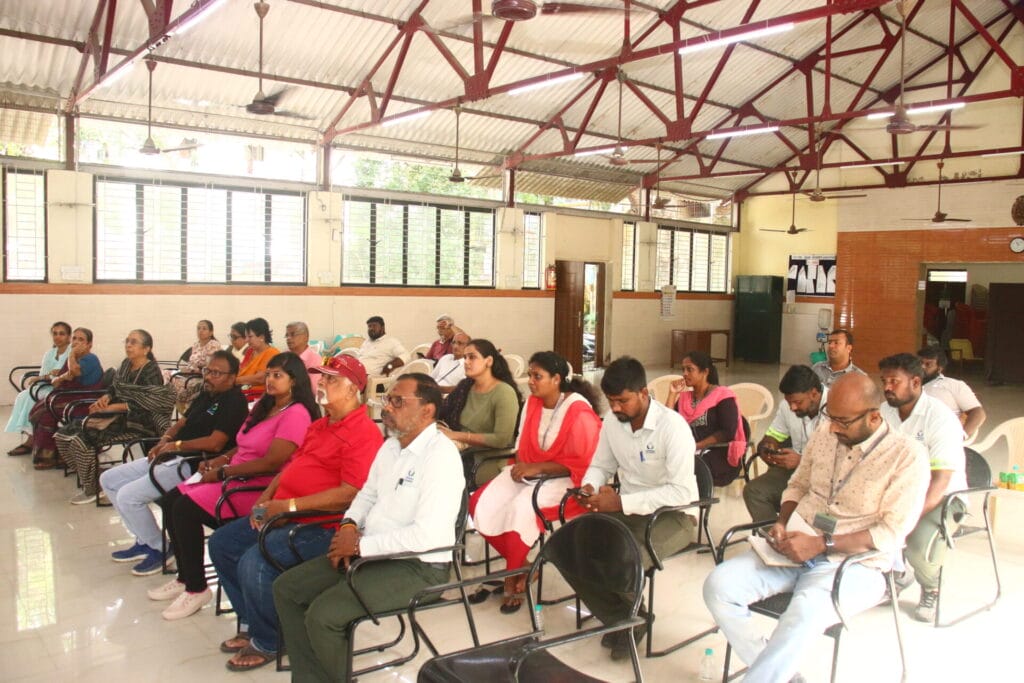
A few months ago, our federation in South Chennai’s Adyar area hosted a meeting with Urbaser Sumeet, the private garbage collection agency responsible for waste management in Besant Nagar, Adyar, and Thiruvanmiyur. This event was part of the Federation of Adyar Residents’ Association’s (FEDARA) regular catch-up meetings with the Urbaser team. It aimed to address residents’ feedback and get a clear understanding of the agency’s challenges in garbage collection and segregation. The goal was to ensure that waste management continues to improve while fostering cooperation between the residents and the waste collection agency.
Concerns about lack of source segregation
The meeting provided an opportunity for Residents’ Welfare Associations (RWAs) and their representatives from Adyar, Thiruvanmiyur, and Besant Nagar to voice their concerns. Each RWA was encouraged to compile a list of issues to discuss with Urbaser.
Various issues were discussed during the meeting, with a particular focus on source segregation compliance, a crucial part of the city’s waste management strategy. Residents raised concerns about whether source segregation is being followed consistently across all wards in Zone 13. The need for increased awareness and education about segregation practices was another topic of discussion. Many residents expressed their concerns about defaulters, who don’t segregate waste as required.
Read more: Packaging waste: Why brands and consumers must act together to address the issue
Janaki, a resident of Adyar, said, “I have a complaint about residents and not the waste collection agency. We throw the waste outside the bins and not inside them, which makes the space around the public bins unclean. We need to change ourselves first.”
In response to these concerns, Urbaser shared that their Information, Communication and Education (ICE) team is conducting an ongoing door-to-door awareness campaign to educate residents and encourage better compliance with source segregation guidelines.
Kamakshi Patti, a prominent civic activist based in Besant Nagar, suggested that she be included in the awareness programmes. By engaging with defaulters directly, the team mentioned that they want to improve waste segregation at the source, which will ultimately streamline the process before waste reaches composting sites or landfill areas, saving time and resources.
Maintaining cleanliness of roads
I also raised a few points during the meeting. These include discrepancies in the garden waste clearance schedule, the disturbances caused during mass cleanings, and the need for mechanical sweepers in the inner roads. Bins are often left in the middle of the road after they were lifted to empty garbage. Many of these bins are often overflowing with garbage. The problem of overflowing garbage was echoed by other residents as well, with some recommending that a bin-less approach might help solve the problem, putting pressure on residents to source segregate as a result.
H Vembu, a resident of Padmanabha Nagar, pointed out that when bins are lifted by the compactor, the entire waste is often not emptied, leaving the area unclean and smelling of garbage until the next pickup. Others have raised concerns about the illegal dumping of construction and demolition waste in public areas by residents and echoed the issue of irregular garden waste collection schedules.
Acknowledging progress and challenges
Over the past seven years, Urbaser has made significant strides in improving waste management in the region. Many attendees highlighted the clean roads and reliable garbage collection. However, the consensus was that the problem still lay in poor source segregation. Proposed solutions included providing coloured bins to residents, emphasising established channels for direct communication with Urbaser, and encouraging residents’ involvement in garbage collection activities in public spaces, such as beach cleanups.
The meeting concluded with a call for continued collaboration between the residents and Urbaser. We have urged Urbaser to proactively maintain cleanliness on the streets and work towards keeping our community tidy and pleasant. While many of the concerns raised stemmed from a lack of awareness among residents, it is clear that there is a shared desire to work together for a cleaner environment.
Specific concerns and responses
- Garden waste clearance schedule:
- Concern: Discrepancies in the garden waste clearance schedule.
- Urbaser response: The garden waste is typically cleared promptly, but efforts will be made to improve the schedule to prevent delays.
- Mass cleaning disturbance:
- Concern: Disturbances caused by mass cleaning and the need for clarity on its necessity. Sand still gets accumulated daily in many streets.
- Urbaser response: Mass cleaning is occasionally required to clear sand accumulation from roads, despite previous cleaning efforts.
- Mechanical sweepers for inner roads:
- Concern: Request for mechanical sweepers on certain inner roads.
- Urbaser response: Due to the narrowness of these roads and the presence of speed breakers, it is not feasible to deploy heavy vehicles in these areas.
- Overflowing bins and bin placement:
- Concern: Complaints about bins being left in the middle of roads and overflowing bins after compactor lifting.
- Urbaser response: The CEO has instructed the supervisor to investigate bin placement issues and to analyse waste generation patterns on a street-by-street basis to prevent overflow.
There is an issue of noise made by the audio systems fitted in individual battery operated buggies. They have a music and a song. Broadcasted thru bad audio system. Imagine some thousands of noise buggies going thru entire city, creating noise pollution for collecting waste!!
Of late may be some change has occurred -not sure. However taking cue, every vegetable vedor blares thru public address system.
Area:Sholinganallur