Ever since the contentious Mamallan reservoir was proposed in the ecosensitive Kovalam–Nemmeli backwater system, fisher communities in Chennai have repeatedly asked: Does it have to be here? Experts and scientists say no, urging the government to abandon the project and work on sustainable alternatives.
Critics point to a long list of costs: high expenditure, land acquisition, and risks to livelihoods and biodiversity. As we have reported earlier, the central concern driving the project is the looming drinking water supply crisis – demand is projected to rise from 1,100 million litres a day (MLD) to over 2,500 MLD for the Greater Chennai Corporation and the rest of the Chennai Metropolitan Area by 2035, according to the environmental impact assessment (EIA).
In this context, the Mamallan reservoir is expected to supply about 1.65 TMC of water to the city. Previously, we have written about the risks to livelihood, and flooding. In a press statement, over 20 scientists urged the state to recognise the wetland as a protected site, proposing that it be named Mamallan Lagoon.
First, where is Chennai getting its drinking water from?
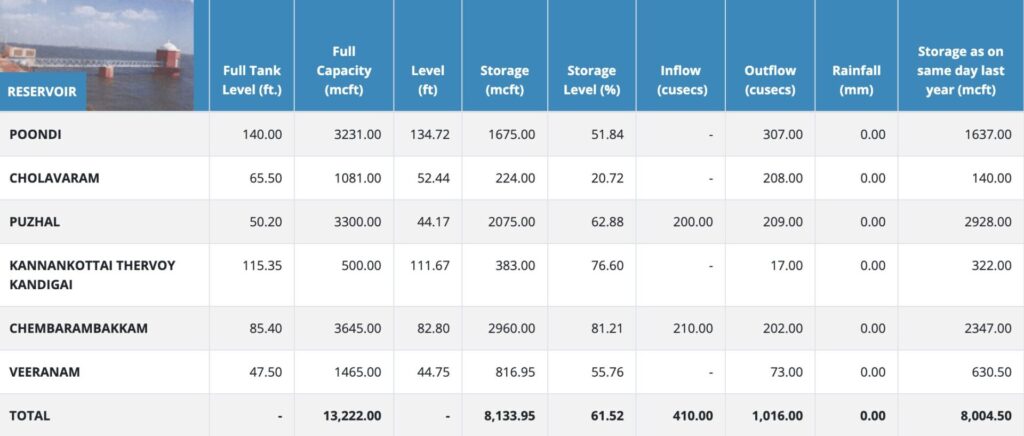
Till about 1870, Chennai residents depended on wells in their houses, public wells, neighbourhood tanks and then, organised supply began in 1872, according to the CMWSSB website. Of the six reservoirs, the city’s water needs largely depend on tanks like:
- Chembarambakkam
- Poondi
- Puzhal
- Cholavaram
Chennai currently has three desalination plants, the first inaugurated in 2010. These plants convert seawater to freshwater, through the Reverse Osmosis method. They are:
- A 100 MLD desalination plant at Kattupalli, Minjur.
- A 100 MLD plant and 150 MLD plant at Nemmeli.
The fourth desalination plant, at a cost of ₹6,078.40 crore, is coming up in Perur along the East Coast Road with a capacity to treat 400 MLD of seawater a day. It is expected to begin trial commissioning by September this year and aims to have a continuous production capacity of 200 MLD at any given time. However, the 100 MLD desalination plant at Minjur has been under repair for several months, but is expected to resume operations shortly.
But is this enough?
“Chembarambakkam, Poondi and Red Hills collectively have a total annual capacity of 11.3 TMC. This can easily supply 1,000 MLD to Chennai,” explains A Veerappan, former Special Chief Engineer, Tamil Nadu Public Works Department (PWD) and currently the general secretary, Tamil Nadu PWD Senior Engineers Association.
Conditions for a good reservoir
The EIA for the proposed Mamallan Reservoir Project, makes an argument in favour of coastal reservoirs, saying that they “allow for the storage of water in estuaries, capturing excess floodwaters from the entire catchment area.” But experts refute this claim.
Given the high cost of construction and the damage to livelihoods, Veerappan points out that a coastal reservoir in the Kovalam-Nemmeli backwater is not feasible. Planned across a low-lying stretch between Thiruvidanthai and Kokilamedu, the project would replace brackish marshland with a freshwater facility.
“From Vagai dam in Madurai to Bhavani Sagar in Erode, true reservoirs form in valleys, flanked by rocky mountains and deep drops of 100–200 feet, conditions that are absent here,” Veerappan notes.
While the project agenda plans for a higher embankment, he warns of seawater intrusion, as highlighted previously. This would lead to salinity in the freshwater reservoir, defeating its purpose.
Focus on a decentralised system
According to the EIA, no other options were explored or alternative sites examined for the project. “We cannot accept that there are no alternatives and we are creating disasters with many projects like this, ” argues geologist Pradeep Elangovan.
Instead of a mega-scale project, Pradeep suggests a decentralised approach, focusing on strengthening, desilting and maintaining the current tanks and waterbodies across other districts. As water supply needs grow in parts of the state like Tiruchy, he urges the government to redirect its attention there.
Similarly, there are over 3,600 hydrologically well-connected waterbodies in the adjoining three districts of Tiruvallur, Kancheepuram and Chengalpattu. As we’ve written before, these tanks can be desilted and deepened so they get filled during heavy rainfall, mentions S Janakarajan, the President of the South Asia Consortium for Interdisciplinary Water Resources Studies (SaciWATERs), Hyderabad and former Professor and Director at Madras Institute of Development Studies (MIDS).
Read more: Chennai needs an integrated water management system to prevent floods and drought: Dr S Janakarajan
Desilting and deepening reservoirs
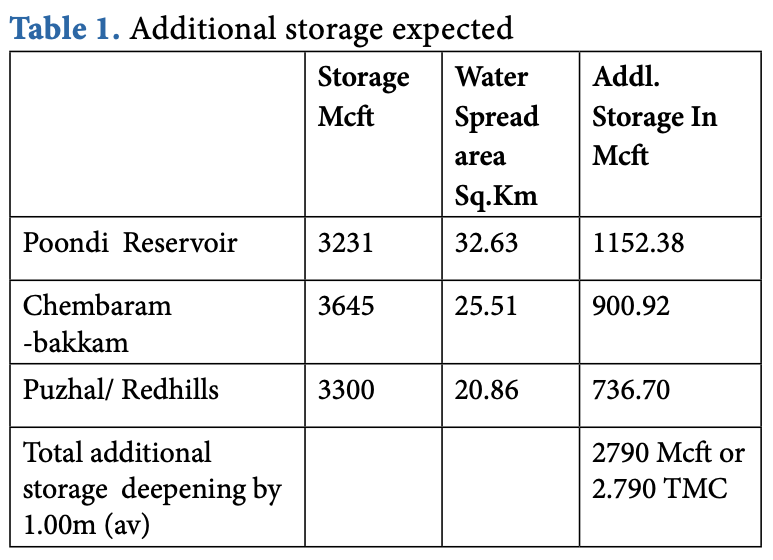
Meanwhile, the Mamallan project is estimated at over ₹400 crore. Veerappan, however, proposes an alternative at just ₹100 crore. “If you desilt and deepen Poondi, Chembarambakkam, and Puzhal reservoirs by one metre each, then you will get an additional 3 TMC,” he says. That’s higher than the capacity of the Mamallan Reservoir, which is projected to be 1.65 TMC. He adds that this revenue generation model could be outsourced to the promoters of National Highways and contractors.
In a paper titled ‘A New Project for Augmenting Drinking Water Supply to Chennai City by forming new Reservoir near Kannankottai and Thervaikandigai, Thiruvallur District, Tamilnadu – An Alternative Efficient & Cost Effective Proposal,’ authored along with M Lakshmipathy, he breaks up the costs and points to additional storage expected:
Another option Veerappan suggests is desilting 505 rain-fed tanks in Tiruvallur, Chengalpattu and Kancheepuram. “If they are desilted, they will give an additional 8 TMC of water. Mamallan reservoir is unproductive and needs to be abandoned,” he highlights.
Meanwhile, Metro Water officials have argued that setting up water treatment plants (WTP) near multiple, scattered water bodies will be cost-intensive and finding space to build them within the city will also be difficult.
Quarries as supplementary storage
Another alternative that is debated in the public sphere is the diversion of water from existing reservoirs to abandoned quarries near Chennai for water supply.
A 2024 study says that during the summer, reservoirs see a loss of water to evaporation, affecting supply. To avoid evaporation from reservoirs and maximise water usage, the researchers suggest using abandoned quarries as retention ponds to manage water resources.
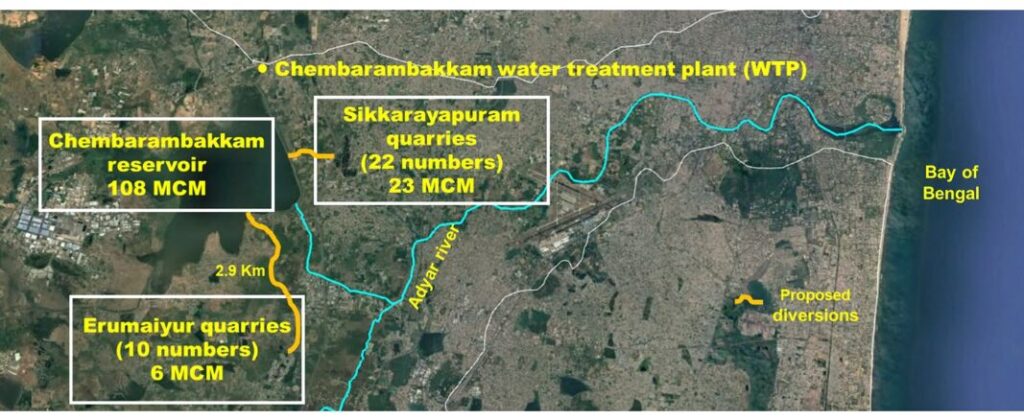
The Sikkarayapuram quarries can hold a capacity of about 22.6 Million Cubic Metres) MCM and the Erumaiyur quarries have a capacity of 5.6 MCM, both amounting to around one-third of the Chembarambakkam reservoir’s capacity (3.645 TMC).
The TDS of the water was assessed and deemed to be fresh, and its recommended usage was domestic water supply after passing through a treatment plant. In 2025, the Water Resources Department (WRD) and Chennai Metrowater had proposed to utilise abandoned quarries areas such as Sikkarayapuram, Tiruneermalai and Chettipunyam in Chengalpattu to add to the city’s water supply.
Rainwater harvesting, a long-term solution
For citizens, instead of relying on reservoirs and desalination plants, groundwater harvesting is a long-term sustainable solution, experts say. It aids water security and could also replenish Tamil Nadu’s groundwater levels, which declined in 29 out of the 38 districts in February 2026, compared to 13 out of 37 in 2025.
Read more: Chennai’s water woes worsen as reservoirs dry up and groundwater levels decline
In the early 2000s, the Tamil Nadu government passed an ordinance mandating rainwater harvesting (RWH) for new buildings in Chennai, with a three-month deadline. But over two decades later, this vision has not translated on the ground amid lackadaisical enforcement and, in some cases, incorrect harvesting structures across plots.
“Rainwater is the predominant source of all freshwater from rivers, lakes, and reservoirs. The city should have decentralised systems like rainwater harvesting,” says Rain Centre executive member Ramshankar N. He points out that while the Tamil Nadu Combined Development and Building Rule (2019) outlines rainwater harvesting guidelines for houses and apartments, most residential areas ignore them or remain unaware. He insists the government must enforce this legislation across neighbourhoods.
According to the Rain Centre, a 2,400 sq ft house in Chennai can harvest two lakh litres of rainwater annually. With proper systems, a family of five can get 100 litres daily, says Ramshankar. He notes that setting up costs ₹30,000–₹1 lakh and takes two rain cycles to streamline. “This will significantly reduce dependence on municipal water supply,” he adds.
However, authorities must stop groundwater contamination by industrial effluents and solid and biomedical waste let into water bodies.
What scientists and experts recommend:
- Restore waterbodies and reservoir systems across Chengalpattu to cater to local needs.
- Restore current wetlands, marking the Nemmeli-Kovalam wetland as a lagoon system.
- Governments to consider decentralised methods water storage.
- Establish use of rainwater harvesting structures and local quarries for water security.
- Enforce rainwater harvesting when new houses are granted approvals. Mandate upkeep of such structures, before monsoon.