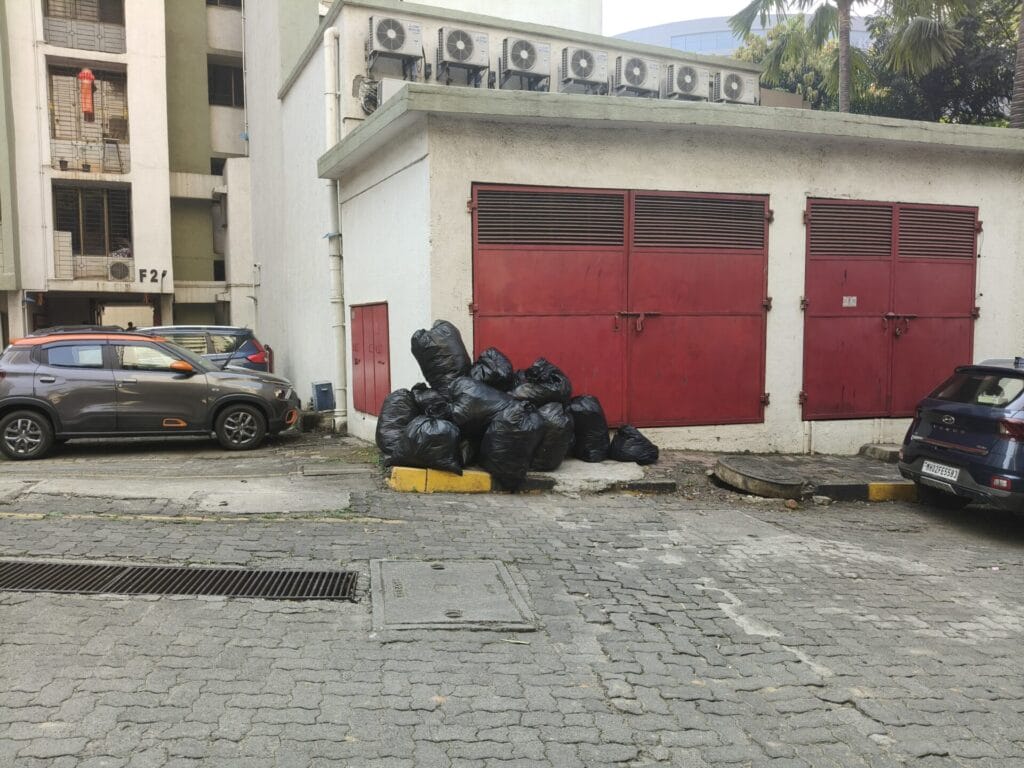
Even as the Mumbai skyline changes with redeveloped buildings of vertiginous heights, towers of another kind loom large over the city’s two dumping grounds. The Deonar landfill, in use since 1927, holds a mountain of garbage 40 metres high. The Brihanmumbai Municipal Corporation (BMC) plans to shut it down by cleaning it up through bioremediation, leaving Kanjurmarg as the city’s sole dumping ground.
According to BMC’s Environment Status Report (ESR) 2024-25, 86% of Mumbai’s daily waste, around 6,300 metric tonnes, goes to Kanjurmarg. However, a Comptroller and Auditor General (CAG) report flags discrepancies: while the BMC records 6,514 tonnes of waste collected daily, the Swachh Maharashtra Mission estimates 9,841 tonnes.
Experts say the city generates waste faster than it can process, highlighting the need for effective solid waste management. And much of it can start at the community level.
Decentralising waste management
“Process the waste at source,” says Kedar Sohoni, founder of Green Communities Foundation, a not-for-profit working in waste management and sustainability. He stresses that food waste should ideally be processed at the ward level, not sent to dumping grounds. Composting at home or within housing societies is the most effective way to decentralise.
But in Mumbai, where space itself is a luxury, allocating areas for composting is rarely a priority. Few want a composting or dry waste centre near their homes. Yet, Kedar points out that vertical home composting setups require no more than two to three square feet.
Stree Mukti Sangathana (SMS), an organisation working with waste pickers, is helping communities, including bulk waste generators, to go zero waste. SMS trains women in sustainable waste practices. Housing complexes can then employ them to compost wet waste within their premises.
Read more: Privatised trash, public cost: Is Chennai’s waste model failing the city?
Vijay Nagar: A community solution
One such community practising decentralised waste management is the Vijay Nagar housing society in Andheri, which has 500 flats across 14 towers. Each house produces around 300 grams of wet waste, amounting to 150 kilograms in total.
When the building was redeveloped in 2012, residents requested the removal of two BMC bins outside their gates. The BMC agreed on the condition that the society would segregate and process its own waste. Resident Varsha Bapat, who was at the forefront of the initiative, says: “It is true that the government needs to take care of this, but we too have a role to play.”
Read more: Dumping garbage at Bengaluru citizens’ doorsteps, but has the government done its job?
Waste processing for bulk generators
The BMC identifies housing societies, among other establishments, which have a plot exceeding 5,000 square feet or generate more than 100 kg of garbage daily as bulk waste generators (BWG) and expects them to process wet waste on their premises.
Due to space constraints, BMC had allowed third-party agencies to process waste from BWGs. They were supposed to segregate the waste and hand it over to these agencies. However, after finding irregularities in the operations of these agencies, BMC halted outsourcing in August 2025. The civic body asked the housing societies to hand over the segregated waste directly to the BMC, causing confusion among bulk waste generators.
Convincing residents was the first hurdle. Many cited a lack of time, the unavailability of three bins, and apprehensions about the foul smell. The first step was to persuade people to use paper liners instead of plastic for the wet waste. Jyoti Mhapsekar of SMS explains that the trick is to reposition the process. Instead of asking people to “segregate” waste, simply ask them to keep their wet and dry waste separate.
Varsha, along with other residents, worked with the 30–40% willing to segregate, rather than grappling with the rest. They made presentations, showed visuals of Mumbai’s garbage mountains piling up in dumping grounds, and distributed colour-coded bins for each flat. Posters and pictorial charts explaining about wet and dry waste were displayed across the colony, even near the lifts. Their efforts paid off, and today, 90% of the society’s residents segregate their waste.
Some houses have senior citizens who may not be able to segregate, or people living on rent who take time to get accustomed to the system.
Jyoti says cost can be an obstacle in the decentralisation of waste, and Vijay Nagar was no different. “People did not want to spend money. So, we broke down the expenses and showed residents that each household has to spend only ₹100 per month,” says Varsha.
Read more: How a gated society in Gurugram has turned dry waste segregation into a civic habit
Wet waste processing
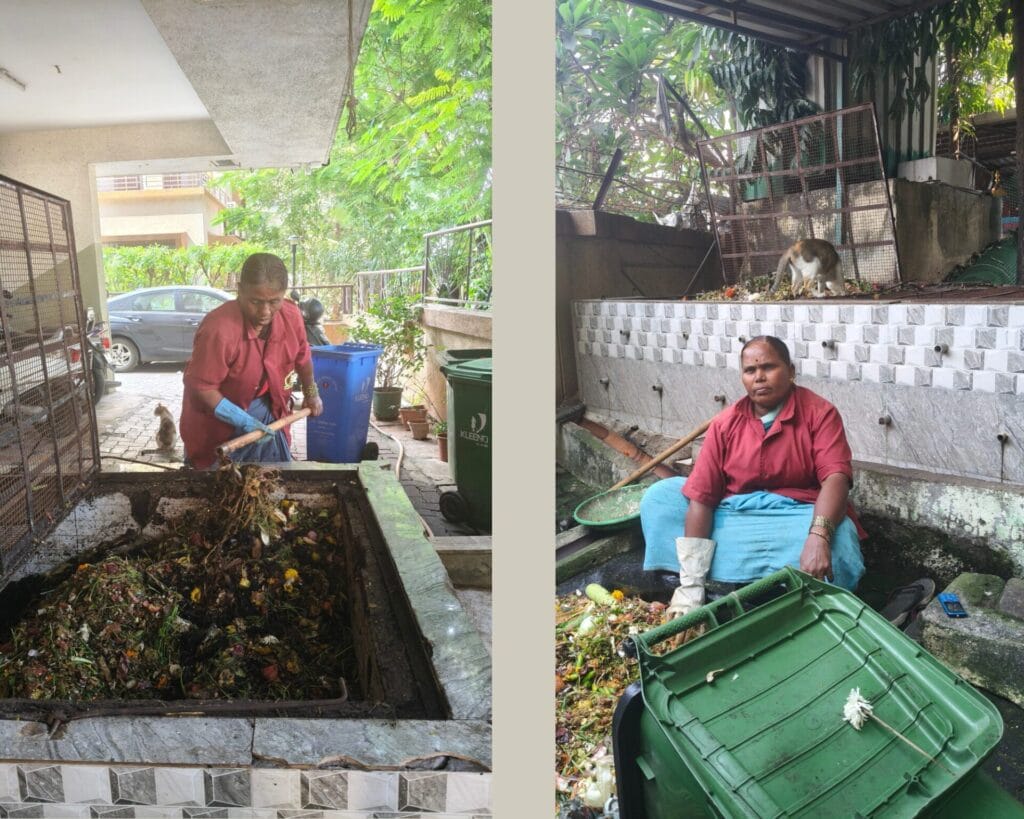
Housekeeping staff at Vijay Nagar collect waste in three categories: wet, dry, and hazardous. Dry and hazardous waste is picked up daily by the BMC. Wet waste is processed by three SMS women in five compost pits within the complex. They churn it using a garden fork and add compost from previous batches to process the wet waste.
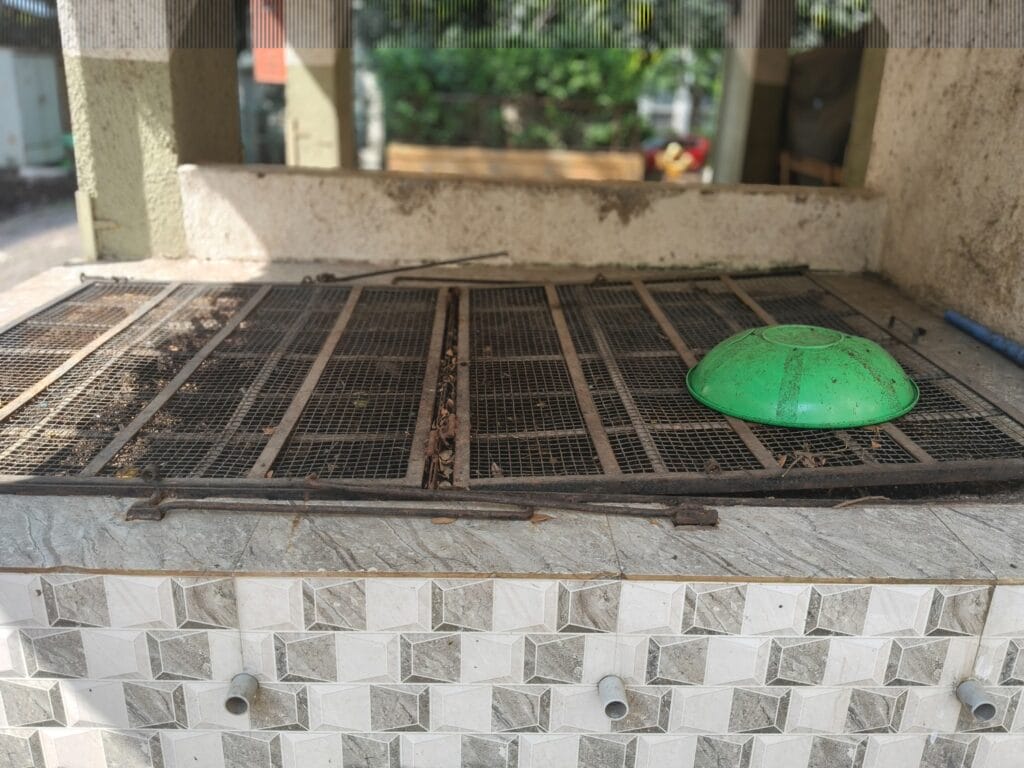
At Vijay Nagar, though space was allocated for compost pits, it is not quite enough, says Varsha. Moreover, the pits were to be built below the kitchen and bedroom windows of some of the apartments. Hence, there was considerable resistance from the residents initially.
Other successful projects by Stree Mukti Sangathana
- Anushakti Nagar (BARC Colony): Biogas plants were built in 2003, but residents were not segregating waste. SMS created awareness among 10,000 families, and today the township is zero waste, diverting nearly eight tonnes of wet waste daily from landfills.
- Mahim Makarand Sahanivas: SMS women have been processing dry waste here for nearly two decades, making the housing complex a model of long-term sustainability.
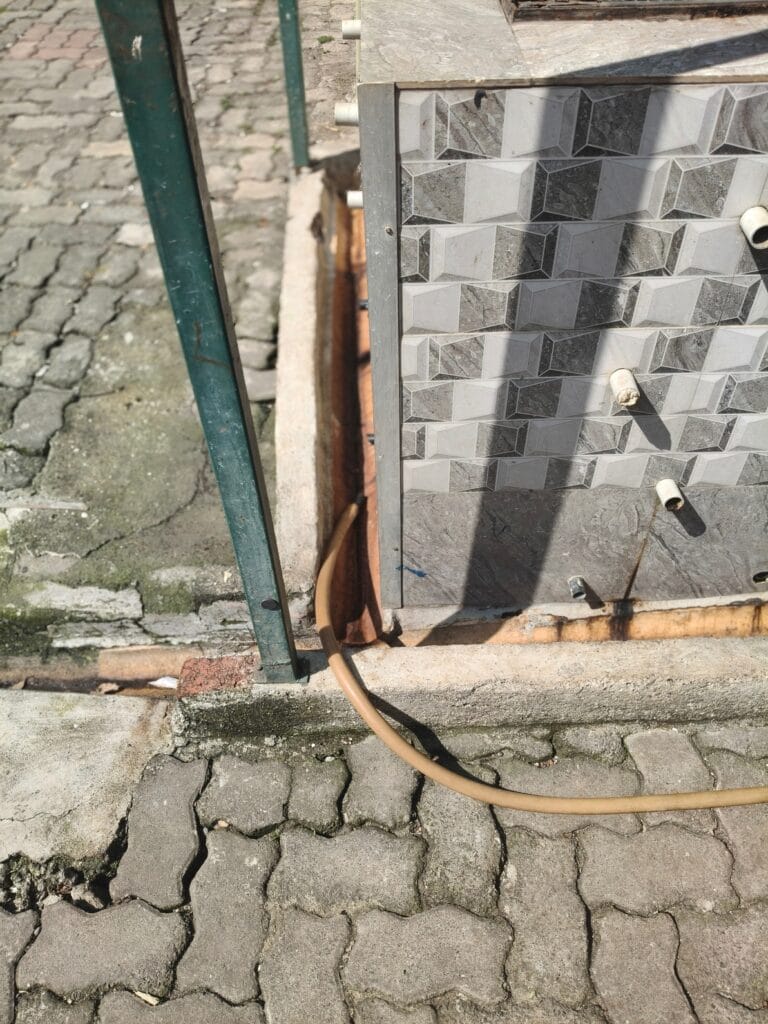
Varsha admits that sometimes a faint smell emanates from the pits, but it is the smell of mud and soil. A slight smell of garbage can arise at times when it is being poured into the pits, depending upon the wind direction. Another source of odour is the leachate, which drains out of the decomposing material. But water is poured down the channels carrying the leachate daily to ensure the smell does not linger.
She adds that corrective measures, such as adding the prepared manure containing bacteria, dry leaves or coconut fibres, are taken to speed up decomposition or when the water content in the waste is high.
The society generates 400 kg of compost each month. It is used for the plants in the complex, and is even sold. In fact, one of the problems the complex faces is the extra compost—they have no place to store it. An incentive, which cemented the initiative’s success, was a cash award the society received. The money was used to set up solar panels in the building.
Changing attitudes
Citizens often blame the corporation, but do not want to take responsibility for their waste. Jyoti points out that waste-related work falls to the lot of caste-oppressed people, and municipal workers are often mistreated. The least citizens can do is segregate their waste. “Why should anyone else put their hands into your waste?” questions Jyoti.
But some societies are initiating change. Moreover, under the Unified Development Control and Promotion Regulations for Maharashtra, housing complexes with a built-up area of 4,000 square metres or more must have systems to process 100% of their waste on-site. Builders are supposed to provide space for this. While this often becomes a ticking-the-box exercise, Vijay Nagar has set a good example.
While it is possible to set up such systems in housing complexes, decentralised waste management faces unique challenges in informal settlements. In the second part of this story, we explore how these challenges can be met.
Also read:
- Poor segregation is choking Bengaluru’s waste system. How can this change?
- Invisible in the heat: Waste workers struggle as Bengaluru gets hotter
- Himalayan group urges action on plastic: Less waste, reform, producer accountability