When Ranjan Gogoi, the former Chief Justice of India, retired from the Rajya Sabha two months ago, his performance in Parliament became a matter of debate. As per an analysis by Livelaw, Gogoi did not ask a question to the government even once during the six years of his tenure and participated in the debate on only one Bill.
More recently, when seven AAP MPs defected to BJP, another analysis by Indian Express revealed that one of these seven defecting MPs, Harbhajan Singh, a former cricketer, had only 26% attendance.
Why do we typically go around digging data on the performance of an MP in Parliament only when they retire or defect or come in the limelight for several other reasons? Why don’t we, the people of India, undertake a regular and routine ‘performance audit’ of our MPs throughout their tenure?
More fundamentally, why do we even need to look at all these parameters of their performance?
Read more: In world’s most populous democracy, citizen concerns struggle to reach Parliament
‘Accountability’ at the heart of our parliamentary democracy
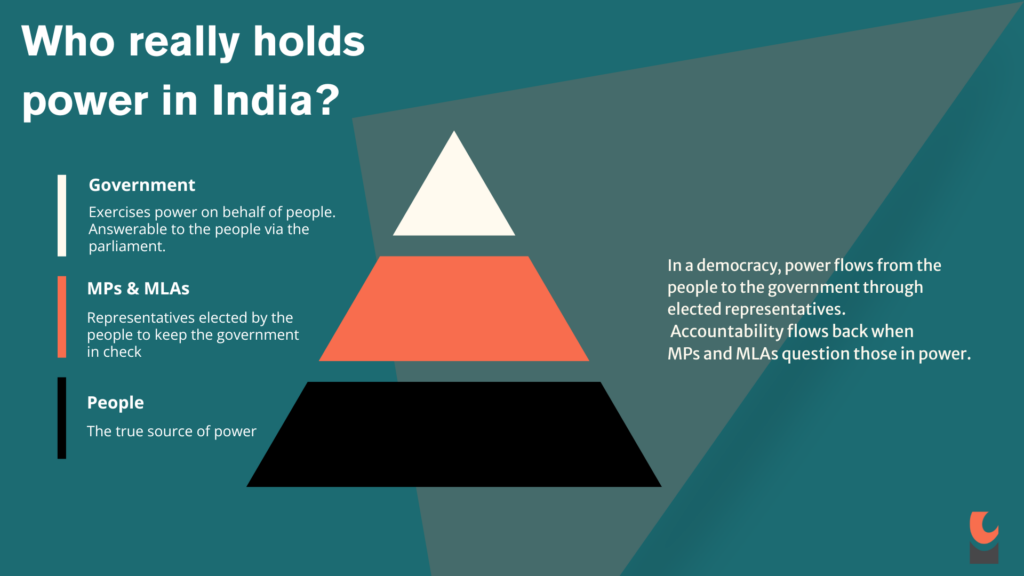
The Preamble to the Constitution describes India as a ‘sovereign’ democracy. A sovereign nation is free from external control; in a democracy, people are the true source of power. This is why democracy is often described as a government ‘of the people, by the people, for the people.’
In India, therefore, power ultimately rests with the people. When we vote, we transfer that power to our elected representatives in Parliament and State Assemblies. Some of these representatives are then chosen to form the government and govern the country. In this way, power flows from the people to the government through the legislative institutions.
But where there is power, there is also a risk of misuse. That’s why it’s so important to have accountability — those in power must also be answerable for their actions. If, as mentioned above, power flows from the people to the government, there must be accountability from the government to the people. This is where our elected legislators, the MPs and MLAs, play an important role.
While most people believe that the primary role of MPs and MLAs is to make laws and represent citizens, their first constitutional duty is to question the government, keep them in check and thus ensure accountability. A closer look at what MPs do in Parliament makes this clear.
Making executive ‘responsible’ routinely
When Dr B R Ambedkar introduced the draft Constitution, he recommended a parliamentary form of government for India. He argued that a parliamentary democracy leads to a ‘responsible’ executive for two reasons: first, a government stays in power only so far as it enjoys confidence of the legislature and secondly, everyday responsibility is ensured through questions and debates in Parliament.
Thus, these instruments of routine everyday accountability assume considerable significance. Let’s look at what purpose each of these instruments serve in Parliament:
| Instrument | Purpose served |
| Parliamentary questions, including Starred questions, answered orally during Question HourUnstarred questions, responded in writing | Making government answerable: Ensuring transparency in governance (since all answers are available in public domain) |
| Raising issues of public importance, through submissions during zero hour and Special Mentions | Representing people’s concerns: Highlighting governance issues for government attention and demanding action |
| Policy debates, through Short duration discussions; Calling attention motions; Special discussions; General discussion on Budget; Debate on President’s Address | Analysing performance of government policies and highlighting shortcomings and areas for improvement; Suggesting policy solutions |
| Legislative debates on Government bills, Private Member Bills | Highlighting pros and cons in government bills, suggesting improvements; Bringing new ideas and reforms through private member bills |
| Committee work – Each MP is part of at least one Committee, which may be of the following kinds: Financial Committees: to supervise government finances Department related Standing Committees: to supervise work, bills and policies related to specific ministries and departments of government Ad-hoc Committees: to review specific Bills Specific purpose Committees: For example, petitions committee, to which ordinary citizens can send petitions to look into policy issues (Committee work continues throughout the year, even when Parliament is not in session) | Close scrutiny of functioning of various government schemes and policies; In-depth analysis of government budget and bills; Recommending reforms; Public consultation – Committees are the only formal mechanism within Parliament to invite public feedback and inputs and to interact with stakeholders and experts |
Therefore, everything that an MP does in Parliament and in Committees is closely linked to their main role of seeking accountability from the government and to make the Prime Minister and Ministers answerable and responsible. And we, the people, must constantly demand accountability from our MPs for fulfilling their constitutional responsibility.
Measuring the performance of an MP
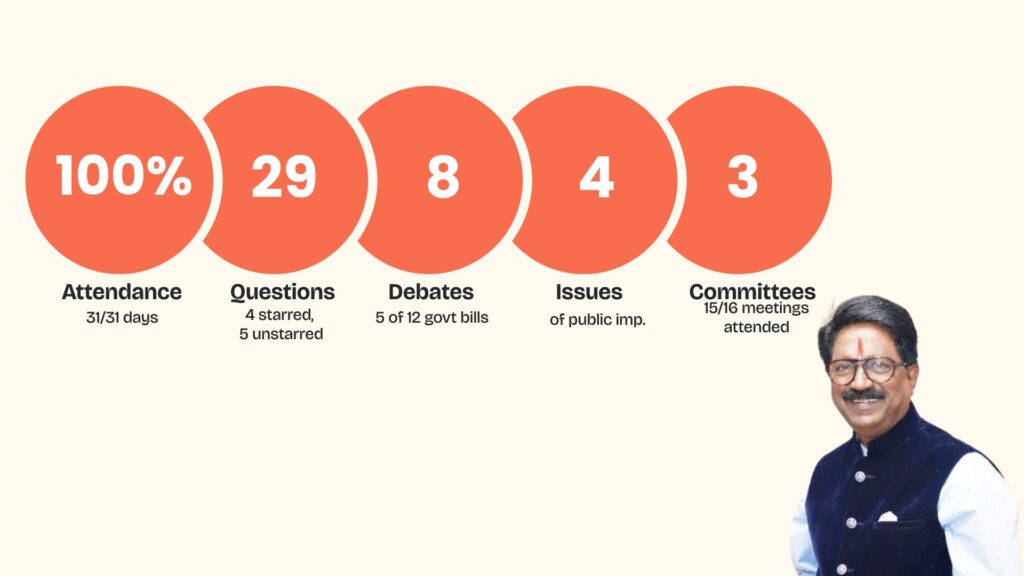
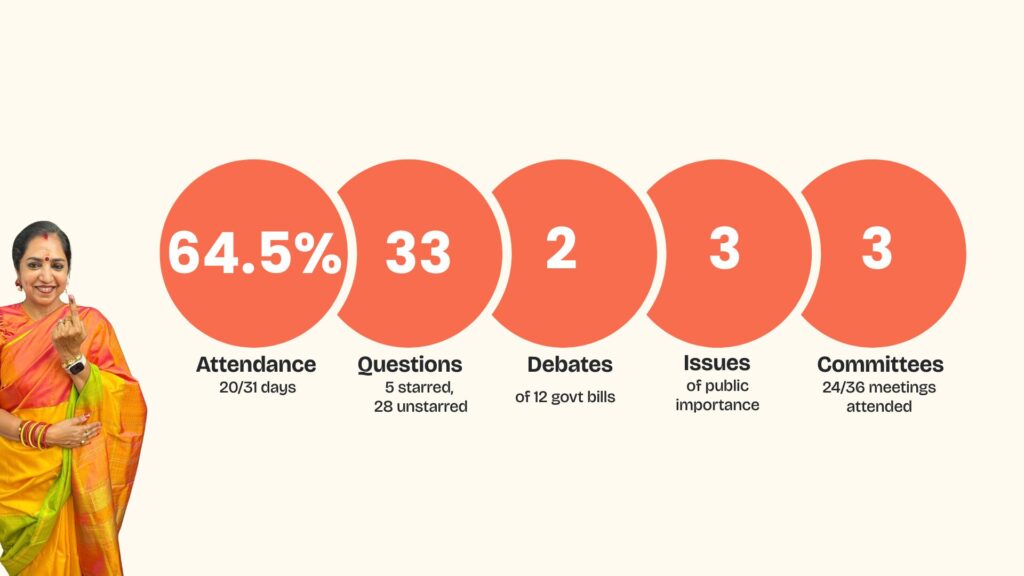
Most of the information related to an MP’s performance in Parliament is publicly available on Parliament websites. Some organisations like PRS Legislative Research also make this information more accessible to people. So, lack of information is not a problem, but very few of us go looking.
Thus, as an experiment to get more of us curious about how our MPs are working, we looked at the performance of 11 Lok Sabha MPs representing the major cities of Bengaluru, Chennai and Mumbai during the recently concluded Budget Session of Parliament, which had 31 sittings spread over January to April 2026.
Before we get into the interesting statistics, it needs to be mentioned that one MP each from Bengaluru and Mumbai (Shobha Karandlaje, Bengaluru North and Piyush Goyal, Mumbai North ) are currently Ministers in the Union Government. Their performance audit has not been undertaken because as Ministers, they cannot raise questions in Parliament, they are supposed to answer them. They are also not members of Parliament Committees but they are answerable to these Committees.
But most importantly, they are not required to mark their attendance. Yes, while all MPs need to mark their attendance, the Prime Minister, all Ministers, Speaker of Lok Sabha, Deputy Chairman of Rajya Sabha and Leader of Opposition in both Houses are exempt. Why? No logical reason exists. As citizens, should we not have a right to know how often the Prime Minister and Leader of Opposition are attending Parliament?
The analysis has thrown up some interesting and striking contrasts — from low attendance and limited participation to near-perfect records and active engagement in debates and committees.
A prominent Chennai MP recorded an attendance of only 26% during the Budget session, while four out of five Mumbai MPs observed had a perfect score of 100% !
While an MP from Bangalore raised as many as 60 questions during the session, another from the same city asked only six.
Representation in committees and regular participation also reveal a lot about the individual MP’s political priorities and what citizens could expect from them. There are other insights and even cross-city, cross-party comparisons that are possible using this data.
So, what has your MP been up to? If you would like to know how your elected representative performed in parliament over the just concluded session, do check out our MP Tracker.