Several Marathi poets have captured the beauty of the month of Shravan: the gentle, short spells of silken raindrops, playing hide-and-seek with the sun, and etching rainbows in the sky. After one and a half to two months of dark skies and consistent rainfall in Mumbai, Shravan, when it starts around August, is seen as a time for Mumbaikars to enjoy the rains, as the monsoon wanes in intensity towards the end of the season. At least, that used to be the case.
Over the past couple of years, however, rains have started to visit Mumbai at the beginning of June. Then it vanishes, only to return with a vengeance in August, and again in September, when it is expected to bid us adieu.
And while Mumbai can still enjoy poetry, more prosaic matters occupy our minds in the wake of changing rainfall patterns — how should we prepare for monsoon and think of flood prevention in view of these changes?
Changing rainfall trends
In May this year, Mumbai experienced record-breaking rainfall. The observatory at Colaba recorded 300 mm in May. The highest rainfall that the city had seen during the same month before this was in 1918, at 279.44 mm. This year, pre-monsoon showers set in from May 6th, and the Indian Meteorological Department (IMD) declared the onset of monsoon on May 26th, the earliest in 75 years.
Rainfall is not just starting early, but the monsoon is also longer now. The year 2022 saw Mumbai receive the highest October rainfall in a decade at 216 mm. Moreover, over the last couple of years, Mumbai has been getting rainfall in shorter, more intense bursts. For instance, in 2023, the city got 90% of its average June rainfall in just five days. Where the average rainfall for June is 537 mm, for just five days in June that year, the Santacruz observatory recorded 485 mm of rain.
A study published in the international journal Theoretical and Applied Climatology found that the intensity of rain is rising in Mumbai. The researchers looked at rainfall data from 1985 to 2020. They found that in the monsoon months between June and September, the rate of increase is 5.18 mm per year, whereas the annual rainfall, which includes pre- and post-monsoon showers, has increased by 22 mm per year.
Read more: Mumbai monsoon: Understanding BMC’s flood mitigation measures and what to expect
The paper also found a pattern in the number of ‘heavy’ and ‘extreme heavy’ rain events. The frequency of days when Mumbai received more than 120 mm rainfall per day went up in Santacruz after 1994, but only after 2005 in Colaba. The occurrence of heavy rainfall days has gone up both in the city and the suburbs over the past two decades.
BMC’s flood mitigation efforts
While these changes in rainfall can be attributed to climate change, experts say that more rigorous studies are needed to pinpoint other reasons. From an immediate operational viewpoint, policy makers need to take into consideration this erratic behaviour of the monsoon while planning flood mitigation measures in Mumbai.
This serves the purpose of reducing the burden on the stormwater drain system in the low-lying, flood-prone areas of Dadar and Parel. This becomes particularly important for the vehicular traffic going from Mumbai city to the eastern suburbs or vice versa.
According to an official from the Storm Water Drains (Operations and Maintenance) Department, the tank at Pramod Mahajan Udyan at Dadar has a capacity of 3,60,000 litres. The tank at St. Xavier’s ground in Parel can hold 2,80,000 litres, and the one at Milan Subway in Vile Parle has a capacity of 3,00,000 litres. Besides this, there are 514 dewatering pumps at flooding hotspots and nine mini pumping stations, the official adds.
Read more: Is rehabilitation the only way for residents along Mumbai’s rivers to escape floods?
Yet, shop owners at Hind Mata, where the pump for the holding tanks is located, say that when it rained heavily in May this year, water entered their shops. They add that when it started raining, the pumps had not started working.
Another official from the SWD Department admits that there was a delay in the tendering process for the contract for the pumps, but also claims that on the morning of May 26th, the pumps had already been installed and started functioning. Usually, the tendering process itself would start by the end of May, but this time pumps were installed as early as May 25th (and will continue till October 15th), the official says.
How effective are the BMC’s flood mitigation measures?
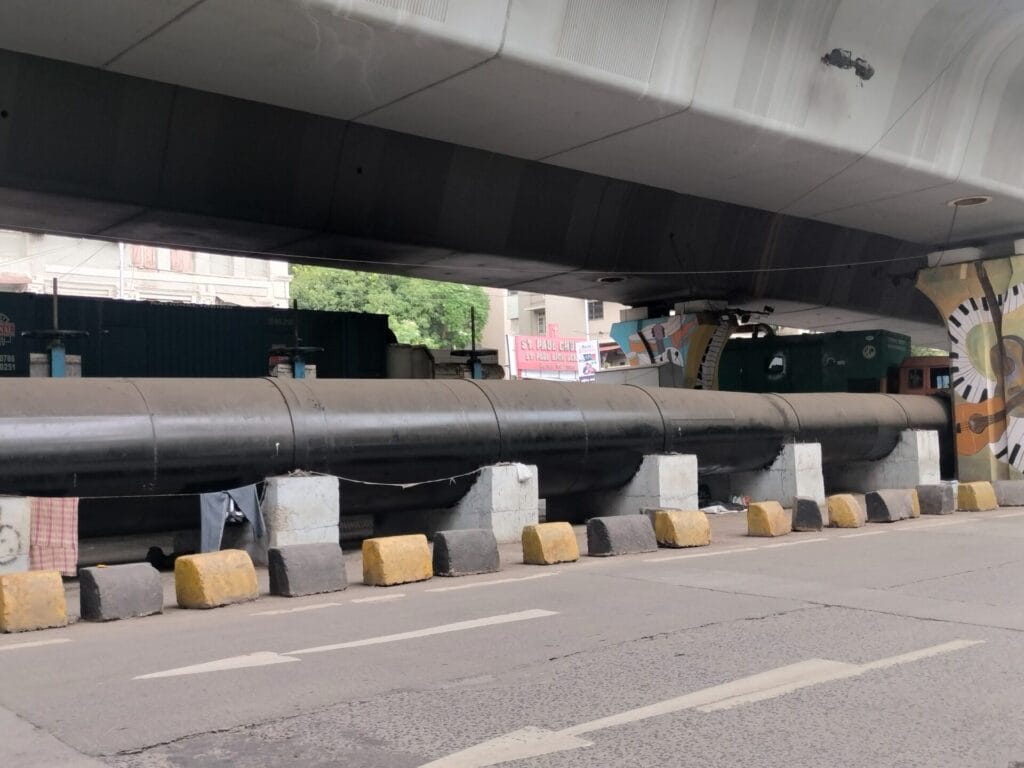
The official asserted that given the specific topography of Mumbai, flooding is bound to happen, despite measures taken by the BMC. Hence, their effort is directed at getting the water to recede as soon as possible. He cited the instance of waterlogging at the Hind Mata cloth market. He claimed that earlier, water would take ten hours to recede before the installation of the holding tank, but now it takes only about an hour. However, given that the pumps installed to drive water into the holding tanks can pump 3,000 cubic metres per hour, they may fall short in the case of an extreme rain event.
What changes are necessary?
Sayali Lokare, Senior Programme Associate, Flood Resilience at WRI India, agrees. “If the rainfall exceeds that design parameter, then the channels leading to the holding tanks are automatically just going to keep carrying their capacity, and the excess rainfall is going to spill out of the channels. So, it is not that the channels are not efficiently carrying the water to the pond.”
Mumbai’s stormwater drains were designed for 25 mm rainfall per day until 2005. Following the July 2005 deluge, the drain capacity was increased to 55 mm rainfall per day. However, BMC says that this upgrade has not been consistent across the city due to drain encroachments, the presence of utility lines, and land acquisition issues. All of these factors come under different departments and agencies, though they are in the same geographical location.
Read more: Warnings overlooked: Mumbai floods intensify despite reports and recommendations
“We urgently need different public agencies and departments to find ways of working together more effectively. The speed at which these departments and agencies can come together to reflect that action on the ground is, I think, very crucial. Additionally, the community is a powerful resource in times of disasters. So, equipping first responders with the right skills would be helpful,” says Sayali.
Moreover, according to the BMC, lack of space is an issue when it comes to expanding the capacity of the tanks. They also say one of the biggest operational challenges that they face arises due to the garbage that people throw in the drains and lack of better early warning systems.
Beyond holding tanks
Sahana Goswami, Senior Programme Manager at WRI India, agrees that most municipalities face constraints when it comes to such measures. A shift in our approach to storm water management is necessary, she says. “Efficiency becomes restricted if you only have one type of solution. She stresses the importance of a variety of solutions to deal with different scenarios.
Sahana suggests dealing with rainfall at every stage where it interacts with city surfaces. This can be done through rainwater harvesting in buildings, parks and big campuses with recharge wells, and wetlands, which perform the same function as holding tanks.
She cites the example of Bengaluru, where there are aquifer recharge wells outside metro stations, particularly significant as transport is one of the first things to be hit by heavy rain. She also cites the use of permeable concrete in road construction to reduce the strain on flood mitigation infrastructure.
In Mumbai, too, there are reportedly plans to add holding ponds on railway land to reduce commuter woes. Flooding on rail tracks causes chaos every year, with commuters facing delays on Western, Central and Harbour lines. The Mumbai Railway Vikas Corporation (MVRC) has asked IIT-Bombay to conduct a study to check the feasibility of such a project.
Need for long-term measures
The holding tanks are currently in three prime, low-lying, flood-prone areas. To improve flood mitigation, they should be decentralised, says Sayali. This will capture water not just where there is a flooding hotspot, but at other upstream locations of the catchment. She also suggests using a mix of grey and blue infrastructure for flood mitigation, particularly as the latter will also serve other purposes like fostering biodiversity.
The larger answer to the question of how to deal with changing weather patterns, therefore, may lie in flood adaptation as opposed to only mitigation. Adaptation requires us to anticipate the effects of flooding over the next two decades and plan accordingly. Initiatives for adaptation must take into account protection of vulnerable populations such as those living along river banks.
The topography is not going to change. Hence, our planning measures must take into account the way we use land and how that can change, says Sayali. This, she says, can happen only if the development plans are informed by changing weather patterns, backed by funding to execute long-term measures.
Also read:
- Can blue green infrastructure fix Mumbai’s floods and heat waves?
- Explainer: Why we have urban floods and how to stop that
- Monsoon ready? A checklist for Mumbai residents and neighbourhood