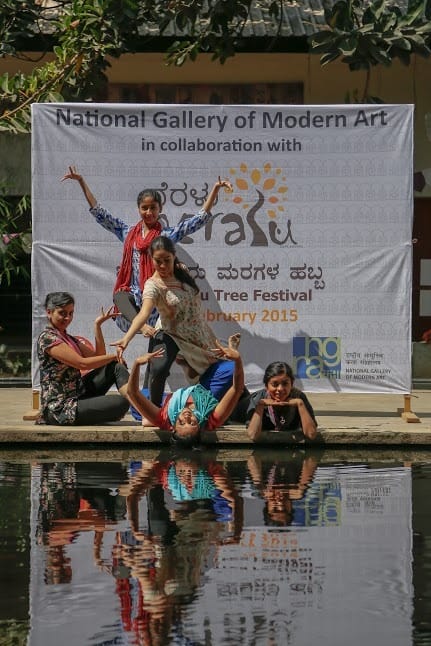
Padme Float at the mirror pool at NGMA
The first phase of Neralu, the three-day Urban Tree Festival, concluded at NGMA (National Gallery of Modern Art) Bengaluru, on Sunday Fenruary 8th. Citizens of all ages participated enthusiastically in tree walks, listened to talks by naturalists and artists, and appreciated the movies, performances and street plays.
At Neralu, children experienced the world of trees through animated storytelling sessions, tree journaling, and sketching workshops. The tree walk conducted for young adults from Samarthanam Trust for The Disabled emphasised the different ways in which trees can be perceived.
Other highlights of the Tree Festival included a riveting dance performance, Padme and Float by Anita Ratnam’s troupe. Artist Malavika Sarukkai also gave a talk followed by a performance.

A tree walk at NGMA. Pic: Neralu team

Children try their hands at journalling trees. Pic: Neralu team

An art installation in progress. Pic: Neralu team

Tree walk conducted for young adults from Samarthanam Trust for The Disabled. Pic: Neralu team

An audio walk in progress. Pic: Neralu team
$(document).ready(function(){ $(‘.carousel .carousel-inner .item’).first().attr(‘class’, ‘active item’);});
Dr S Subramanya, Professor of Entomology at University of Agricultural Sciences, Gandhi Krishi Vidya Kendra, who seeded the idea of NERALU and helped shape the festival, said, “Neralu is an amazing initiative. I would like to see it happening every year with an even greater spread of activities and experiences through the city.”
“Anywhere, a social movement can become stronger and successful only when it reaches the younger generation and the general public. Bengaluru has number of varieties of trees. They are not just biological structures but have historical significance too. Neralu is doing a yeoman service in making Bengalurians realise the importance of preserving these trees for posterity,” said Suresh Moona, Founder Director of AARAMBH.
“Like with great minds and huge old trees, the wisdom available for free in public festivals like Neralu is immense. So happy to be part of this festival. Thanks Neralu team!”, said Mala Kumar, Editor at Pratham Books.
Noted naturalist Gururaja said, “As a scientist, Neralu provided me a platform to interact with citizens. It was a great to connect with trees and people using the Android app. I look forward to educating citizens about the connection between trees and frogs next year.”
KG Kumar, Director, NGMA, said “The effort of Neralu to remember, honour and celebrate the trees of our city, bringing man and nature together, is commendable, and will go a long way in furthering harmonious co-existence. NGMA, Bengaluru is proud to collaborate with the citizens of Neralu, to celebrate this festival for the trees of the city.”
Visit www.neralu.in for more details.
Related Articles
Bal Bhavan to play host to grand closure of Neralu on February 14th
Painting the town red, green, yellow and every other colour
Shade the city green at the Neralu Tree Festival