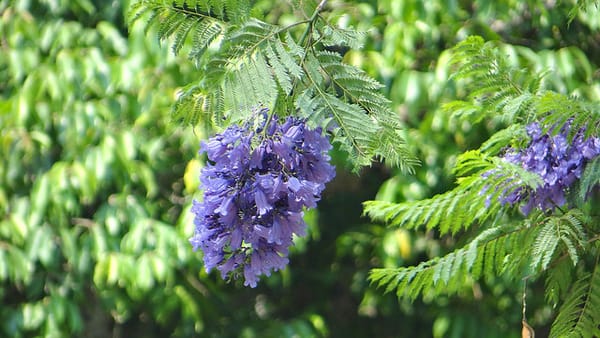
A Jacaranda tree in bloom. Pic: Deepa Mohan
The second edition of Neralu, a citizen-led Urban Tree Festival is being organised on February 7th, 8th and 14th February 2015 at multiple venues across Bengaluru. In the month of February, the city’s trees burst into spectacular blooms, and the play of colors continues through the year. Neralu, which translates to ‘shade’ in Kannada, has been planned to coincide with the blooming season in the city. It will bring citizens together to celebrate the garden city’s glorious natural heritage.
Bound by a common love for trees
Naturalists, ecologists, artists, technologists, storytellers, homemakers, photographers, students and many more citizens from all walks of life have come together to put together Neralu. This year, we celebrate trees in different localities and public spaces, from the traditional tree platforms or kattes, to our neighbourhood parks and streets that are a part of our lives. Events are in collaboration with various institutions, networks and community groups.
Follow Neralu for updates
Website: www.Neralu.in
Mail: Neralufestival@gmail.com
Facebook: www.facebook.com/Neralufestival
Twitter: https://twitter.com/NeraluFestival
Instagram: http://instagram.com/Neralufestival/ http://instagram.com/mumbaipaused (co-curating from Bombay)
The festival begins on February 7th at Doddamavalli Katte near Lalbagh; a platform where peepul, neem and banni trees stand tall, along with snake stones and the people who revere them. Local communities have been using this space for years, and Neralu’s focus is to draw attention to the old-world charm that flourishes in many parts of Bangalore. Workshops, talks, audio walks, performances and art installations will be hosted at NGMA (National Gallery of Modern Art) on 7th and 8th. Some of the distinguished speakers who have confirmed their presence are Dr TV Ramachandra, Vijay Thiruvady, KN Ganeshaiah and Suresh Moona amongst others. For the morning of February 8th, we have planned tree walks which will introduce the public to trees through cultural and ecological narratives, and a unique photo walk where participants will record tree-stories in various localities of Bangalore. A mini-Neralu event will also take place at MN Krishna Rao Park, Basavanagudi on February 8th, with activities that will bring together people of all age groups to enjoy their Sunday morning in the wonderful company of trees. The following weekend, on Saturday February 14th, the festivities will move to Bal Bhavan, Cubbon Park, with a host of art activities and cultural performances that bring a grand closure to the Neralu tree celebrations.
Two interesting on-going public participation projects are the Neralu Photo Project and the Neralu School Project. This is to engage Bangaloreans in fun and informative projects that will bring them closer to trees.
In the spirit of keeping the festival participatory, the volunteers meet every Sunday at 3 pm at Bandstand in Cubbon Park, to discuss and plan the festival. Interested citizens are welcome to join these meetings to take part in organising this unique Tree Festival. Do consider volunteering — http://neralu.in/volunteer.
Schedule for Neralu 2015
|
Venue |
Date |
Time |
|
NGMA (National Gallery of Modern Art) |
February 7th and 8th |
10 am to 7 pm |
|
Doddamavalli Katte, off RV Road |
February 7th |
8 am to 10 am |
|
MN Krishna Rao Park, Basavanagudi |
February 8th |
7:30 am to 10 am |
|
Bal Bhavan, Cubbon Park |
February 14th |
10 am to 6 pm |
Like last year, Neralu 2015 too is entirely crowd-funded by citizens, and participation in this citizen-driven festival is free. The festival has been successfully crowd-funded, with over 150 citizen donors. Here is an overview of activities planned during Neralu:
- Heritage, ecological and histo-cultural walks, in multiple localities of Bangalore city.
- Talks by experts on history, culture, climate change, ecology and urban spaces.
- Tree journalling, design, mapping, identification and movement workshops
- Documentary and artistic film screenings of local and global narratives about trees
- A panel discussion with experts from various disciplines
- A curated photo exhibition showcasing tree stories
- Performances by musicians and folk artists
- Storytelling events involving diverse traditions and forms
- Games and fun activities for children
- Mega hug-a-tree campaign
For the complete schedule of activities, click here.
If you want to take part in the workshops and walks, you will need to register beforehand. Slots are available on a first-come-first serve basis and are filling fast, so register quick! Please register here: http://goo.gl/XphpfL or in the form below.
Register for walks and workshops at Neralu
Related Articles
Neralu School Project: Getting the next gen enthused about trees
The Neralu Photo Project: Express your love for trees through your photographs
Neralu – Bangalore’s very own citizen-led tree festival
Lalbagh, Cubbon Park, Basavangudi to witness Bengaluru’s Neralu tree festival