It has taken just about 2 months to flood National Games Village (NGV) after the initial protest on 25th February from the residents for opening up the storm water drains. The trauma has just started with the first few summer showers. We had water overflow from the drains reach areas near the centre court in Tungabhadra, NGV on 22 April.
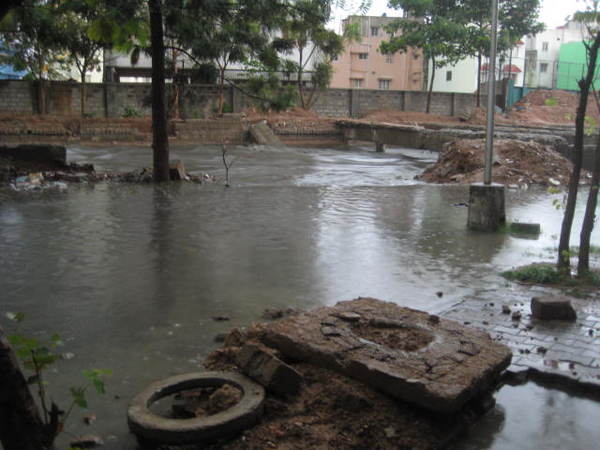
Water overflowing from open drains into the residential area. Pic: Meera Rajesh
There was no way to cross between the towers without stepping into the dirty water from the drain! BBMP had earlier taken an on the spot decision to open up the drains. The drains are opened up completely inspite of several protests and requests from NGV.

Flooded compound. Pic: Meera Rajesh
Earlier BBMP had promised to follow the court order of ensuring the boundary wall would be built and wire mesh placed on top to ensure water does not overflow. There is still no sign of ensuring the completion of the boundary wall by BBMP.
If this continues, very soon NGV residents would have to have days without safe water. Who is responsible to ensure the health and safety of residents are considered while making hasty decisions ? The water in the drain reached alarming levels at areas where there is no wall. If two hours of rain can play havoc during summer, what would be the situation when the monsoon commences?

Residents protesting opening up of drains by BBMP on 25 February. Pic: Meera Rajesh
Residents of NGV has surely got a reminder on the carelessness of BBMP officials on such grave matters involving people’s well being. ⊕
I think this set of buildings are constructed on a lake bed, that is why the sorry problem exists.
I fail to understand Bengaluru being a city at 3000′ above MSL getting flooded. In fact this city gets clean wash only due to monsoons with an average rainfall of 900 mmsin a year. uch flooding is man made, first due to filling tank beds with concrete structures, unscientific management of natural flow of storm water, clogging of most drins by debris, garbage etc. I wish someone sues BBMP, BWSSB for los of precious lives during heavy rain and take away entire money from these irresponsible Govt. Institutions.