In 2015, when her infant daughter began wheezing, Subashini R purchased a machine she had only ever seen in hospitals. Daily trips from Kattukuppam in north Chennai to Tondiarpet Hospital were expensive, costing at least ₹500 then. Although the nebuliser cost four times her daily healthcare expenses, it reduced long-term costs in a region struggling with the lasting effects of pollution.
“Every doctor tells locals to leave the region due to the chemicals here,” says the activist, part of the Save Ennore Creek Campaign. A decade later, nearly every household in Ennore has a nebuliser. Her younger daughter now suffers from wheezing, too. Subashini attributes the rise in respiratory problems to the two ports and 30-odd industries, all red-category, that have shaped Ennore’s landscape.
In a bid to control pollution and restore these areas, the state government launched the Manali-Ennore Restoration and Rejuvenation Council (MERRC) in September 2024. This came after the twin disasters: the oil spill and ammonia gas leak.
Yet, the goals of MERRC, a Special Purpose Vehicle, have remained on paper, and pollution continues in an unabated manner, say residents and the recently-released report titled ‘Report Card on Tamil Nadu Government’s Performance on Promised Improvement of Environmental, Health and Economic Status of Ennore-Manali Region’ by the Save Ennore Campaign. Assessing the compliance of 22 government bodies with legal and policy obligations, the report card gave the government an overall grade of 9%, below the pass grade of 40%.
What is MERRC?
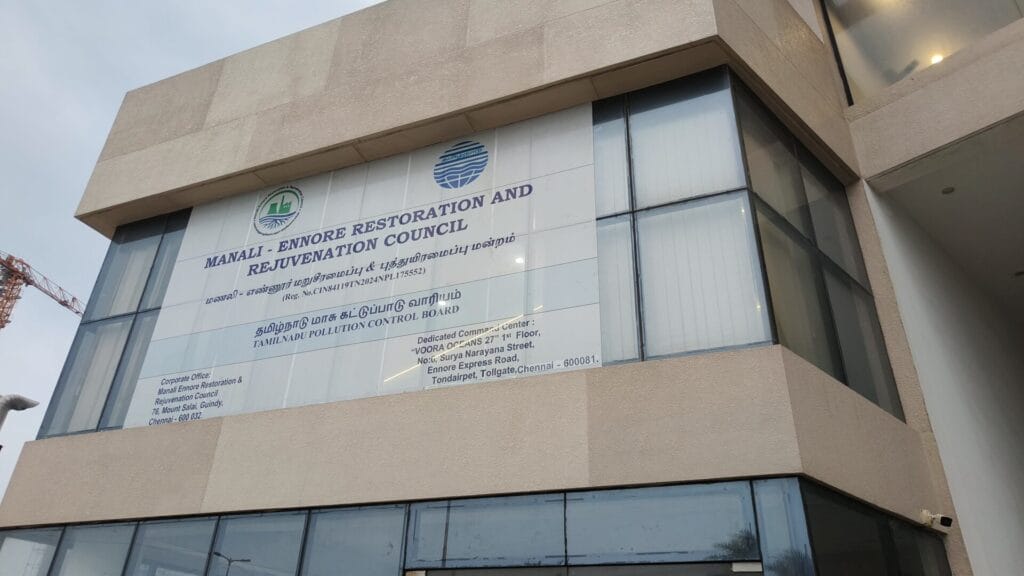
In 2024, MERRC was announced at a cost of ₹1 crore. According to a government order, it “aimed to improve the livelihoods of Manali-Ennore residents and restore ecological equilibrium and overall biodiversity.” Touted to be the first of its kind, the council was registered under Section 8 of the Companies Act, 2013. It is supposed to focus on,
- green projects
- waterbody restoration
- solid waste management
- pollution control
- community infrastructure development
According to officials working with MERRC, the council coordinates between several departments, including the Tamil Nadu Pollution Control Board (TNPCB), Manali Industries Association, the Revenue Department, and the Department of Industrial Safety and Health, among others. An office was set up a few months ago at the Tondiarpet tollgate, which houses two flying squad offices, and an Emergency Response Centre (ERC) equipped to respond swiftly to floods, cyclones, and industrial accidents.
Also, in a post on X, Additional Chief Secretary to the Government of Tamil Nadu, Supriya Sahu notes, the ERC has “real-time monitoring of industrial emissions, effluents, and ambient air quality systems to ensure swift emergency response and seamless multi-agency coordination.”
Read more: Public backlash: Why Ennore residents are opposed to the thermal power plant expansion
Real-time monitoring and emergency response
Speaking about MERRC’s purview, officials said the special purpose vehicle deals with monitoring of air quality in the area, passes on information to stakeholders, and conducts periodic inspections at industries to assess compliance. “Earlier, only one assistant engineer oversaw Manali and Ennore, and now we have set up an office, two flying squads and an emergency response centre to strengthen monitoring in the area,” says an official, on condition of anonymity.
Apart from this, authorities planted trees and deployed 30 mechanised sweepers to control dust in Manali and Ennore. Officials say the sweepers operate daily in Thiruvottiyur, while dredging continues at the creek. The council is collecting samples from eight sites in the Buckingham Canal and two in the Kosasthalaiyar River to identify sewage outfalls. Meanwhile, work is underway to upgrade the Kathivakkam Public Health Centre.
The team periodically monitors how industries maintain stormwater drains and uses a mechanism that alerts companies and stakeholders when stack emissions exceed standard limits, claims an official. An alarm system notifies both officials and industries if parameters are breached, prompting immediate action. In emergencies, the entire MERRC team takes responsibility.
The ground reality
When Citizen Matters visited the premises, we noted there were vehicles as part of the flying squad. A monitoring room was set up with information on Manali and Ennore, a dashboard that maps the number of hospitals, industries, other local infrastructure and the ambient air index. At the time of the visit, the dashboard showed the AQI of Manali was 42.
However, as Subashini points out, “Why is this body in the Tondiarpet tollgate, far from Ennore? And nobody has given us awareness about it, or provided clarity as to what the body aims to do.” There is no clarity or communication on what has been conducted on the ground, add activists and residents. Other residents say that even if a helpline number was provided, residents might be scared to call in case of backlash. They recommend staff on the ground, direct communication, and WhatsApp groups for better communication.
“We watch our children’s breathing and we are scared each minute that it will stop,” says Amudha M, a resident of Bhadrakali Nagar, Ennore. Skin infections, asthma, wheezing, and seizures, she lists out, when asked about the health impacts of pollution.
Meanwhile, a yellow chemical film covers the Kosasthalaiyar River, and Sathyavani Muthu Nagar was layered in toxic dust over the past few months. While the government took samples of the yellow layer, we are yet to get results, says village head, Karunakaran. “The oily chemicals have been layering the river at least once a month, causing rashes, affecting the fish and our livelihoods,” he adds.
Read more: Women of Ennore are living testimony to the many costs of pollution
Gaps in implementation
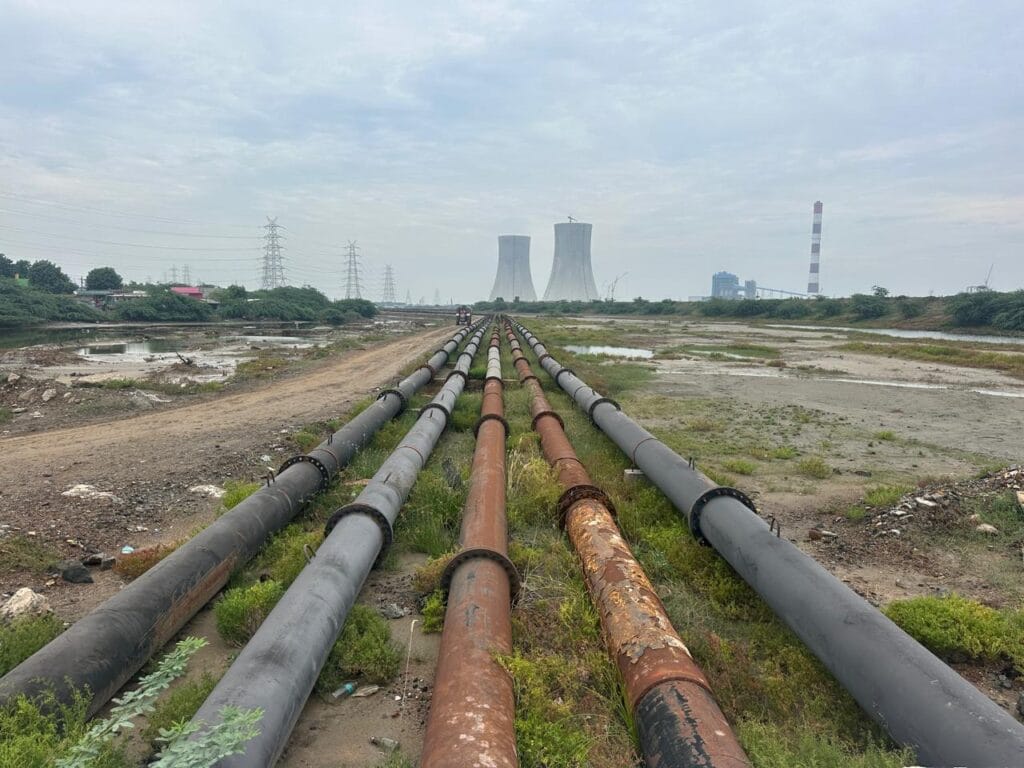
The report also highlights the continued unauthorised outflows of sewage into the Kosasthalaiyar River, Buckingham Canal and Ennore Creek and the discharge of fly ash from TANGEDCO and North Chennai Thermal Power Station (NCTPS) towards the creek. This is despite orders from the National Green Tribunal to change faulty pipes that leak fly ash slurry inside the wetland.
And health infrastructure? While the Kathivakkam PHC is undergoing renovation, the report flags the need for diagnostic and treatment facilities. Health camps, mock disaster response drills, and awareness programmes have yet to be conducted, it adds.
In a 2017 study, Dr Hisamuddin Papa of Huma Specialists Hospital found that nearly one in five Ennore residents screened showed chest X‑ray abnormalities, with studies confirming toxic heavy metals.
The delays in implementation show that the government is not serious, says activist and co-author of the report Nityanand Jayaraman. “What can be done quickly is the installation of health facilities, the removal of kaaka aazhi (invasive species) and the dredging of the river. We are asking for the law to be enforced, and illegal pollution to be stopped,” he adds.
The idea behind MERRC has value but will fail without public involvement as locals know exactly what is happening on ground, says Shweta Narayan, campaign lead of the Global Climate and Health Alliance.
So far, residents say the government has failed to:
- Arrest fly ash from TANGEDCO’s ash pond between NCTPS–Athipattu Road and Ash Pipeline Road. Repair leakages in pipes and ensure regular maintenance. Residents report the latest leakage was in the first week of December.
- Address yellow chemicals over Kosasthaliayar River; findings from samples have not been shared with locals.
- Share results from samples of toxic dust that cover Sathyavani Muthu Nagar. Expedite dredging processes in Ennore and removal of invasive species of charru mussels (kaaka aazhi)
- Communicate information on project implementation to locals.
An uncertain future
With continued pollution, futures remain uncertain, say residents, flagging issues of alcohol abuse and drug usage in the area. “Now we pay for water to drink. I worry generations after me will be in a situation where they can’t even pay for clean water. If this continues at this rate, all our villages will all end up like Athipatthu (the area’s land was taken up for the North Chennai Thermal Power Station), if this continues,” says Amudha.
The neglect and lack of action in Ennore have left residents with high levels of disillusionment, says Dr Kalpana Karunakaran, researcher and contributor to the report. “There’s a loss of faith in the state apparatus and a strong sense of being neglected. The message people take home is corporate impunity and state callousness bordering on wilful cruelty.” She adds that the brunt and pressure is on women in the community, who face mounting debts, and mental stress.
Enforcement of norms and community involvement is necessary in the effort towards restoration, say stakeholders and residents.
Recommendations from the report, residents and experts:
- Enforce strict pollution laws with immediate compliance.
- Penalise industries for untreated effluents.
- Stop new industries in Ennore and Manali.
- Deploy government staff in villages to prevent illegal release of effluents.
- Provide accessible and free/subsidised health screenings, especially for children, women and the elderly.
- Set up alcohol de-addiction and mental health counselling facilities.
- Launch recruitment drives, skill training, employment opportunities.
While officials are working on a toll-free number, residents can now call MERRC on 044 46204764.