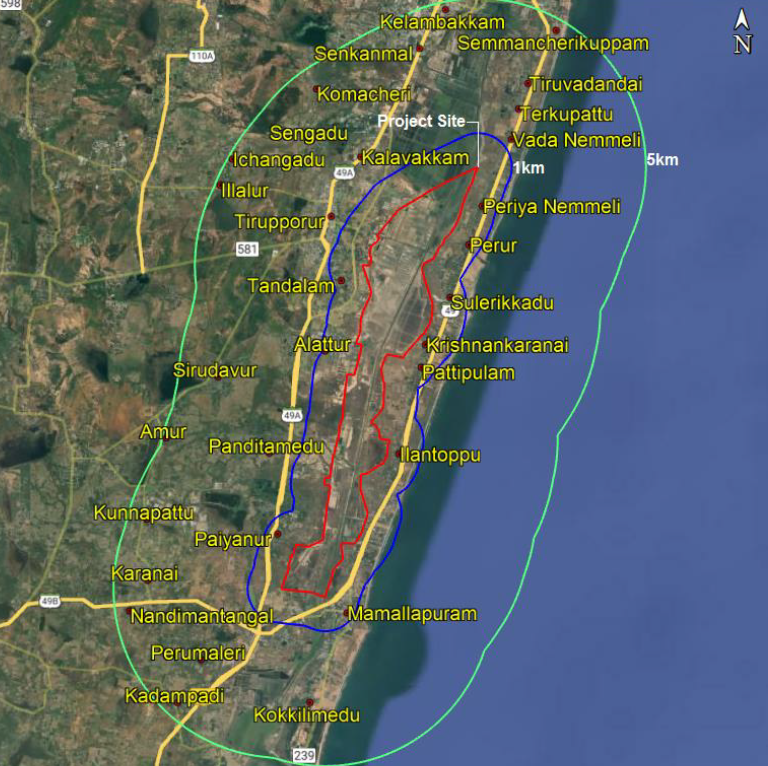
As work on the Mamallan Reservoir project is picking up pace, environmentalists and locals dread the devastation it is unleashing. The project not only threatens the fragile Kovalam-Nemmeli coastal wetland and the habitats it supports, but also poses flood risks to communities living nearby.
In an earlier article, we showed how field studies by the Suzhal Arivom team documented the damage this project will cause to the local ecology. Based on that same report, Part 2 looks at how the project impacts the daily lives and livelihoods of people in the Kovalam-Nemmeli area. The project can trigger the erasure of traditional marine-based livelihoods, forcing displacement of fishing communities. Shoddy planning, a flawed Environmental Impact Assessment (EIA) and token mitigation promises add to the problem.
The TN government has allocated ₹342.60 crore of public money for the Mamallan Reservoir. Is this the best use of public funds, when the coastal wetland already provides flood protection, supports the livelihoods of 16 fishing villages and shelters over 230 bird species? What is destroyed cannot be brought back.
What dangers lie ahead
Habitat Loss
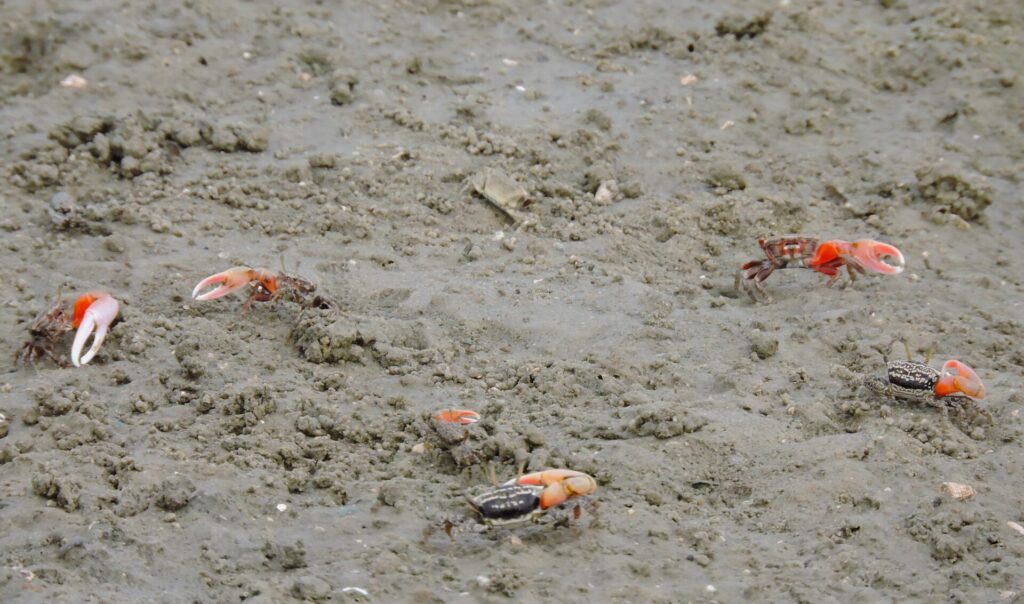
The habitats of benthic organisms (bottom-dwelling species such as worms, molluscs, and crustaceans) that live in sand and mud, as well as those of fish and prawns that live underwater, would be destroyed. This would also adversely affect marine resources.
Muttukadu (Kovalam-Nemmeli Wetland complex) is designated as one of the 107 Important Coastal and Marine Biodiversity Areas (ICMBAs) in India by the Wildlife Institute of India (WII). Our field documentation at the Muthukadu estuary records 13 finfish and shellfish species nursing their young, all dependent on the brackish conditions the reservoir would remove.
Read more: From Kovalam to Kokilamedu, livelihoods of hundreds threatened by proposed Mamallan reservoir
Converting this wetland, which has two estuaries, into a freshwater area would completely disrupt the breeding and nursing environment for critical species present in the marine food chain.
Moreover, salt has been produced here for a long time and it enriches the soil and surface of the wetland. Removing this long-established salinity and creating a freshwater reservoir in its place would be a highly challenging task.
Loss of livelihood
The Kovalam-Nemmeli wetland serves as a primary breeding ground for important prawn species and fish. By turning the brackish ecosystem into freshwater, the breeding environment will be destroyed. As a result, the livelihoods of numerous fishing families from 16 fishing villages who depend on this water body would be severely affected.
Flooding risks
If, during high tide, seawater is prevented from reaching the expansive wetland, that water will flood nearby residential areas and cause damage. Since this area is prone to severe storms, coastal surges during disasters would create additional problems.
Over the past few years, seawater intrusion into the land in the Nemmeli area due to coastal erosion, has been occurring continuously. So, the wetland, located just 800 metres from the coast, is in a high-risk zone. Establishing a freshwater system at a landscape directly connected with the Bay of Bengal through two estuaries is ill-conceived, considering the impacts of climate change.
Key gaps in the REIA
The project covers more than 5,000 acres across multiple Coastal Regulation Zones (CRZ IB, II, III, IVB). Yet, it relies on a three-month Rapid EIA that ignores the monsoon season. A project of this scale, which permanently transforms thousands of acres of tidal wetland, demands a year-long, Comprehensive EIA covering all seasons. Regulatory authorities such as the State Environment Impact Assessment Authority (SEIAA), State Expert Appraisal Committee (SEAC) and the Tamil Nadu State Coastal Zone Management Authority (TNSCZMA) should have rejected this limited study and demanded a complete assessment.
- Baseline monitoring was done only in April–June 2025 (dry season), ignoring the monsoon hydrology and biodiversity that define the wetland’s ecological role.
- A six‑day site visit (Oct 31–Nov 5, 2025) cannot capture the complexity of a 17.71 sq. km ecosystem, especially its role as a flood buffer and migratory bird habitat.
- By breaking the project into smaller phases and reporting data for only 4,375 acres, the study hides the actual damage to the entire Kovalam-Nemmeli wetland complex. The project’s own documents show it covers 10,962.3 acres.
- Approving the project based on the current process risks safety of the community and the global, migratory bird flyway.
The project is also facing legal scrutiny before the southern bench of the National Green Tribunal, where concerns have been raised about the absence of a Fisheries Department no-objection certificate, among other things.
Why REIA’s ecological mitigation measures don’t hold up scientifically
| Proposed mitigation measure | Ecological reality and why it fails at Nemmeli |
| Relocation to Kokilamedu (3.45 sq. km existing Kazhuveli) | Most wetland birds return to the same foraging patches year after year because they know where the food is. Forcing a displaced population into a neighbouring site ignores the fact that birds cannot simply “move” and settle elsewhere. This could trigger inter-species conflict and starvation, as the “relocated” birds may be forced to compete for already-depleted resources in a new territory, risking the decline of both populations. |
| Conversion of Salt Pans (5.12 sq. km Uppalam/Uppangazhi) | Salt pans are hypersaline environments. You cannot simply “declare” them freshwater marshes. The soil chemistry is toxic to the freshwater flora intended for the “Kazhuveli” land. Without massive, high-cost soil remediation, the salt-saturated ground will prevent the growth of the freshwater vegetation, resulting in a biological desert. These salt pans are also habitat in their own right, used by many wetland birds. Converting them would remove existing habitat. |
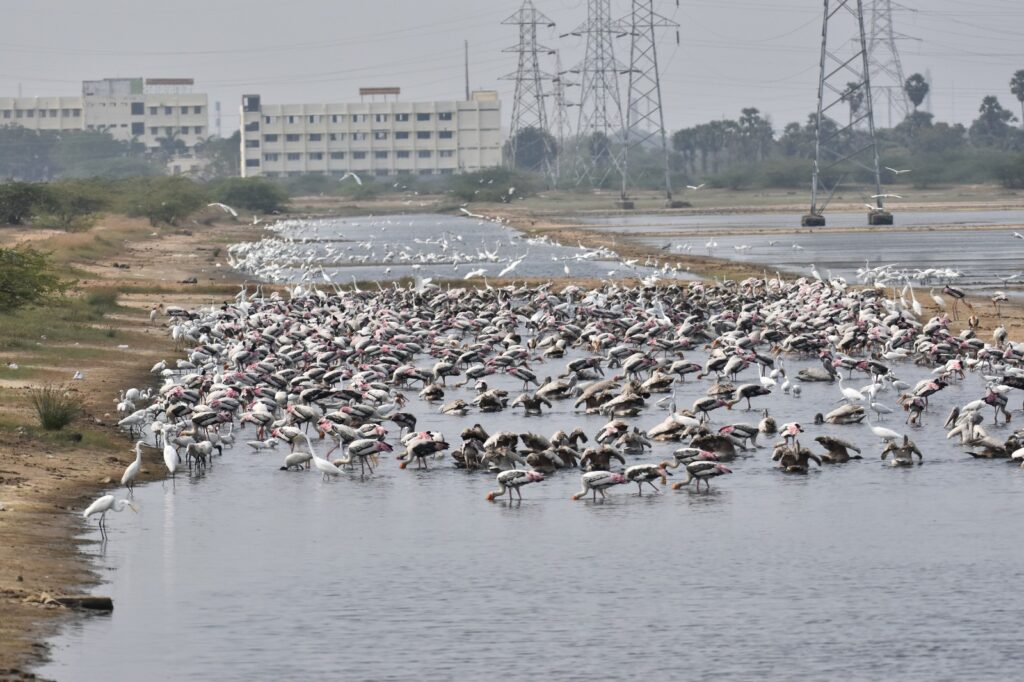
| 6 Artificial Islands (1,200 sq. m total) | The proposal to construct six artificial islands, totalling a mere 1,200 sq. m (0.3 acres) to compensate for the destruction of thousands of acres of natural wetland is an ecological absurdity. This represents a near 100% loss of functional habitat, offering a “token” instead of a viable mitigation strategy. Because these islands will be surrounded by three metres of deep water, they are biologically useless for thousands of birds such as Sandpipers, Stilts, and Teals, which depend on Nemmeli’s expansive, shallow mudflats and marshlands. |
| Compensatory Wetland Offset (Designated feeding areas) | A natural wetland is a complex web of benthic organisms (worms, larvae, crustaceans). A “created” wetland is just a pit of water. It takes years, if not decades, to develop the food density required to sustain migratory birds. |
A legacy of mismanagement: From Pallikaranai to Nemmeli
The current construction of the Mamallan Reservoir in Nemmeli is a high-stakes repetition of the flawed 2021 Pallikaranai reservoir plan, which was eventually halted due to its ecological unviability. Both projects share a fundamental “engineering-first” approach, treating complex, tidally influenced coastal wetlands as simple inland depressions.
Just as the 2021 intervention in Pallikaranai was halted after experts warned it would destroy the marsh’s role as a “natural sponge,” the Mammalan project ignores the site’s status as a coastal ecotone.
If construction continues at Nemmeli, the region faces the same engineered vulnerability that Pallikaranai narrowly avoided. By erecting 4.5-metre-high bunds to trap freshwater, the project does not merely destroy saline mudflats and marshlands; it dismantles the natural floodplains and, in our assessment, may create a rigid “flood trap” that raises the risk of overtopping and embankment failure during extreme weather. We will explain this in detail in Part 3 of the series.
Alternatives to the reservoir
Alternatives exist. The Tamil Nadu Senior Engineers Association (TANSEA) has put forward alternative proposals to help improve Chennai’s water security without destroying the Kovalam Nemmeli wetland. A. Veerappan, former Special Chief Engineer of the Tamil Nadu Public Works Department, has said that desilting and deepening the Poondi, Chembarambakkam and Puzhal reservoirs by one metre each would add about 3 TMC, against the 1.65 TMC projected for the Mamallan reservoir.
Our demands
- Immediately halt all construction and site-preparation activity related to the Mamallan Reservoir, and formally withdraw the project, given the flaws in its environmental assessment and the irreversible damage it poses to a living coastal wetland.
- Adopt the alternative water security measures proposed by TANSEA, which can help improve Chennai’s water supply without destroying the Kovalam Nemmeli wetland.
- Formally notify the Kovalam Nemmeli coastal wetland as a priority wetland under the Tamil Nadu Wetlands Mission and the Wetlands (Conservation and Management) Rules, 2017, with a legally defined boundary and a management plan.
- Declare the wetland as Chengalpattu district’s first Biodiversity Heritage Site under the Biological Diversity Act, 2002, through a people-inclusive process led by the local Biodiversity Management Committees, so that the fishing communities and residents who depend on it become partners in its conservation.
- Carry out science-based ecological restoration of all areas already disturbed by project activity, including excavated topsoil, embankments and altered tidal flow, so that the wetland’s natural brackish hydrology, habitats and flood-buffering function can recover.
- Identify similar coastal wetlands across Tamil Nadu and legally designate them as protected wetlands.
Nemmeli is not an empty tank to be filled but a living coastal shield, and protecting it means protecting the whole web of life that Chennai depends on: its people, fisheries, climate resilience, wetlands and wildlife.