Kalavathi, 33, has been working as a pourakarmika for the past 11 years. Until last summer, she had to report to work at least half an hour early, so that she could take breaks later in the day when the heat became unbearable. The heat hits badly after 10 am. “Work starts at six in the morning, but I used to come here at 5:30 am. I was then able to balance the breaks and finish work on time,” Kalavathi said. She adds that the heat is worsening each summer.
This year, Bengaluru recorded its hottest July in 112 years, with temperatures as high as 33.6 degree celcius. According to a recent study, the city’s land surface temperature increased by 7.9°C between 1992 and 2017, going up to 41°C. Whereas the average air temperature has been rising by 0.23°C per decade since 1975.
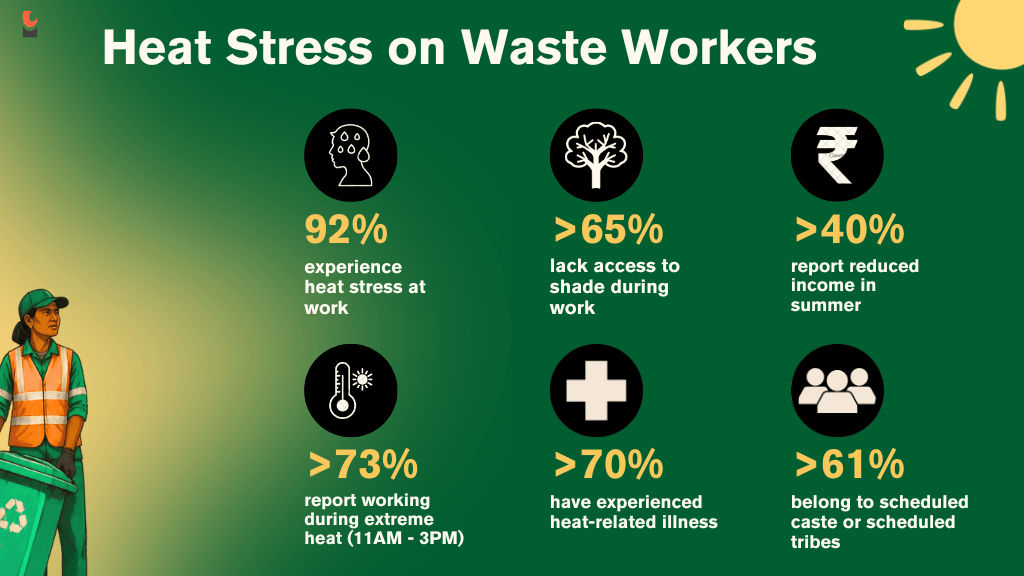
While the demand for indoor cooling systems is surging, outdoor workers are increasingly at risk with no respite from heat. Of the 154 waste workers in Bengaluru surveyed last year for the report Rising Heat and Waste Workers, 92% said heat impacts their work. Hasiru Dala, a non-profit working for waste workers in Bengaluru, and the research and advocacy initiative HeatWatch, jointly prepared the report. More than 61% of the surveyed waste workers belonged to scheduled castes or scheduled tribes. Eighty eight per cent of female workers and 70% of male workers reported increased difficulty in working during the summer. These findings highlight the disproportionate impact of heat on women and underprivileged communities.
Cooling kits put together based on workers’ feedback
Besides waste workers, heat also heavily impacts other outdoor workers such as ASHAs and traffic police personnel. Hasiru Dala, along with the social impact organisations C40 cities and Sensing Local, recently piloted an initiative to help outdoor workers mitigate heat impacts.
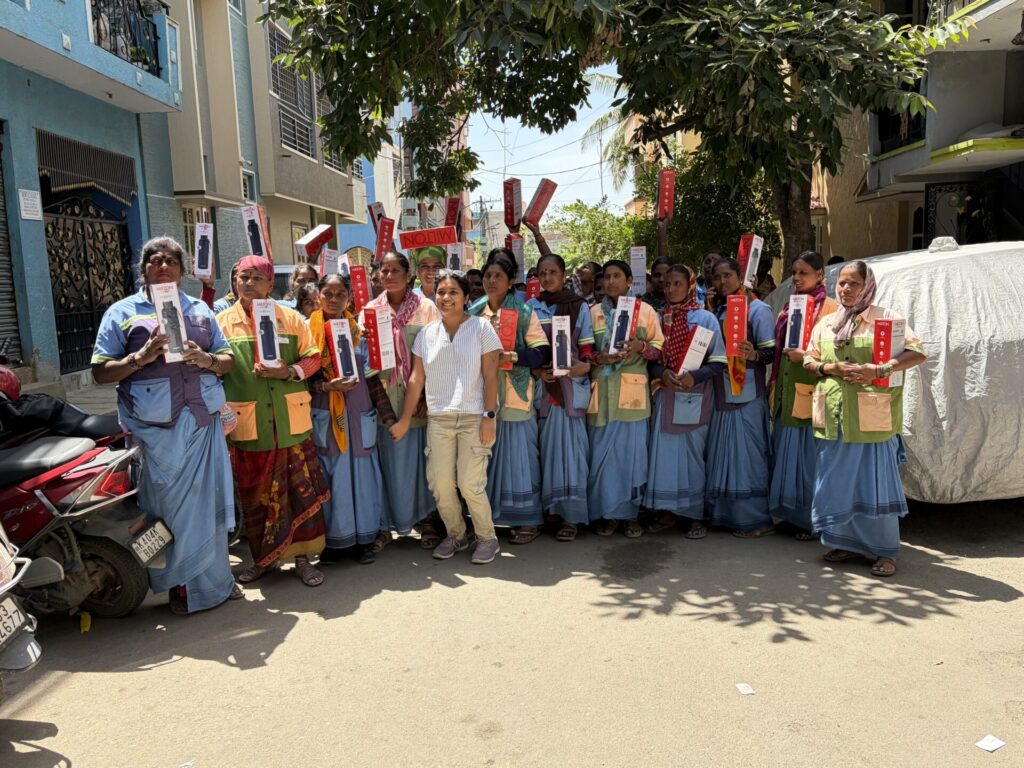
The team distributed a kit among outdoor workers to tackle heat. This April, 202 workers, including 46 ASHAs, 18 Dry Waste Collection Centre (DWCC) workers, 116 pourakarmikas and 20 traffic police personnel received the kit. Each kit included a UPF50+ sun hat, a pair of UV-protected cooling sleeves, and a thermosteel bottle. The kits also included neck fans that the workers can share among themselves.
The team decided to include these materials based on the study as well as interviews and focus group discussions with outdoor workers. The workers had reported severe exposure to peak heat and limited access to hydration, and discussed their preferred cooling items. “Our partners on the project, Sensing Local and Hasiru Dala, are also deeply engaged with waste workers on a regular basis,” said Naim Keruwala, Regional Director – South and West Asia, C40 cities. “This field feedback was combined with case studies from other C40 cities to optimise the impact.”
Each personal cooling kit cost approximately ₹2,160 ($23.76), with the expenses covered by the project team.
The team did consider other products such as breathable shoes for traffic personnel, but could not adopt these due to funding constraints, said Dhrishya Ravindran of Hasiru Dala.
The informality of the workforce made the project challenging, said Dhrishya. For example, DWCCs are operated on a contract basis, because of which the team had to get multiple approvals. Besides, there are still challenges in formal recognition of waste pickers. “The project cannot be limited to just government-employed workers,” she said. “We tried to include free-roaming waste pickers who are the most vulnerable, but we didn’t get approval for it. Because, to distribute products, you need a government entity to sign off”.
Project to be scaled up in North City Corporation
The project team distributed the kits mostly in the North City Corporation. Kalavathi is one of the beneficiaries. “Tackling heat is better with the hats and sleeves. The kit is very helpful for us and every pourakarmika should be provided with this,” she said.
“Following a good response on the cooling kits by outdoor workers, we are planning to scale this up to all the waste workers and health workers in North Corporation,” Naim said. This will be done using funds under the National Heat Resilience programme by the Ministry of Housing and Urban Affairs (MoHUA) and the National Institute of Urban Affairs (NIUA). The team is also preparing a report to document the impact of the pilot project.
The team and beneficiaries say the other four city corporations should adopt the programme. Further, the uniforms provided to waste workers should help them cope with heat, Dhrishya said. For example, the fabric of their uniforms can be pure cotton. Black leather shoes heat up their feet, and so these should be modified, she said.
Read more: Heat stories: The daily grind of outdoor workers under the scorching sun
Cooling centres for workers
Besides distributing cooling kits, the team has identified buildings that can be converted into cooling centres for outdoor workers. The team audited Indira canteens, public schools, anganwadis, DWCCs, ward offices and pourakarmikas’ mustering points for this purpose.
“Out of all of these, Indira canteens made sense for various reasons – they’re all uniformly built. They have some amount of green cover around them, and they have the basics of water and shade, and people can rest there,” said Dhrishya. Anganwadis and schools could not be feasible locations due to their varied architecture.
The project team has developed a Heat-Health Protocol after consultations with state and city officials, urban practitioners, partner organisations, academia and particularly vulnerable communities. “The document provides every department and frontline worker guidance on exactly what to do before, during, and after a heat event,” said Naim. Cooling centres are a part of this response. Disaster Management Cells, the Forest, Environment, and Climate Change Management (FECCM) department, and the respective corporations will activate cooling centers based on standardised Heat-Health Protocols once temperature thresholds are reached.
The project team has proposed activating 63 Indira canteens across all five city corporations as public cooling centres during heat alerts, said Naim. These canteens have to be stocked with drinking water and ice packs. Workers, particularly those in high-risk neighbourhoods, can access these spaces for relief during peak heat hours. The canteens would also serve as first-aid centers, and would be connected with Namma clinics for further medical assistance. They would also be linked with Urban Primary Health Centres (UPHCs) to provide serious medical intervention if required.
Read more: No breaks, no dignity: How heat affects menstrual health of Chennai’s women workers
“The FECCM department will lead final operationalisation as the nodal agency, supported by a steering committee of 15 departments, with an additional nine departments engaged based on their criticality to the provision of cooling centres,” said Naim. “This framework transitions heat response from a seasonal effort into a permanent cyclical system.”
“Following successful pilot testing in Indira canteens, there are plans to expand the programme to UPHCs, Namma Clinics, and other facilities,” Naim said. However, securing city-wide inter-departmental approvals would be a challenge, he added.
Beyond a pilot project
Kalavathi may no longer have to depend only on arriving early to cope with the day’s heat. The pilot has shown that simple measures such as cooling sleeves, hats, and access to rest spaces can make a tangible difference. But scaling them up will require more than pilots and short-term projects. It will need government commitment, dedicated budgets and policies that recognise heat as an occupational health risk for every outdoor worker—not just those employed by the government, but also informal workers who face the greatest exposure.