“Ae Dil hai mushkil jeena yahan, Jara hatke, jara bachke, ye hai Bombay meri jaan!” This song from the 1956 hit movie C.I.D has become most Mumbaikars’ anthem since the monsoon has started—replace the words “kahin building, kahin trame” with open manholes and falling trees. Residents have seen mayhem and mishaps due to lashing rains in the city.
Within the first six days of July, the Colaba and Santacruz observatories have recorded 823.4 mm and 898.4 mm of rainfall, respectively. The Indian Meteorological Department (IMD) had initially issued an orange alert on July 3, which was changed to a red alert on July 6. Thirteen rain-related fatalities have been reported, with three of these due to the falling of trees or branches:
- Eleven-year-old Vihaan Srivastav died when a tree fell on his school bus in Chembur.
- Yunus Kundawala (63) died in Kurla.
- Hasan Raza Jahangir Alam Syed, an 18-year-old, died at Aarey Colony in Goregaon.
According to the Brihanmumbai Municipal Corporation (BMC), 1,251 branches had fallen and 902 trees were uprooted as of July 17 this year. Mumbai’s last tree census, conducted in 2018, recorded 29,75,283 trees. The next census is currently underway after an eight-year gap. But what explains this spate of tree falls? While concretisation and unscientific pruning are primary culprits, choosing the wrong saplings plays a major role too.
Concretisation, the culprit?
The BMC has undertaken concretisation of roads in Mumbai. Of 2,175 roads which cover 714.10 kilometres, 1,575 have been concretised. While concretisation may not always affect the surrounding greenery, it is likely to damage urban trees. This is especially true of the recent monsoons: between June 24th and July 9th, 2,168 incidents of falling trees and branches have been reported.
To assess the problem, environmentalist Rohit Joshi, along with volunteers and BMC officials, inspected 1,115 trees across twelve wards in Mumbai this June. The inspection focused on factors such as tree concretisation, condition of the basal root zone, soil availability and permeability, among others. They found that 61% of the trees were choked with concrete.
Read more: Is concretisation killing trees in Mumbai?
Environmentalist Dayanand Stalin attributes 90% of tree falls to concretisation, explaining that it leaves roots with inadequate soil for growth. While the taproot grows deep downwards, the lateral roots grow horizontally to absorb water and nutrition. They also anchor the tree firmly to the ground. Pouring concrete over these roots, weaken the tree’s hold making it vulnerable to falling.
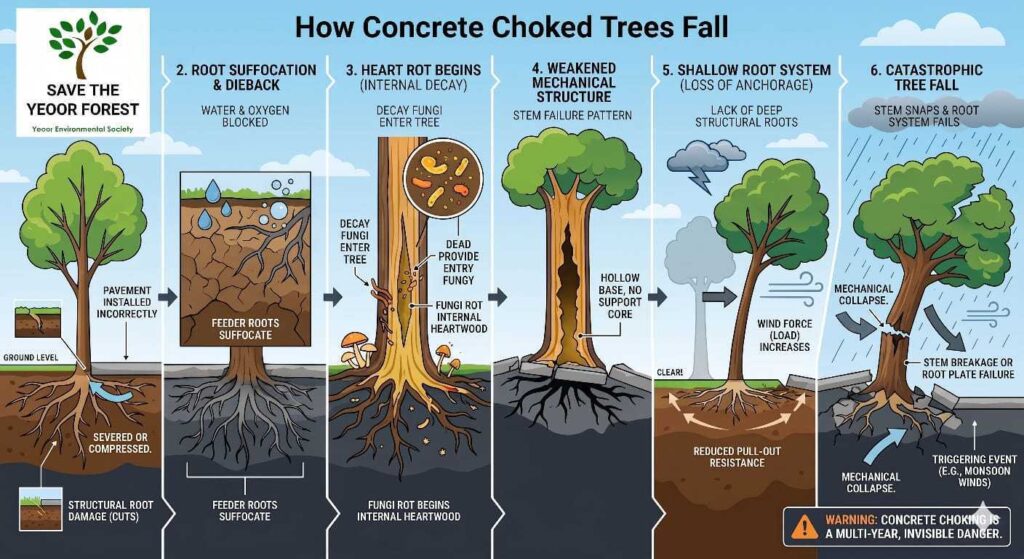
In 2015, Stalin’s NGO, Vanashakti, surveyed 1,400 trees over one and a half years. The report was submitted to the BMC, which ignored the findings. This forced Vanashakti to approach the National Green Tribunal, which subsequently ordered that a one-metre unpaved space be maintained around all tree bases at all times.
Landscape architect Shruti Barve points to the constant digging of roads for utility lines as another critical issue. The repeated excavation highlights a lack of coordination among civic departments. Moreover, she notes that widespread redevelopment projects across the city continue to disturb root systems, leaving trees increasingly vulnerable.
Stalin raises another important point: few trees fell during the historic 2005 deluge, whereas much lighter rainfall today triggers collapses. Despite this, the Municipal Commissioner has refused to accept that concretisation is responsible for the collapse of so many trees.
Pruning for its sake?
While concretisation has played its part, tree collapse during monsoon is not new to Mumbai. From 2012 to 2019, there were 17 tree-related fatalities, with 292 people suffering injuries.
Each year, the corporation undertakes pruning as a part of pre-monsoon preparedness. But experts say that the pruning is not carried out with arboricultural principles in mind. Arborist Vivek Rane explains that the point where a branch meets the trunk or a branch meets another branch is called a union. Trees have a natural defence zone in that region. If a branch is cut at the union, it does not lead to decay. But cutting beyond that portion does. Branches have to be assessed before being cut.
The second parameter he says is pruning to provide space for wind to go between leaves. Large trees with extensive canopies have dense foliage. He says, “We have to thin down the foliage so that air passes through the leaves; then the tree won’t collapse.” If the gap between the leaves is inadequate, it causes the wind to squeeze between them leading to pressurised gusts of wind. Secondly, a dense foliage acts like a trap for the rain water which trickles down the branches. If they get saturated with water and become heavy, the chances of the branches snapping off are higher.
Vivek stresses on scientific assessment of trees before they are pruned. Moreover, May or June is too late to initiate the process. Ideally the assessment should be completed by December so that high risk trees are identified. In the following three months these trees should be monitored. By March, an arborist will conclusively be able to identify trees which pose a safety hazard during the monsoon—those need to be cut down.
Instead, a more ad hoc approach is adopted. Pallavi Latkar, architect, town planner, and founder of Grassroots Research and Consultancy, points out that branches are pruned for reasons such as leaves falling on the street, branches growing close to windows, birds sitting on trees defecating on cars, etc. As a result, there is uneven cutting, which impacts the balance of the trees.
Moreover, pruning is carried out by private contractors, who are allowed to sell the wood stock they chop. So, the pruning exercise is driven by monetary gains rather than a scientific approach, adds Shruti.
Read more: Save Mumbai Mangroves campaign: Who really benefits from the coastal road?
What and where to plant?
While the selection of trees is important, identifying the right location for plantation is also significant. A manual, Greening Mumbai, lists places where small, medium and large trees can be planted. While small plants are ideal for windows and private balconies and terraces, medium-sized plants can be planted on terraces, in open spaces of societies, near compound walls and in pocket parking. Large trees should ideally be planted in open spaces and gardens.
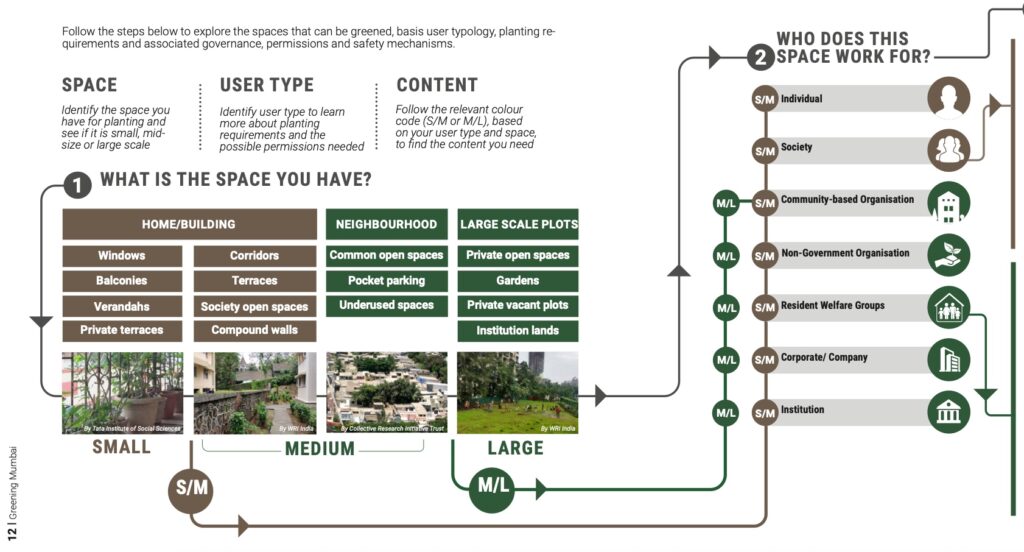
Planting diverse species is better than monoculture. Shruti explains that in a space-constrained city like Mumbai, cluster planting with diverse species works well. According to A Manual for Urban Greening in MMR, published by Grassroots Research and Consultancy with the Mumbai Metropolitan Region Environment Society (MMRIES), a plant cluster consists of heterogeneous species growing together in a homogenous habitat.
Pallavi advocates for this approach because it allows urban biodiversity to thrive. For example, mango, neem, moringa, and custard apple grow well together. Another combination recommended in Greening Mumbai pairs Tamhan (Lagerstroemia speciosa), Bahava (Cassia fistula), Adulsa (Adhatoda vasica), and Chitrak (Plumbago zeylanica).
Experts also advise choosing indigenous plants over exotic species like Gulmohar (Delonix regia) and the Rain Tree (Samanea saman), as native trees are more resilient. Vivek notes that while native trees like mango take longer to reach full maturity, exotic trees grow much faster, and as a rule of thumb, faster growth leads to weaker branch unions.
Morevoer, a broader canopy needs more root space to remain stable. Both Shruti and Vivek strongly recommend planting native trees like Peepal (Ficus religiosa) and Banyan (Ficus benghalensis).
What experts recommend
- De-concretise tree bases: Leave a 1-metre open soil gap around every tree to let roots breathe and anchor.
- Prune scientifically: Consult arborists to help trim trees for safety and wind flow.
- Plant native species: Switch from weak exotic trees to indigenous species using mixed-cluster planting.
- Coordinate utility work: Stop damaging tree roots through repeated road digging and unchecked development.
- Ensure civic accountability: Audit high-risk trees to prevent collapses.
The BMC must take responsibility for the deaths of residents caused by tree falls, considering its negligence in the matter. After the fatalities and numerous incidents of tree collapses, the civic body ordered an audit of the city’s trees and the deconcretisation of their bases. But Rohit warns that this cannot be a knee-jerk reaction. The deconcretisation should be carried out scientifically and the monsoon might not be the best time to do it, as the soil is loose due to the rain.
Here is what you can do, if a tree looks dangerously close to falling:
Call the BMC’s disaster management department helpine at 1916 or the Forest Department at 1926. Residents can also report fallen trees by sending details and photos to email: sg.gardens@mcgm.gov.in.
Also read:
- Mumbaikars are fighting for their mangroves. Here’s how you can join them
- BDA’s tree plantation drive faces accountability issues, not accounting errors
- Bloom-bay: Mumbai gets a splash of flowers in short-lived spring