‘Inconvenience today for a better tomorrow’ signs follow commuters across the city as work inches on for the 118-km Chennai Metro Phase II. Residents eagerly await three corridors that will connect Madhavaram to SIPCOT, Lighthouse to Poonamalle Bypass, and Madhavaram to Sholinganallur by 2028. But the project is resulting in an irreversible loss of green cover along the corridors, far more than was estimated at the time of its approval.
A total of 8,029 trees would be affected, either felled or transplanted, for the project. Over 7,000 of these trees have been uprooted already. Though new trees are planted to compensate for those cut, there is no public database on their status. Further, over a third of the transplants have failed as well.
| Tree felling | Tree transplantation | ||
|---|---|---|---|
| Permitted | Felled so far | Permitted | Transplanted so far |
| 6,042 | 5,472 | 1,987 | 1,615 |
Three times as many trees to be felled than estimated for Phase II
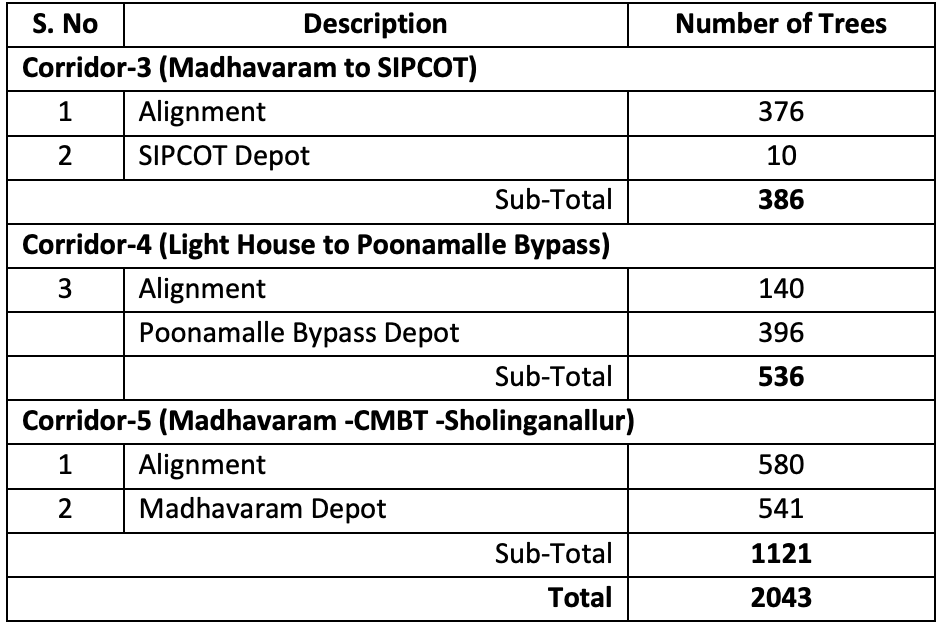
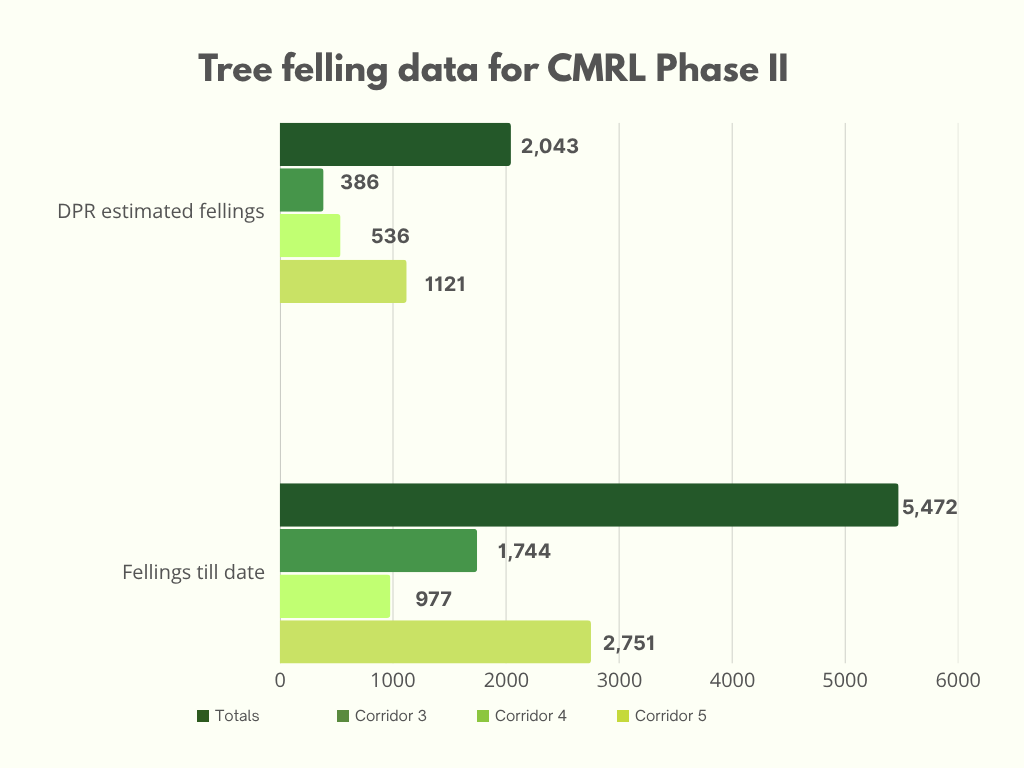
The detailed project report (DPR) for Phase II, submitted by the public sector consultancy RITES Ltd in 2020, had estimated a loss of 2,043 trees. The DPR noted this tree loss would annually reduce oxygen production by a massive 22,473 kg, and carbon dioxide absorption by 6,129 kg.
But, on the ground, the figures are nearly three times higher. So far, 6,042 trees have been permitted to be felled for Phase II, according to data the Chennai Metro Rail Limited (CMRL) shared with Citizen Matters. Of these, 5,472 trees have been felled already.
The Greater Chennai Corporation (GCC) mandates government departments to submit online applications for tree removal. District Green Committee (DGC), constituted at the direction of the High Court to protect trees, have to approve the requests. GCC levies a fine of ₹1 lakh for cutting trees in public spaces without approval.
Read More: Protecting urban green cover: The process and penalties for tree felling in Chennai
However, the GCC and CMRL had directly approved the majority of tree cuttings for Phase II. This was because approvals were routed through the District Green Committee only from this January.
Around eight agencies, including Larsen & Toubro (L&T) and Tata Projects, were awarded the Phase II construction packages, says the CMRL team. Third-party agencies are then in charge of tree felling, transplantation and compensatory planting. These agencies would earlier approach CMRL, check with a general consultant about tree felling, and proceed to select a site for transplantation or compensatory planting, says a CMRL official on condition of anonymity. The official says the process is more streamlined now with companies having to apply online to the DGC.
No public database on status of compensatory or transplanted trees
In 2010, the Madras High Court ruled that government departments must plant 10 saplings for every tree axed. The court reiterated its order in 2014, noting efforts must be made to save old trees.
The CMRL team tells Citizen Matters that 12 trees are being planted for every casualty tree. Since the DPR had projected the loss of only 2,043 trees, it estimated compensatory planting of 24,516 trees.
But, with a lot more trees being cut, 78,378 compensatory trees have been planted across 50 locations so far. A few thousand more are yet to be planted. These numbers includes compensatory planting for 598 trees that didn’t survive transplantation.
CMRL has approved a list of 37 indigenous tree species, including amla, neem, banyan and trumpet flowers for compensatory afforestation. The trees have been planted on panchayat land, institutions such as Lady Willington, Alamathi and Queen Mary’s College. Though compensatory and transplanted trees should ideally be close to their original site, this isn’t possible sometimes due to built-up stretches or the lack of permission from residential colonies, according to CMRL. “These are the constraints — you have to go slightly further away to institutions, or land that’s under government control,” says Dr Rajeev K Srivastava, Chief Environmental Advisor to CMRL and retired Principal Chief Conservator of Forests.
“Compensatory greening beyond the 5-km radius of the tree loss area is meaningless,” says T D Babu, marine biologist and DGC member. He adds that compensatory planting must have legal protection so as to avoid loss to development projects.
While metro rail can help reduce the use of private vehicles, it must be acknowledged that once a tree is cut, it cannot grow back in the same form, says Deepak V from the conservation group Suzhal Arivom. He adds that compensatory planting must be tailored to the local climate.
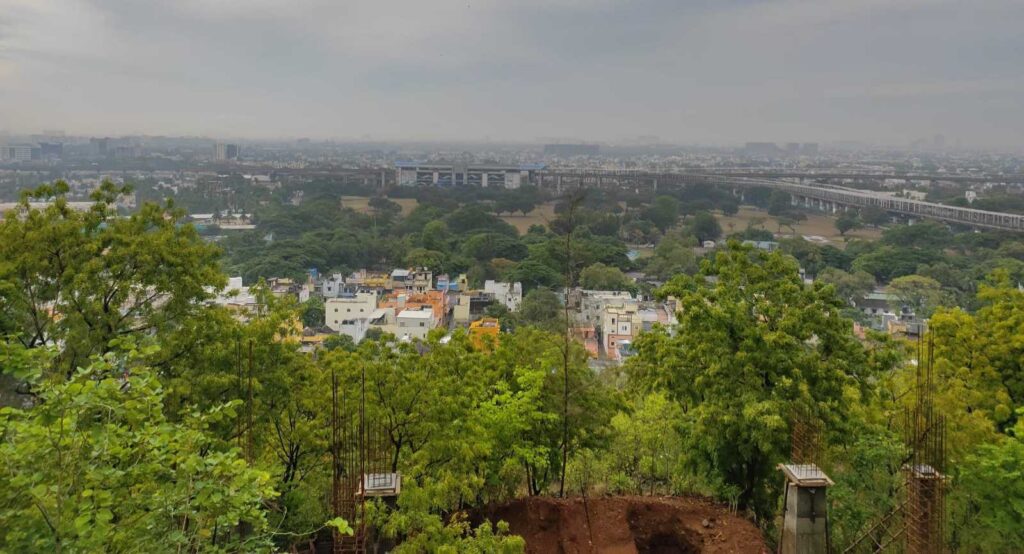
Aalapana Kumar, a resident of Anna Nagar West, says green cover has disappeared in parks such as Aavin Park in Adyar.
Adyar resident Meera Ravikumar points out that the absence of a publicly available database on the costs and survival of the transplanted trees makes follow-up difficult for residents. “If no maintenance is done for the tree, it’s a complete waste of money.” She flags the case of lifeless trees that had been transplanted in Kotturpuram playground for the GCC’s stormwater drain work.
Over a third of tree transplantations have failed
In addition to tree cutting, a total of 1,987 trees along the Phase II corridor are to be transplanted. Of these, 1,615 trees have been transplanted already. However, only 63% of them have survived, according to the data Rajeev shared.
| Corridor | No of trees transplanted |
|---|---|
| Corridor 3 | 653 |
| Corridor 4 | 463 |
| Corridor 5 | 499 |
The number of trees transplanted so far for Metro Phase II. Source: Data shared by CMRL team.
The success of tree transplantation depends on the tree’s age, careful trimming of select branches, and minimising moisture loss. Ficus trees such as peepal and banyan have higher rates of successful transplant.
Before transplant, the tree’s branches should be pruned, and then the tree should be covered with cow dung or slurry and wrapped up immediately with cloth to minimise moisture loss, explains Rajeev. The tree’s main root must be kept as intact as possible, and treated with insecticide or pesticide.
Transplantation should be done within 6-7 hours of trimming, ideally to a nearby location with the same soil type. At the new site, a pit 1.5 times the size of the root must be prepared and watered beforehand, to encourage microbial activity. Additionally, ‘mother soil’ around the tree’s root zone would be mixed into the new site to allow specific fungi and microbes to multiply, and root hormones would be added. The pruned parts are covered with cloth or jute bags to prevent fungal attack, says Rajeev.
“We then monitor intensively for two to three months — watching for any pest or fungal attack and watering regularly. It is like an ICU,” Rajeev says.
Read More: How to transplant trees marked for felling: lessons from Bengaluru
Dr D Narasimhan, conservationist and retired botany professor, says contractors often cut roots, which damages the root ball and lowers the success rate of transplantation.
DGC member Babu points out that the 63% survival rate of transplanted trees is on the lower side. “Generally, the species recommended for transplantation have a high survival rate of 95 to 100%. The low survival reflects poor or no aftercare of the transplanted trees,” he says. Recommended species include banyan, peepal, Indian ash tree, to name a few.
Loss of green cover can warm Chennai further
Studies link the loss of green cover to urban heat island effect (UHI), rainwater runoff and groundwater depletion. The Tamil Nadu Green Climate Company’s 2026 study found the UHI phenomenon in hotspots across Chennai, characterised by sparse vegetation, and larger built and concrete surfaces.
Between 2003 and 2020, India’s cities warmed at the rate of 0.53°C per decade, double the rate of the rest of the country. In this context, green canopies must be tracked, trees must be counted, and legislations for protection of trees must finally be drafted, say experts.
Recommendations from experts and residents:
- Transparency of data on tree fellings, transplantation, etc from CMRL, and other government departments
- An independent third-party committee to track transplantation, felling, and compensatory planting
- Planting of trees ahead of a project instead of transplantation
- Enact legislations protecting trees
Addendum: Following the publishing of this article, CMRL officials havesaid that for Phase II, around 53% of the green cover has been recovered. To queries about information for citizens on tree felling, they responded that there is no dedicated contact number for tree felling/transplantation. All environmental issues may be reported through the respective Corridor-wise Grievance Redressal Committee (GRC) or through CMRL customer care. The public can get more information on planting on the CMRL website: https://chennaimetrorail.org/plantation/