Indian cities are struggling to breathe. Air pollution is a year-round governance challenge. In 2024, 35 of the 50 most polluted cities globally were in India, with PM2.5 concentrations above 66.4 μg/m3. This is at least 13 times the World Health Organization (WHO) guidelines and at least 1.6 times the National Ambient Air Quality Standards (NAAQS) in India.
Citizens continue to bear the brunt of worsening air quality, and urban local governments (ULGs) are at the forefront of the problem, being primarily accountable for their citizens’ first mile. While they do have a role to play in addressing this threat, they are still not empowered enough to carry out the full range of actions required to deliver clean air.
Funding for clean air
Significant funding has gone under the NCAP and the XV Finance Commission grants to 130 non-attainment cities (NACs). Between FY 2020 to 21 and FY 2025 to 26, INR 20,130 crore was allocated under NCAP. Of this, INR 16,539 crore was allocated to million-plus cities under XV FC, covering 48 cities across 42 urban agglomerations, while INR 3,591 crore was allocated under the MoEFCC’s Control of Pollution Scheme for the other 82 non-attainment cities. As of September 2025, INR 13,415 crore (66% of the allocated amount) had been released to cities, but only INR 9,929 crore had been utilised.
Based on a systematic review of air quality trends in the cities under NCAP, their city action plans, fund release and utilisation patterns, and visits to nine million-plus cities — Bengaluru, Chennai, Mumbai, Navi Mumbai, Thane, Pune, Patna, Varanasi, Vadodara — we identified four key challenges in the current state of air quality governance.
No unifying entity for coordinated action
The primary challenge is fragmented governance of clean air with no single point of executive authority and accountability. The primary responsibility for air quality management rests with the ULG, the state pollution control board, and the state environment department. At the same time, several other stakeholders, including transport, public works, energy, power, and agriculture departments, are expected to act within their domains, as each plays a critical role in improving air quality across the country.
Under NCAP, cities are required to set up City‑level Monitoring and Implementation Committees with broader representation, including the police department, transport department, civil society organisations, and experts from academia or research institutes. While these committees have been established as mandated, their functioning has remained weak.
The committee meetings are being used only to give periodic updates, with many key departments even being absent for multiple meetings. As a result, they are failing to serve as platforms for collective decision-making.
Without mechanisms to align actions, timelines, and accountability across institutions, efforts will remain fragmented. At the state level, only Steering Committees exist, meeting at irregular intervals to receive updates. However, there is no single state-level body that is tasked with, responsible for, and empowered to ensure continuous, coordinated action across departments on urban air pollution, or to provide strategic direction.
Read more: From garbage burning to traffic: Why Bengaluru needs hyperlocal air monitoring
Absence of crucial data
The second challenge is the unavailability of timely and credible data on air quality at the ULG level. Of the 130 cities under NCAP, 30 still do not have continuous ambient air quality monitoring stations (CAAQMS). Among the 100 cities that do have monitoring stations, about 25 had limited data for systematic annual air quality improvement comparison. Even so, while some data on pollution levels from monitoring stations is available, there is no reference or linkage to the actual emission sources. Further, there is considerable lag between identifying emission sources and formulating the actions. Under the NCAP, emission inventories and source apportionment studies of the cities were meant to inform city-level actions by identifying significant pollution sources, emission sectors to target, and how funding should be allocated.
However, these studies have faced significant delays, with some cities receiving reports several years after sample collection. Others are yet to receive these studies. Presently, only about a third of the 48 million-plus cities have received their emission inventories and source apportionment data/studies. This indicates that most cities continued implementing projects beyond their initial action plan without the data that was supposed to guide them.
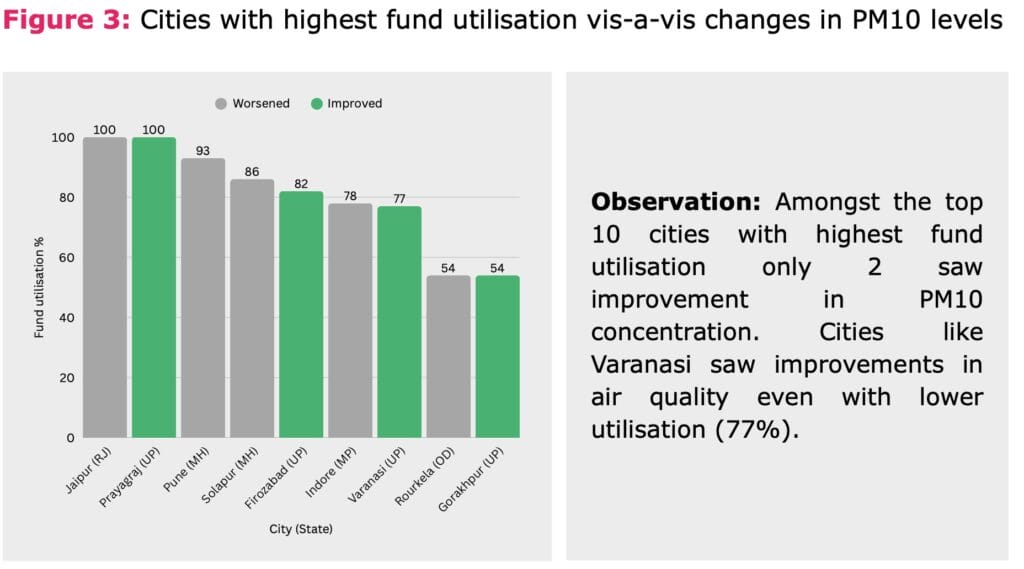
As a consequence, ULGs took recourse to actions that were under their jurisdiction, work areas and funding related to urban development schemes; instead of prioritising as per pollution sources and areas. Possibly for this reason, evidence gathered during year-long research into the impact of XV FC grants on air quality does not show any correlation between funds spent and air quality improvements.
Limited role of urban local bodies
The third challenge is limited institutional capacity at the city level. ULGs, already struggling to deliver and maintain essential services like roads, drains, streetlights, and waste, are expected to implement complex air quality action plans. Yet they lack the technical and managerial capacity needed to identify the right mitigation projects.
Major ULGs do not have dedicated environment departments, and for the ones that have, there are no appropriate & dedicated technical staff. In several ULGs, staff in solid waste management or engineering departments are given additional charge of clean air. While NCAP has appointed consultants at the ULGs, their role is mostly limited to data reporting, without decision-making power.
The staff ultimately responsible for air quality management, are routinely burdened with other ancillary responsibilities and subject to frequent transfers. This makes consistent progress challenging and results in ad-hoc measures rather than sustained action with long-term impacts.
Need for a comprehensive action plan
The fourth challenge is that air pollution as a problem has geographic implications beyond cities. While every city was supposed to create and implement its own action plan, air pollution sources extend beyond municipal boundaries.
NCAP also mandated state-level action plans to tackle the emissions from sources beyond municipal boundaries through state and central coordination, most states still struggle to have a comprehensive action plan targeting emission reduction across all departments beyond municipal boundaries. So, instead of driving coordinated regional action to cut emissions, the state often limits itself to reviewing city progress, while departments provide only broad updates without accountability for specific, time‑bound measures.
What is the way forward?
- Strengthen monitoring networks and ensure emission inventories and source apportionment studies are updated regularly.
- Adopt a systems-based approach to air pollution that improves city planning, coordination, and data use.
- Create a strategic framework involving state departments, pollution control boards, municipal governments, and civil society for aligned objectives.
- Establish specialised Clean Air Cells in cities with full-time technical experts, engineers, and data managers.
- Fund these Clean Air Cells through ring-fenced capacity‑building sub-grants to guarantee continuity and long-term planning.
- Strengthen state-level governance and accountability frameworks to direct, coordinate, and support city-level actions.
Poor governance or weak “city-systems” have a direct impact on air quality in Indian cities. We need to acknowledge the same.
[This article has emerged from Janaagraha’s year-long study of air pollution financing to address root causes towards clean air.]