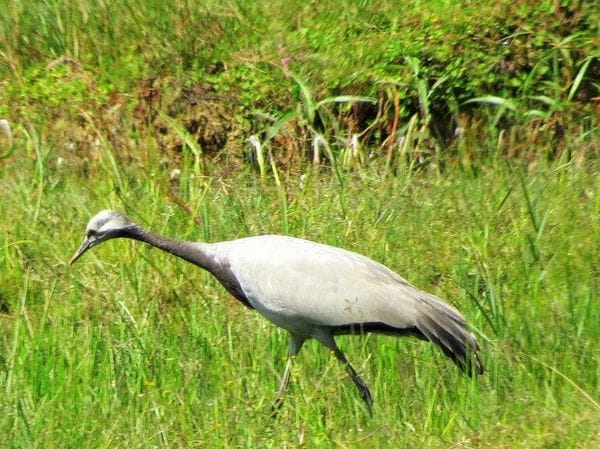
At the last minute, on the morning of December 13th, I convinced 20 other birders that instead of going to Valley School, we should bird along the Kaggalipura-Bannerghatta stretch, and then go to check out Hulimangala. And there, at nearly the end of a long birding outing, we saw a migrant which has never before been sighted in the Bangalore area… the Demoiselle Crane.
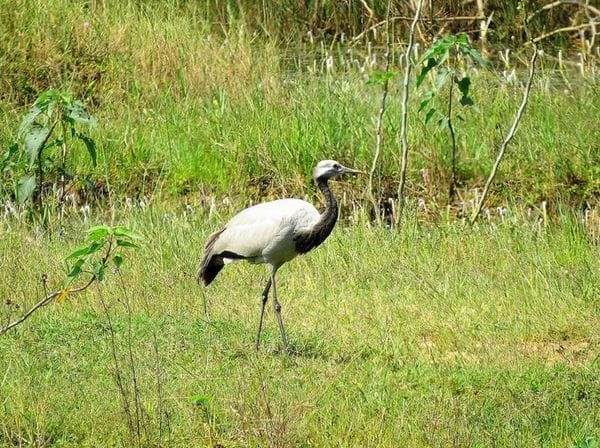
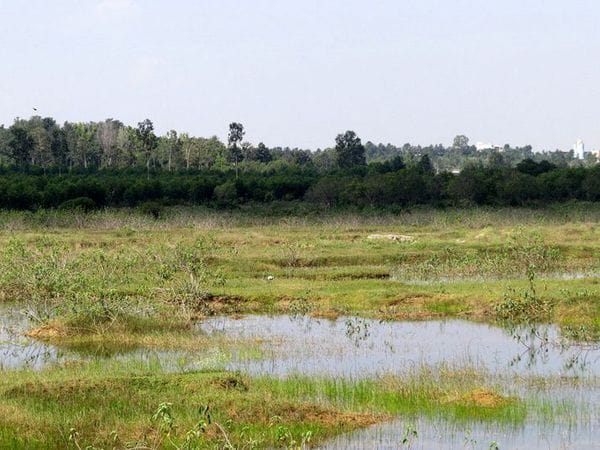
Can you spot the crane in its habitat?
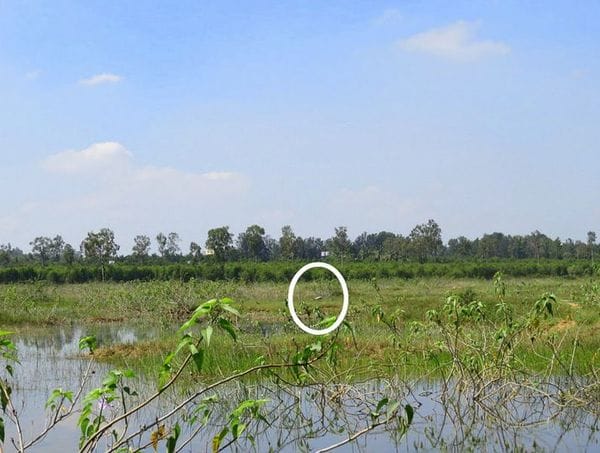
Here it is:
Demoiselle cranes undertake one of the toughest migrations in the world…. as tough as that of the Bar-headed Geese.
From late August through September, they gather in flocks of up to 400 individuals and prepare for their flight to their winter range. During their migratory flight south, demoiselles fly like all cranes, with their head and neck straight forward and their feet and legs straight behind, reaching altitudes of 16,000-26,000 feet (4,875-7,925 m). Along their arduous journey they have to cross the Himalayan mountains to get to their over-wintering grounds in India. Many die from fatigue, hunger and predation from golden eagles.
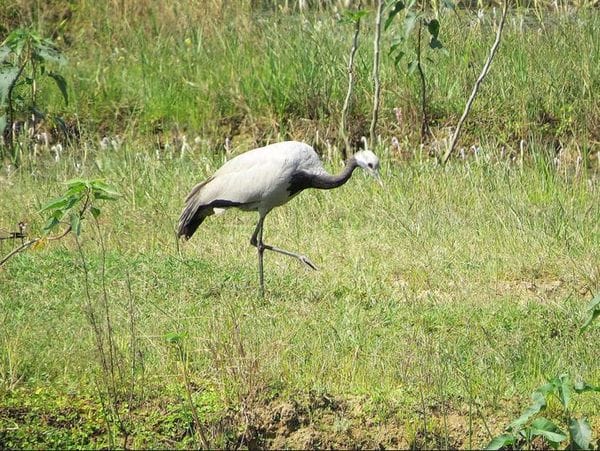
The Demoiselle Crane is known as koonj in the languages of North India, and figures prominently in the literature, poetry and idiom of the region. Beautiful women are often compared to the koonj because its long and thin shape is considered graceful. Metaphorical references are also often made to the koonj for people who have ventured far from home or undertaken hazardous journeys.
In Khicahan, Rajasthan, villagers feed the cranes on their migration and these large congregations have become an annual spectacle.
The name koonj is derived from the Sanskrit word kraunch, which is a cognate Indo-European term for crane itself. In the mythology of Valmiki, the composer of the Hindu epic Ramayana, it is claimed that his first verse was inspired by the sight of a hunter kill the male of a pair of demoiselle cranes that were courting. Observing the lovelorn female circling and crying in grief, he cursed the hunter in verse. Since tradition held that all poetry prior to this moment had been revealed rather than created by man, this verse concerning the demoiselle cranes is regarded as the first human-composed meter.
How does the English name of the Crane come about?
Queen Marie Antoinette of France gave the demoiselle crane its name. Demoiselle means maiden, or young lady, in French (one is more familiar with “mademoiselle”). The queen was enchanted by the crane’s delicate and maidenly appearance.
Here’s the response from N S Prashanth (“Daktre”) who is very knowledgeable on the subject:
“Nice record Deepa! I see that the most recent southern Karnataka record is by Shivaprakash from Kollegal (south-west of Bangalore). He includes the following interesting notes on its previous rare sightings in and around Mysore as comments in his record (see linked checklist). He too has sighted a solitary bird amid Black-headed Ibis. Thought you may find this useful.
These have been recorded at Yelandur & Nanajangudu (nearby area) reported by Phythian-Adams (1940), Asian Mid-winter waterfowl census January 23rd 1992 at Maddur Kere near the place where earlier recorded by Vijayalaxmi Rao, Guruprasad P and others, and on January 28th 2001 in KRS backwaters by Shivaprakash A, Ramesh S and Mohankumar M.”
References:
-
- Phythian-Adams, E. G. 1940. Small game-shooting in Mysore. J. Bombay Nat. Hist. Soc. 41: 594-603
- Shivaprakash, A. 2002a. Re-occurrence of Demoiselle Crane in Mysore district. Newsletter for Birdwatchers: 42(1):8
And he also gives the reference list on eBird, here.

Here’s the fact sheet for this bird:
Class: AVES
Order: GRUIFORMES
Suborder: GRUES
Family: GRUIDAE
Name (Scientific): Grus virgo
Name (English): Demoiselle Crane
Name (French): Grue demoiselle
Hindi: Karkara, Koonj

Here is a beautiful video (link provided by David d’Costa), showing how these birds migrate at such incredible heights, crossing the snowy peaks:
Here’s Prem Prakash Garg’s video of what I think is the male, taken the next day (December 14th 2015).
I have since got information that there are at least two individuals on the lake. But here’s the first one sighted!
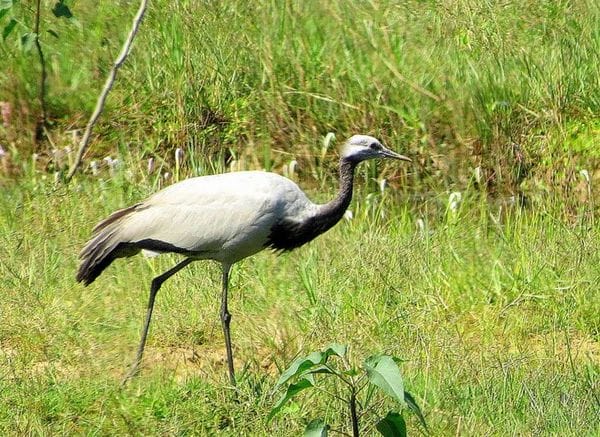
A completely delightful sighting of a very graceful and interesting bird!
Amazingly, in the past one week, the crane’s neck feather have grown darker, as this possible juvenile (which must have wandered away from the main flock?) grows up in front of our very eyes!
Hi guys,
I have land close to Kaggalipura near tharalu village where the lake is there and I have also spotted few birds there if intrested you can buzz me so you can come and stay there with your tents and shoot few pics of the birds. My mobile 9916804720
Thank you Vijayranjan! We will take you up on this!