Small-scale warfare

On our way back from our nature/birding outing, I suddenly caught sight of a beetle and a snail, on a tiny twig. Seeing these two together isn’t very common, so I decided to photograph the scene.
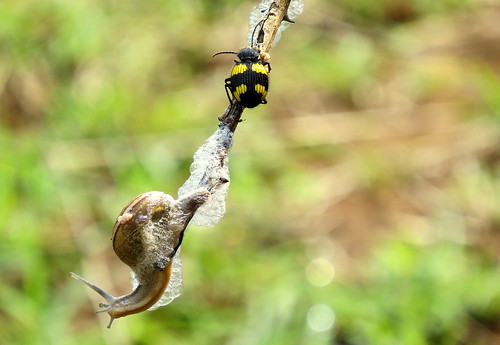
I then realized that what was going on was an attack, and a major war! The beetle, like all ground beetles, likes a snail diet, and was attacking this one.
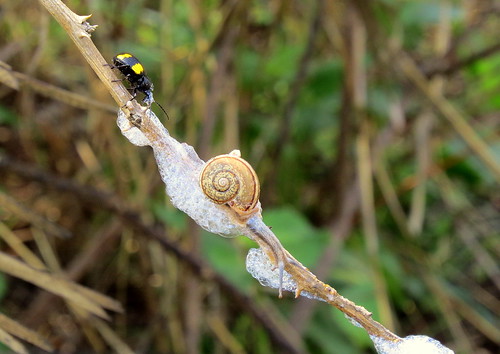
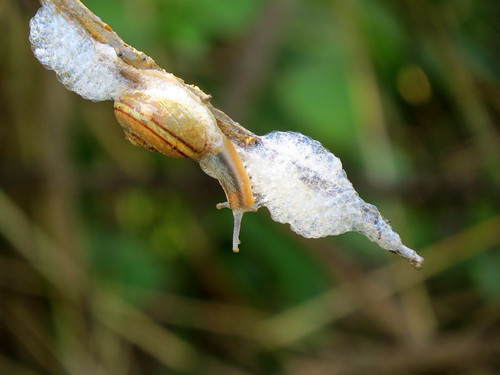
This was an amazing drama that we watched for a while. The beetle was attacking the snail, which produced the froth in self-defence.

Whenever the beetle approached the snail, it would get caught in the froth and would go off with a little bit in its mouth.

You can see this here:
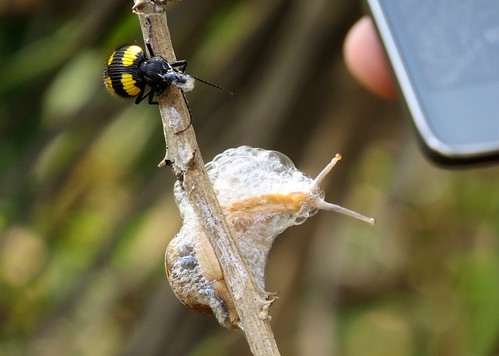
The snail obviously had nowhere to go, given its speed of locomotion, and its postition at the end of the twig. It had to fight.

Having got just a mouthful of froth for its efforts, off the beetle would go, up the twig, try to get rid of it, and return to the fray,er, froth!
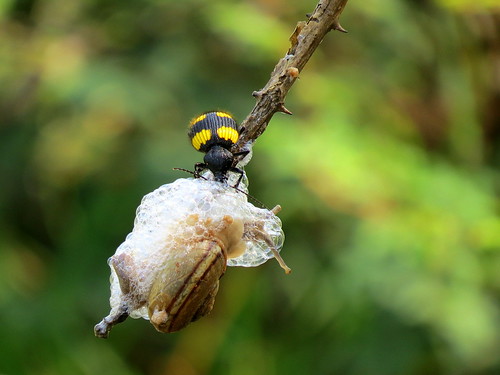
Such miniature fights-to-the-death happen all the time, around us…in the parks, in our own gardens. All it needs for some dramatically interesting moments is a little observation!

Comments:

  1. daksha says:

    lovely pics of beetle and warfare! magical

Leave a Reply

Your email address will not be published. Required fields are marked *

Similar Story

Where are the pollinators in Bengaluru?

Despite the volumes of citizen-generated data on the city's biodiversity, pollinators who sustain the urban ecosystem do not seem to be getting their due attention.

Urban biodiversity is often discussed in terms of tree cover, lakes, or flagship species, but far less attention is paid to pollinators—the insects and birds that quietly sustain urban ecosystems. In Bengaluru, a rapidly urbanising city with a strong culture of citizen science, large volumes of biodiversity data are now being generated by the public. But what does this data tell us about pollinators in the city? This article draws from a data jam hosted by OpenCity in Bengaluru that explored pollinator observations using publicly available, citizen-generated datasets. By analysing long-term observation records and spatial data on land use and…

Similar Story

Beyond the parks and gardens, Bengaluru’s ‘wasteland’ ecosystems call for protection

Open Natural Ecosystems in Bengaluru harbour rich biodiversity. Take a look at what they hold and what we risk losing to unchecked development.

When we discuss urban nature, we often forget about real natural habitats. In Bengaluru, widely called the Garden City, most talks about urban nature focus on landscaped parks, roadside trees, and manicured gardens; in other words, artificial ecosystems designed for looks and human comfort. As lay citizens, we usually notice only such nature as we see around our homes, workplaces or other areas we generally pass by. While these places do have some ecological value, they mostly support a few highly adaptable species. This has strong negative implications for native flora and fauna that depend on open scrublands, grasslands, rocky…