Thousands of children from the Children’s Movement for Civic Awareness (CMCA), will be thanking traffic cops across the city this month. Flagging off the 8th Traffic Police Day thanksgiving in a ceremony at the Traffic Police Park on St. Marks Road on 12th January, children from private and government schools associated with CMCA presented cards, flowers, sweets and messages to traffic police personnel. The children also recited poems thanking the traffic police and interacted with constables, who enjoyed the occasion. The children also cheered and clapped for the traffic police.
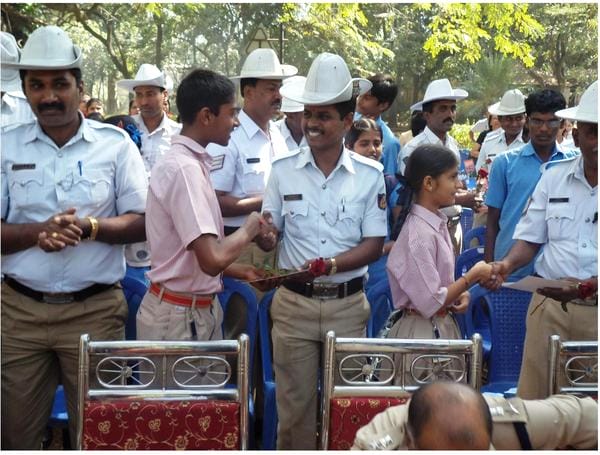 Children thank traffic police personnel on Traffic Police Day (pic: CMCA)
Ajai Kumar Singh, the former Director General and Inspector General of Police, Karnataka who was present at the event, said, "CMCA has been celebrating Traffic Police Day for the past 8 years. I am very happy that Traffic Police Day was started when I was the Commissioner of Police for Bangalore". A 12-year old volunteer driven, civil society organization, CMCA mooted the novel idea of celebrating Traffic Police Day to recognize the tireless efforts of the traffic police in keeping Bangalore safe and on the move, for pedestrians and commuters alike. The Traffic Police Day also sensitizes the public that alongwith the right to safe roads and smooth traffic flow, comes the responsibility to follow road rules. M. A. Saleem, Additional Commissioner of Police, Traffic, said, "Events like these motivate us and boost the morale of the traffic police personnel to do better and be self-disciplined. For better traffic regulation, we must be transparent".
CMCA conducts a national "civic club‟ programme in schools across India to nurture active citizenship in children and youth. Throughout January, children from CMCA schools across Bangalore will visit traffic police stations and junctions near their schools to thank constables. The traffic police department will also send a wireless message from CMCA to constables thanking them. CMCA urges the citizens of the city to participate by following traffic rules and thanking a police person on duty this week.
⊕