Wearing masks no longer mandatory in Mumbai
On March 31st, Mumbai saw 42 news COVID cases and no casualties. The gradual decline in cases led the state executive comm to ease all COVID restrictions in Maharashtra. The state government has relaxed all curbs and checking for vaccination and social distancing will stop.
Wearing masks is now voluntary and no longer a finable offence. For districts that still have a high number of cases and low vaccination rates, stricter curbs may be implemented as they do not meet the criteria to relax all restrictions.
However, the Brihanmumbai Municipal Corporation (BMC) has urged all citizens to use masks as the situation is not entirely under control.
Source: India Today, Hindustan Times
Provisional Aggregator Licence issued to four app-based transport companies by the Mumbai Transport Authority
The Mumbai Metropolitan Region Transport Authority (MMRTA) has issued a provisional aggregator licence to four app-based travel companies that operate in Mumbai. Uber, Ola, Meru and Mahindra Logistics have been issued this licence.
Bombay High Court instructed all app-based transport services to comply with the given rules to continue operations in Mumbai with a valid licence. Many companies have applied over the years, but their licences have been rejected due to non-compliance of all rules.
Four companies that fulfilled the conditions have been provided a provisional aggregator licence. This will allow them to continue working in the MMR.
Source: The Indian Express, Hindustan Times
Dahisar-Kandivali-Goregaon metro line starts on April 2nd
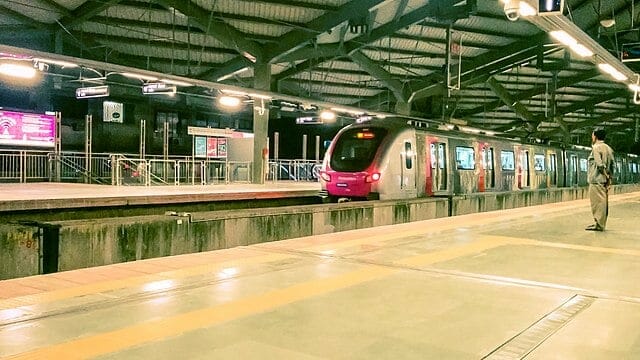
On March 25th, The Mumbai Metropolitan Region Development Authority (MMRDA) received safety certification from the Commissioner of Railway Safety to operate two new metro lines in the city from April 2nd at a 70km/h speed limit. The metros will only work partially on April 2nd. Full operations will start on April 3rd from 5 am to 11 pm, daily.
The two metro rail corridors are Metro-2A between Dahisar and Dahanukarwadi, spanning from Dahisar (east) and to DN Nagar in Andheri West, Link Road, and Metro-7 between Dahisar and Aarey Colony is extended till Andheri (east) Western Express Highway.
This will increase the metro rail span to 50km in the city, from the original 12km that was started 8 years ago from Versova to Ghatkopar.
Source: Hindustan Times, Mid-Day
Read more: The cost of the delay in Mumbai Metro Project
Remodelled Kalyan Station to make local and interstate travel faster
According to an official, the Central Railways’ (CR) remodelling of stations and yard lines will be beneficial for the smooth entry and exit of trains coming in from the North and South India in Mumbai. The biggest project CR has undertaken is the remodelling of the Kalyan Station and its yard lines. This implies dismantling and rebuilding close to 32 pre-existing lines. More foot-over-bridges, 4 new platforms and elevated decks are being planned to make Kalyan station more accessible.
On-ground work has begun, while other preparatory works continue around the site, like demolishing old buildings to make way for the project, outsourcing work by awarding contracts for bridges, etc.
Source: Mid-day
Higher than usual heat predicted in April
Predictions from the Indian Meteorological Department say that Mumbai will see warmer than usual temperatures for the month of May, and so will the rest of the Konkan region.
The extended range forecast predicts that there is a 75% to 85% chance of higher-than-normal temperatures in daytime maximum temperatures in the coastal belt, while there is a 45%-55% chance of increased night-time minimum temperatures.
This winter there was large-scale cooling of the ocean surface in the Indian ocean. This phenomena, called La Niña, influenced the climate, resulting in longer and colder winters this time around. The IMD forecasted that this would lead to heat wave like conditions during summer time.
Source: Hindustan Times
(Compiled by Radha Puranik)