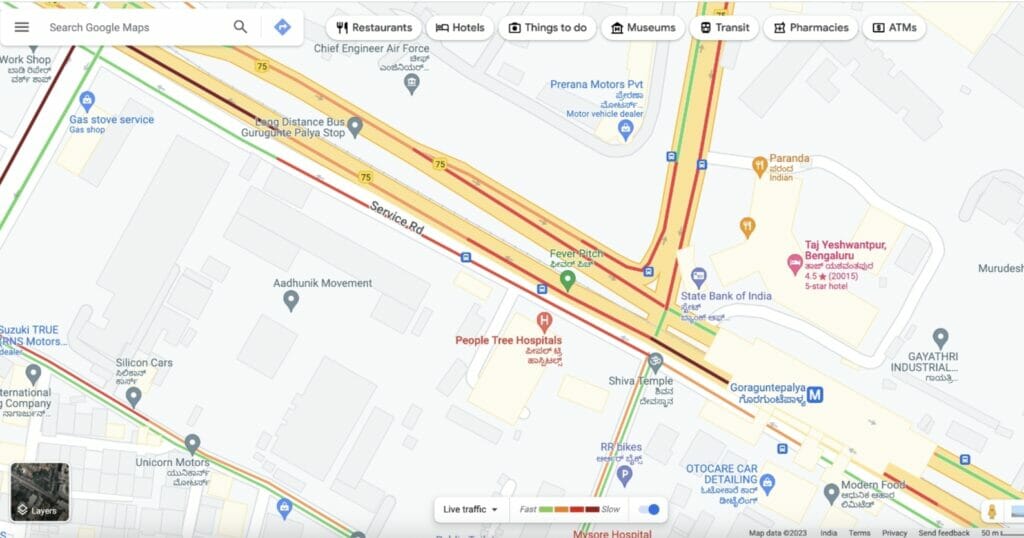
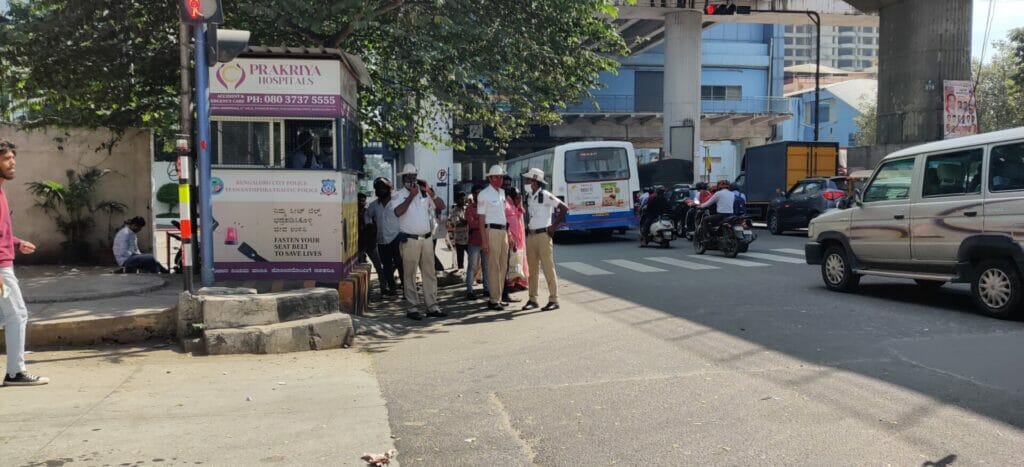
As the morning peak hour rush begins to build up on Bengaluru’s roads, Ramesh Gowda (name changed) has been at the Goraguntepalya traffic signal, one of the most congested areas in the city, since 7.30 am. Till around 11am, he and his coworkers from the Yeshwanthpur Traffic Police Station, are on their feet, trying to ensure smooth traffic flow at the busy signal. Big trucks are allowed to ply on that stretch of road only post 11am.
Reasons for chaotic traffic
The congestion at Goraguntepalya signal is largely due to vehicles coming in from CMTI signal, which is located a little ahead towards Tumkur Road. At the Goraguntepalya signal, the traffic moves straight towards Yeshwanthpur and to the left towards the Outer Ring Road. Although there are automatic signals in place, traffic is controlled manually when there is heavy traffic. Traffic police resort to automatic signals for a while, usually late in the afternoon, when there aren’t too many vehicles on the road.
Read more : The whys and hows of Bengaluru’s infamous traffic jams — a personal experience through Iblur junction
Amidst the cacophony of horns and engines, the policemen on duty hardly get time to take a well deserved break. “There are no hotels close by to eat,” says one traffic policeman. “There are no quiet places where we can have our lunch. We are forced to eat by the side of the road quickly within 15-20 minutes.”
Health concerns
Clad in white shirts and brown pants and hats, these men begin their day at 7.30 am and wrap up by around 9 at night. Apart from a quick lunch break, they stand for almost the whole day. Health concerns like varicose veins have become a part of their lives. “Almost three years ago when I first started working in this signal, I looked different,” says Ramesh Gowda. “Now I am tanned and no amount of sunscreen is helping.”
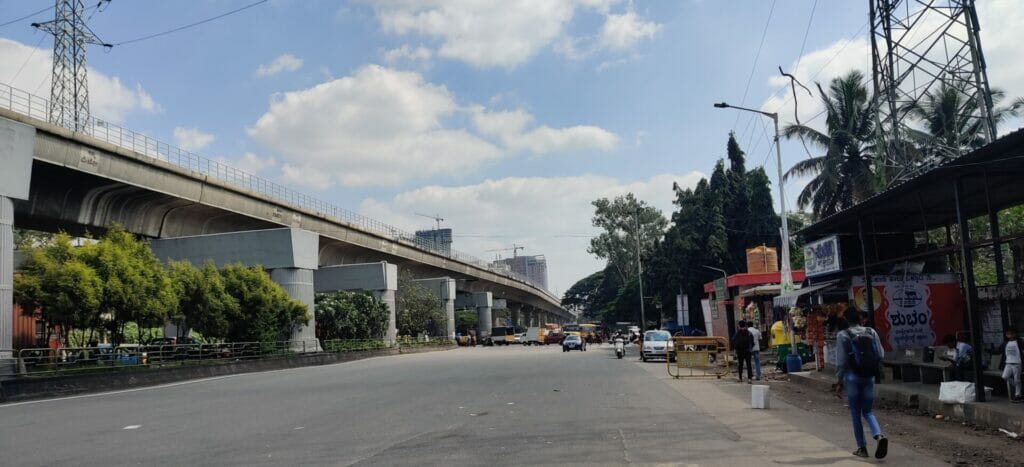
While I observe trucks, bikes, cars, buses, and autos pass by the signal, I notice that crossing the road is difficult. The problem gets worse during the evenings when workers from nearby textile factories travel down these roads to go back home. “If we have a subway or a skywalk here, pedestrians can walk with ease, ” says Ramesh.
Gadgets for aid
ITMS (Intelligent Traffic Management System) is used in several parts of the city to detect traffic violations. However, it is yet to be implemented at the Goraguntepalya signal. Ramesh and his colleagues rely on the FTVR (Field Traffic Violation Report) mobile app to capture violations. It is installed on their smartphones.
But the app reduces the speed of their smartphones and the phone often hangs. “I bought this phone almost three years ago,” says Ramesh, showing his smartphone “I haven’t been able to use this phone properly because it hangs most of the time. I don’t think we should be asked to install the app on our personal phones.”
Read more : How to make Bengaluru traffic jams go away
Despite the app not working properly, these men are expected to capture 40 to 50 violations each day.
Ensuring respectful interactions
On their clear white shirts I observe a small black gadget. They are called body-worn cameras, explains one of the traffic policemen. Ramesh says these cameras are helpful especially when citizens are rude to them.
Body-worn cameras record the traffic policemen’s interactions with everyone and it is connected to the Traffic Management Centre. It was introduced to ensure that civility is maintained between the police and public during their interactions. Previously, several complaints were raised regarding violent and abusive interactions when policemen confronted citizens. The recordings from these cameras are used as proof when allegations are raised and it also acts as a reminder to maintain civility.
Years of service don’t pay the bills
I ask Ramesh and his colleagues why they chose to become a traffic policeman. One of them simply smiles while another says he didn’t know what to do after his undergraduate course. Ramesh thinks for a while and says in Kannada: “Tumba aaseyintha ee department ige apply madkonde (I applied to the traffic police department because I wanted to be a traffic policeman).”
It has been 15 years since he joined and earns around Rs 36,000 a month. Ramesh’s age (he is in his late 40s) makes him ineligible for benefits and increments compared to his colleagues, who have just joined the force. Due to his age, Ramesh receives minimal incentives only. “This is common in other professions as well. The youngsters are paid better and receive more benefits,” says Ramesh.
During my brief interaction, Ramesh’s eyes were on the road. He was mindful of where the vehicles were going and coming from. He even caught an unruly rider who used the footpath to get ahead of the traffic. It is surprising to see how calm and patient these men are even as they control chaotic traffic, braving the heat.